Over the last three decades, the NFL has seen countless prolific quarterback performances, but only a very small number rise into a truly rare tier: games in which a quarterback throws five or more touchdown passes and also adds a rushing touchdown. This combination represents a perfect storm of dominance, versatility, and opportunity. It requires not just elite passing efficiency and volume, but also situational awareness, athletic ability, and often a willingness by coaches to let their quarterback finish drives with his legs rather than handing the ball off. When this happens, the result is usually a game that feels overwhelming for the defense and unforgettable for everyone watching. Within the last 30 years, the performances by Trevor Lawrence, Drew Brees, and Aaron Rodgers stand out as clear examples of how exceptional this feat is and how differently it can be achieved.
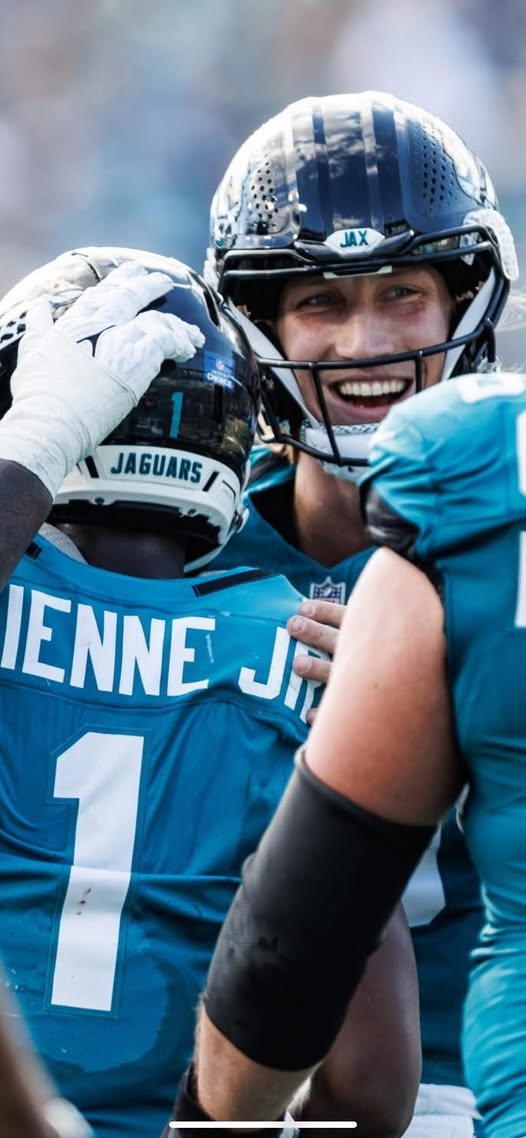
Trevor Lawrence’s performance on Sunday immediately entered rare historical air. For much of his young career, Lawrence has been viewed as a quarterback still searching for consistency relative to the massive expectations that followed him from college. That context makes a five-passing-touchdown-plus-one-rushing-touchdown game even more significant. It was not merely a statistical explosion; it was a statement performance that showcased his full skill set. Lawrence’s passing touchdowns demonstrated his ability to read coverage, exploit mismatches, and deliver the ball accurately at every level of the field. The rushing touchdown, meanwhile, showed confidence and command of the offense, often coming at a moment when the defense had fully committed to stopping the pass. What made the performance stand out was how natural it looked. The touchdowns did not feel forced or fluky. They were the product of rhythm, timing, and control, which is often the clearest indicator that a quarterback has reached a higher tier of play, at least for that day.
The modern NFL increasingly emphasizes quarterback mobility, but scoring a rushing touchdown in a game already filled with passing scores still requires the right circumstances. For Lawrence, that rushing touchdown reflected both his athleticism and the trust his coaching staff placed in him. Rather than taking the safe option and handing the ball to a running back near the goal line, the Jaguars allowed Lawrence to keep the ball and finish the drive himself. Historically, young quarterbacks are often protected from that kind of responsibility. That Lawrence was given that opportunity and capitalized on it adds an extra layer of significance to the performance. It placed him in a statistical club that includes not just great quarterbacks, but legends.
Drew Brees’ entry on this list, coming in Week 14 of the 2019 season, feels different in tone but just as impressive in execution. By that point in his career, Brees was already a future Hall of Famer with nearly every major passing record within reach or already secured. What made his five-passing-touchdown, one-rushing-touchdown game remarkable was not surprise, but precision. Brees was never known for being a prolific runner. In fact, his rushing touchdowns were usually the result of sneaks or short-yardage reads rather than open-field athleticism. That is precisely why his inclusion in this group is so telling. It highlights how even quarterbacks without elite speed or size can still impact games on the ground when their football intelligence and timing are perfect.
In that 2019 performance, Brees dissected the defense with his trademark accuracy. Each passing touchdown felt like a lesson in quarterbacking fundamentals: quick reads, anticipation, and placement that neutralized defenders before they could react. The rushing touchdown, likely coming on a sneak or goal-line keeper, underscored how complete his command of the offense was. It was not about athletic dominance, but about control. Brees knew when the defense was vulnerable, when they were overplaying the pass, and when the smartest option was to take the ball himself for a single yard that counted just as much as a 40-yard strike.
What makes Brees’ performance especially meaningful in the broader historical context is how it bridges eras. He entered the league when quarterback mobility was far less emphasized than it is today, yet he still found ways to adapt and contribute in every phase of the game. His presence on this list serves as a reminder that statistical rarity is not only about physical traits, but also about intelligence, preparation, and situational mastery.
Aaron Rodgers’ 2019 Week 7 performance may be the most stylistically representative of what fans imagine when thinking about a five-passing-touchdown, one-rushing-touchdown game. Rodgers has long been associated with effortless excellence, and that performance reinforced his reputation as one of the most complete quarterbacks of his generation. Unlike Brees, Rodgers has always possessed above-average mobility, particularly within the pocket and on improvisational plays. His rushing touchdown did not feel out of place; it felt like an extension of his ability to punish defenses that overcommit.
Rodgers’ five passing touchdowns in that game highlighted his unique blend of arm talent and decision-making. He was able to push the ball downfield, fit throws into tight windows, and make off-platform passes that few others could attempt, let alone complete. Each touchdown pass felt different, which is often the hallmark of a truly dominant quarterback performance. Some were the result of perfectly designed plays, others of broken coverage, and at least one likely came from Rodgers extending the play and finding a receiver late in the down.
The rushing touchdown added a layer of completeness to the performance. Rodgers has never been a quarterback who racks up rushing scores in bulk, but he has always been capable of choosing the right moment to run. In goal-line or red-zone situations, his ability to read defenders and react instantly makes him dangerous. That rushing touchdown was not just a bonus statistic; it was a reflection of defensive helplessness. When a defense cannot stop a quarterback through the air and also cannot account for him on the ground, the game often slips out of reach very quickly.
Looking at these three performances together highlights just how rare this achievement truly is. Over 30 years of NFL football, in an era increasingly tilted toward offense, only a handful of quarterbacks have managed to combine five passing touchdowns with a rushing touchdown in a single game. That rarity is not accidental. Five passing touchdowns alone is an exceptional benchmark. Adding a rushing touchdown requires either exceptional athleticism, exceptional situational awareness, or both. It also requires a game script that allows the quarterback to remain aggressive throughout, often indicating that the offense was unstoppable rather than merely efficient.
Another important factor is coaching philosophy. Many teams prefer to limit quarterback rushing attempts near the goal line to reduce injury risk. As a result, even quarterbacks who could score on the ground often do not get the opportunity. When they do, it usually signals complete trust from the coaching staff and total confidence in the quarterback’s decision-making. That trust is evident in all three cases. Lawrence, Brees, and Rodgers were all empowered to finish drives themselves, a subtle but important common thread.
These performances also serve as snapshots of where each quarterback was in his career at the time. For Lawrence, it represents potential and promise, a glimpse of the superstar many believe he can become. For Brees, it was confirmation of sustained greatness, proof that even late in his career he could still deliver historic performances. For Rodgers, it was a reaffirmation of his unique talent and his ability to dominate games in ways that feel almost casual.
Ultimately, a game with five passing touchdowns and a rushing touchdown is more than a statistical anomaly. It is a sign of total offensive control, where the quarterback dictates terms from start to finish. Over the last 30 years, Trevor Lawrence, Drew Brees, and Aaron Rodgers have each done exactly that, in their own distinct ways. Their performances stand as reminders that while the NFL evolves, true quarterback brilliance, when it reaches its peak, still looks unmistakable.