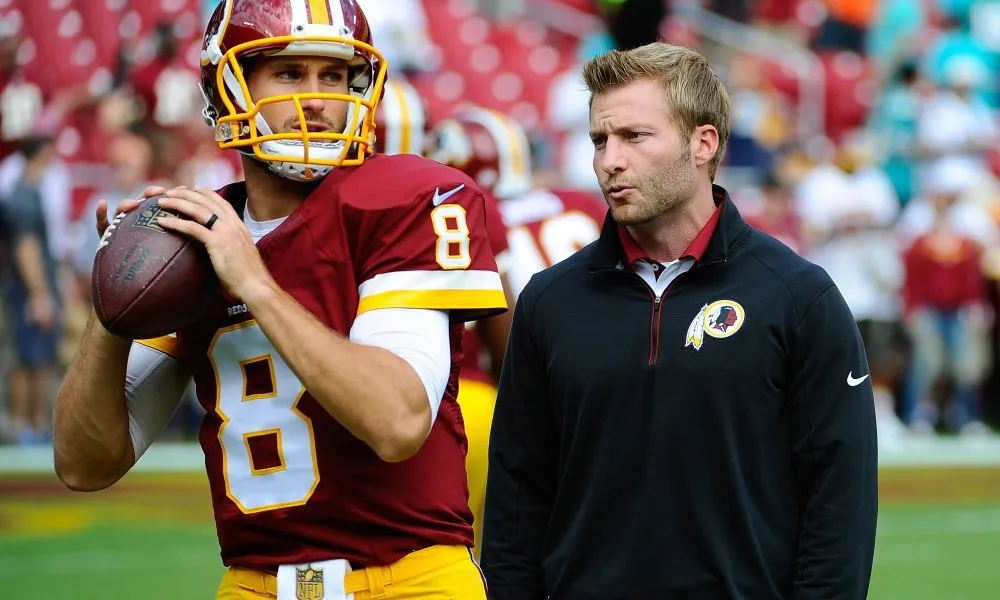
Sean McVay’s name is synonymous with innovative offensive football, NFL success, and a coaching legacy that began when he became the youngest head coach in modern league history in 2017 and then went on to win a Super Bowl with the Los Angeles Rams. (Wikipedia) Over the years, McVay has developed not only his own coaching reputation but also relationships with players and assistants that extend far beyond the practice field. One of those relationships that now appears intriguing on the free‑agent market is with quarterback Kirk Cousins. According to reports from the ongoing NFL offseason, McVay and the Rams have engaged in dialogue with Cousins and his agent about possibly bringing him to Los Angeles, potentially as a veteran backup quarterback in 2026. (NFLTradeRumors.co)
The notion of McVay and Cousins reuniting is rooted in history. Before McVay became a head coach, he was an offensive coordinator in Washington, where Cousins developed into a franchise signal‑caller. (Wikipedia) That professional pairing was successful enough that both men remember their time working together, and now after Cousins was released from his most recent team — the Atlanta Falcons — he finds himself a free agent with more options than typical for a veteran quarterback seeking one more chance to add value, leadership, and experience to a roster. (NFLTradeRumors.co)
For McVay, the quarterback situation at the Rams is delicate. Matthew Stafford remains the starter and has been the face of the franchise for years, but he is approaching the twilight of his career. The Rams have some young talent on the roster, but depth at quarterback is a concern. Stetson Bennett is currently on the roster but has not yet proven to be a long‑term solution in the NFL. (Turf Show Times) Bringing in an experienced veteran like Cousins — a four‑time Pro Bowler — could provide both a capable backup and contingency in case Stafford were to miss time. (Turf Show Times)
At the same time, McVay also expressed interest in re‑signing Jimmy Garoppolo, another veteran who has familiarity with the Rams’ system. (NFLTradeRumors.co) This indicates that McVay wants a steady, experienced presence behind Stafford — someone who can both mentor younger talent and hold the reins if the unexpected occurs. In that light, Cousins fits the profile: he’s a veteran leader, has extensive starting experience, and could shepherd the quarterback room without demanding the spotlight. (Turf Show Times)
Cousins’ own career narrative adds texture to this opportunity. Originally a fourth‑round pick in 2012, he steadily worked his way up to a full‑time starter, becoming one of the NFL’s most consistent passers for years. He landed big contracts with the Minnesota Vikings and later with the Atlanta Falcons. His time in Atlanta was mixed, however, with flashes of brilliance offset by injuries and inconsistent play that ultimately led to him being released earlier in 2026. (Wikipedia) As a result, he enters free agency in a position he hasn’t experienced before in his long career — needing to find not just a starting job, but a role where experience, value, and fit matter more than star status.
For Cousins, the Rams could represent a compelling fit precisely because of the history with McVay and because the role doesn’t require him to be the face of the offense again. In the right situation, a veteran backup can transition into mentoring, serve as a bridge to the future if Stafford retires, or even compete for the starting job if circumstances change. That’s a unique opportunity for a veteran quarterback who has been a starter most of his career. (Turf Show Times)
The story is not just about personnel, though; it’s part of the broader fabric of how NFL teams balance competitiveness with succession planning. Teams always need depth at quarterback; that position is too important to be left to chance. An injury to a starter can derail a season, and having a veteran — particularly one who knows a coach’s system — can be invaluable. McVay’s self‑described intent to speak with both Garoppolo and Cousins about opportunities with the Rams signals that Los Angeles wants to protect itself against upheaval, while also ensuring continuity in leadership and offensive culture. (NFLTradeRumors.co)
From McVay’s perspective, this is also about relationships and trust. The bond between a coach and quarterback can be pivotal. Football history is full of examples where that synergy transformed teams, and McVay and Cousins’ past collaboration, though not in Los Angeles, created a dynamic that both sides remember fondly enough to revisit. In interviews at the NFL annual meetings in Arizona, McVay acknowledged that Cousins is someone he would like to bring onto the roster if other plans don’t materialize. (Steelers Now) That level of public acknowledgment isn’t common unless both parties sincerely see value in exploring the opportunity.
There is also a business angle. For Cousins, signing behind Stafford could extend his career without the intense pressure of being a full‑time starter. It could be a few more years of NFL relevance for someone who has always taken pride in his play. In return, the Rams get a quarterback with experience, leadership, and a deep understanding of pro football nuance. Cousins’ stats, including multiple seasons with 25 or more touchdown passes, highlight his capability to contribute even later in his career. (Turf Show Times) And with the quarterback market being what it is — a finite group of proven veterans with starter experience — Cousins’ availability becomes a valuable asset for teams looking for depth or succession planning.
Beyond the immediate season, there’s also the future picture. If Stafford eventually decides to retire or step back, the Rams would ideally want a successor who is both capable and already integrated into the team’s culture. Cousins fits that description far better than an unknown rookie quarterback with no NFL experience, or an unproven journeyman. The potential of having a bridge quarterback like Cousins smooths that transition, preserves competitiveness, and gives the Rams flexibility in the draft and roster building. (Turf Show Times)
There’s no guarantee this reunion happens — football transactions are notoriously fluid and contingent on many variables — but the fact that McVay is publicly talking about Cousins and actively engaged with his representation suggests this is more than idle offseason chatter. It reflects thoughtful roster construction from a coach who has shown, time and again, that he prioritizes offensive continuity, adaptability, and strategic foresight. These qualities helped McVay turn a struggling Rams offense into a Super Bowl champion and likely explain why he wants known quantities like Cousins or Garoppolo in the building as the franchise looks to maintain competitiveness in a league that never quits evolving. (Wikipedia)
For Cousins, the opportunity to reunite with McVay is a professional and personal moment of recognition. It’s evidence that relationships forged early in one’s career can echo for years and that his past work under McVay has left a positive enough impression to make this a real possibility. Whether it leads to a contract, a roster spot in training camp, or merely a mutual understanding of fit, the discussions themselves show the interconnected nature of the NFL. Veterans like Cousins, with leadership and field success, remain valuable even in roles that might not put them under Sunday night lights as starters.
Rams fans and NFL observers alike have reacted to the news with a mix of optimism and debate. Some believe Cousins could be an excellent addition behind Stafford, providing stability and backup reliability in a year when every team is thinking about quarterback depth. Others argue that the Rams should invest in youth or draft capital instead of veteran backups. This discourse is typical in the modern NFL offseason, where every roster move is scrutinized not just for its immediate impact, but for its strategic consequences over multiple seasons.
Ultimately, the McVay‑Cousins reunion conversation is emblematic of the position football finds itself in at the intersection of relationships, strategy, and roster management. McVay’s willingness to engage with Cousins, combined with Cousins’ potential openness to a new role, underscores how close professional football really is — careers are connected, opportunities arise from past collaborations, and teams constantly innovate ways to maximize competitive advantage. Whether Cousins signs with the Rams, another team, or even chooses to play a different role in the league, the discussions with McVay are significant. They shine a light on how NFL coaches think about continuity, leadership, and the future of their franchises — and how even after many successful seasons, coaches like McVay continue to shape their rosters thoughtfully and with an eye on both the present and the future. (NFLTradeRumors.co)