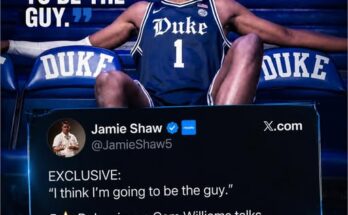
Choke show. That’s the phrase echoing through Durham tonight, bouncing off the rafters and settling into every disappointed conversation. Not heartbreak in the noble sense, not the kind that comes from being outplayed by a clearly superior team, but the kind that lingers because it felt avoidable. Preventable. Self-inflicted. And when it happens once, you grit your teeth and call it a bad night. When it happens twice in a row, in the same month, under the same spotlight, you start asking harder questions. You start questioning Jon’s ability to coach in March.
Because this isn’t just about one game. It’s about a pattern that’s becoming impossible to ignore. Two epic collapses in a row don’t just materialize out of thin air. They’re built possession by possession, timeout by timeout, decision by decision. They reveal something deeper than cold shooting or a lucky bounce. They expose cracks in preparation, in adjustments, in composure when everything tightens and every possession matters more than the last.
Tonight followed a script that’s starting to feel all too familiar. Control the game early. Dictate the tempo. Build a lead that looks comfortable, maybe even commanding. The offense flows, the defense rotates with purpose, and there’s a sense—dangerous as it turns out—that the game is trending exactly where it should. Then something shifts. It’s subtle at first. A missed rotation. A rushed shot. A possession where the ball sticks instead of moving. The opponent senses it before anyone else does. Momentum tilts, just slightly, but enough.
And that’s where coaching matters most. Not when everything is working, not when the shots are falling and the crowd is roaring, but in those fragile stretches when control starts to slip. That’s when you need clarity. You need adjustments that aren’t just reactive but anticipatory. You need a steady hand that can slow the game down, reestablish identity, and remind players of who they are and what got them there.
Instead, what we’re seeing feels like hesitation. Timeouts that come a possession too late. Lineups that linger just long enough to let a run grow from manageable to dangerous. Offensive sets that devolve into isolation when structure is needed most. It’s not chaos, exactly, but it’s not control either. It’s something in between, and in March, that gray area is where games are lost.
The most frustrating part is that the blueprint for success is right there. You can see it in the first halves, in the stretches where everything clicks. The team is capable. The talent is undeniable. The system works—until it doesn’t. And when it stops working, there doesn’t seem to be a reliable counterpunch. That’s what separates good teams from great ones in March. Not just the ability to execute Plan A, but the readiness to pivot to Plan B or C without losing composure.
Two collapses in a row suggest that opponents are figuring something out, and more importantly, that those adjustments aren’t being matched. Whether it’s defensive schemes that disrupt rhythm or late-game strategies that exploit weaknesses, the pattern is there. And the response hasn’t been good enough.
There’s also the psychological component, the part that’s harder to quantify but impossible to ignore. Confidence is a fragile thing in tournament settings. Once doubt creeps in, it spreads quickly. Players start thinking instead of reacting. Shots that felt automatic earlier suddenly feel forced. Defensive rotations slow by just a fraction of a second. And in those moments, the presence of a coach who can steady the group becomes invaluable.
Right now, it doesn’t feel like that steadiness is there. It feels like the tension on the court is mirrored on the sideline, and that’s a dangerous feedback loop. Players look for reassurance and instead find urgency. They look for direction and get ambiguity. And against teams that are playing loose, aggressive, and fearless, that difference shows up quickly on the scoreboard.
What makes this even harder to swallow is the expectation. This isn’t a program that’s supposed to be learning on the fly in March. This is a program built on the idea of thriving in these moments. The standard isn’t just competing; it’s closing. It’s finishing games with authority, not letting them slip away piece by piece.
And yet here we are, talking about another collapse, another opportunity lost. Not because the opponent was overwhelmingly better, but because the game got away and there wasn’t a way to pull it back. That’s the part that stings the most. It’s not just losing—it’s how the losses are happening.
You can point to execution, and that’s fair. Players have to make shots, protect the ball, defend without fouling. But execution doesn’t exist in a vacuum. It’s influenced by structure, by preparation, by the decisions made on the sidelines. When the same issues show up in back-to-back high-stakes games, it’s no longer just about what the players are doing. It’s about what they’re being put in position to do.
The late-game offense, in particular, raises questions. There’s a difference between trusting your players to make plays and putting them in situations where they have to create something out of nothing. The best teams in March find ways to generate good looks even under pressure. They move the ball, they exploit mismatches, they stay disciplined. What we’re seeing instead are possessions that feel rushed, disconnected, and predictable.
Defensively, the breakdowns are just as concerning. Communication lapses, missed assignments, and an inability to get crucial stops when the game hangs in the balance. Again, these aren’t isolated mistakes—they’re recurring themes. And in tournament play, recurring mistakes are fatal.
It’s fair to ask whether adjustments are being made quickly enough, or effectively enough. Whether there’s enough flexibility in the approach to handle different opponents and different game situations. Whether the team is being prepared not just for the expected flow of the game, but for the inevitable moments when things go wrong.
Because things always go wrong in March. Leads disappear. Runs happen. The question isn’t whether adversity will come—it’s how you respond when it does. Right now, the response isn’t good enough. Not in these games, not in these moments.
And so the conversation turns, inevitably, to Jon. Not out of spite, but out of necessity. Coaching in March is a different challenge. It’s not just about building a team over a season; it’s about navigating the most intense, compressed, high-pressure environment the sport has to offer. It requires adaptability, decisiveness, and a feel for the game that goes beyond Xs and Os.
Two epic collapses in a row don’t define a career, but they do demand reflection. They demand an honest evaluation of what’s working and what isn’t. They demand adjustments, not just in strategy but in approach.
Because the talent is there. The potential is there. The early-game execution shows what this team can be at its best. But March isn’t about potential—it’s about performance under pressure. It’s about finishing what you start.
Right now, the narrative is slipping away, turning into something that no one in Durham wants to embrace. The choke show. A label that feels harsh, maybe even unfair in isolation, but one that gains traction with every similar loss. The only way to change that narrative is to prove it wrong, to close games, to show that these collapses are the exception and not the rule.
Until then, the questions will keep coming. About adjustments. About composure. About whether Jon can guide this team through the chaos of March without letting it unravel.
Because two in a row isn’t just bad luck. It’s a warning sign. And in a place where expectations are as high as they are in Durham, warning signs don’t get ignored for long.