Nikola Jokić is one of the most unique talents in the history of basketball, a player whose combination of size, skill, vision, and versatility defies conventional categorization. At 7 feet tall, he possesses the physical presence of a traditional center, yet his ability to orchestrate an offense, make pinpoint passes, and read the floor as if he were a seasoned point guard sets him apart from almost anyone who has ever played the game. Comparisons to other players are inevitably difficult because Jokić blends multiple skill sets that are rarely found together, and his influence on the court can be both subtle and spectacular. To truly understand what makes him comparable—or rather, why he is nearly incomparable—requires examining his game from multiple perspectives: his passing and court vision, scoring versatility, rebounding and defensive intelligence, historical context, and impact on modern basketball.
Jokić’s passing ability is perhaps the most defining feature of his game. Few big men in history have consistently demonstrated the vision, timing, and precision that he exhibits night after night. From the high post, he surveys the floor like a chess master, identifying openings, anticipating movements, and threading passes through traffic with pinpoint accuracy. His passing isn’t limited to obvious outlets; he excels at delivering behind-the-back passes, no-look feeds, and threading the needle between defenders in pick-and-roll situations. This elite vision allows his team to operate with a fluidity that is rare in the NBA, where most offenses rely on guards or wings to initiate playmaking. In this sense, comparisons to historically great passers like Magic Johnson or Larry Bird become more apt. Magic orchestrated the Lakers with unparalleled court awareness, seeing plays develop before anyone else, while Bird had the ability to create offense for teammates in ways that were nearly prescient. Jokić channels a similar sense of anticipation and spatial awareness, but he executes it from the post as a center rather than from the perimeter as a guard or forward.
Scoring is another area where Jokić’s uniqueness becomes evident. He is not limited to one style or range; he can score efficiently in multiple ways, whether it’s in the low post using pivot moves and footwork, pulling up for midrange jumpers, or stepping behind the three-point line to stretch the floor. He has a soft touch around the rim, a deft floater in traffic, and a shooting form that is deceptively quick for a man of his size. Unlike traditional centers who rely predominantly on physicality to score near the basket, Jokić mixes finesse, craft, and spatial awareness to create high-percentage opportunities both for himself and for others. Historically, few players have had this combination of size and shooting versatility. Arvydas Sabonis, for example, was a 7-foot center who could pass with the vision of a guard and shoot from range, but he never had the consistent athleticism or conditioning to fully dominate the NBA the way Jokić does. In this respect, Jokić represents a rare synthesis of skill sets: he is as comfortable setting up a teammate for a fast-break dunk as he is orchestrating a half-court offense through a series of precise passes and fakes.
Rebounding and defensive awareness are often underappreciated aspects of Jokić’s game because his passing and scoring tend to draw more attention. Nevertheless, he is a strong and intelligent rebounder, leveraging positioning, anticipation, and timing rather than relying solely on raw athleticism. He has a keen sense of where the ball is likely to come off the rim and uses subtle movements to get into optimal positions. On defense, while he may not be the most athletic rim protector, he makes up for it with smart rotations, understanding of angles, and the ability to read opposing offenses. His defensive contributions often manifest in forcing turnovers, boxing out effectively, and subtly altering opponents’ shots. While he may not dominate defensively in the traditional shot-blocking sense like some elite centers, his intelligence and positioning allow him to have an outsized impact relative to his physical tools.
When considering historical comparisons, it becomes clear why Jokić is so difficult to categorize. The combination of passing, scoring versatility, and basketball IQ has only been seen in a handful of players across eras, and almost none match his size. Arvydas Sabonis comes to mind again because of his ability to pass and shoot as a big man, but he lacked the same consistent athletic presence in the NBA due to late entry into the league. Larry Bird, while a forward and not a center, shared Jokić’s court vision, unselfishness, and ability to make teammates better. Magic Johnson, as a 6’9” point guard, orchestrated offenses from the perimeter in a way that mirrors how Jokić orchestrates from the post. Tim Duncan provides another point of comparison, especially in terms of calm dominance and fundamental excellence. Duncan’s consistency, understanding of angles, and ability to impact both ends of the floor align with how Jokić influences the game, though Duncan was not as creative in passing or handling the ball. Essentially, Jokić synthesizes aspects of all these players: the vision of Bird, the orchestrating ability of Magic, the fundamentals and poise of Duncan, and the versatility of Sabonis.
In the context of the modern NBA, Jokić is emblematic of the evolution of the center position. Whereas historically centers were often defined by rim protection and post scoring, today’s game values big men who can stretch the floor, handle the ball, and create for teammates. Jokić excels in every one of these areas, making him not only dominant but also transformational. His style challenges defenses in unique ways: opposing teams must account for him as a passer, a shooter, and a rebounder simultaneously, creating spacing issues and forcing rotations that can be exploited by his teammates. This multidimensionality is rare; most players, even the elite, have primary roles and strengths, but Jokić functions as a Swiss Army knife on the court, capable of influencing nearly every facet of a possession.
One way to conceptualize Jokić’s comparables is to break his game into measurable traits and then find historical parallels for each. For passing, Magic Johnson and Sabonis are strong references. For scoring versatility, Bird and Sabonis provide some alignment. For fundamental dominance and efficiency, Tim Duncan is the historical mirror. For overall size and ability to impact both the perimeter and post play, Shaquille O’Neal and Kareem Abdul-Jabbar offer partial comparisons, though they lacked the ball-handling and passing creativity that defines Jokić. While none of these players alone encapsulates Jokić, together they outline the rare dimensions of his skill set. He is simultaneously a creator, scorer, rebounder, and floor general, a combination rarely seen even among Hall of Famers.
Another key element that sets Jokić apart is his basketball IQ. The ability to read the flow of a game, anticipate opponent movements, and make split-second decisions distinguishes him from nearly all other players. Basketball IQ is difficult to measure statistically, yet it is often the difference between great and transcendent players. Jokić’s decision-making is almost preternatural: he knows when to pass, when to attack, when to slow the pace, and when to exploit mismatches. His teammates consistently benefit from his choices, often finding themselves in positions to score that they might not have reached without his vision. This cerebral element of his game is part of why he is so difficult to defend: he doesn’t just react; he predicts, shapes, and manipulates the game’s rhythm.
Durability and conditioning are additional factors that make Jokić remarkable. He logs heavy minutes, often playing in multiple positions and sustaining his high level of play throughout entire seasons. His endurance allows him to maintain the intensity required to run pick-and-rolls, rebound, and create plays across both halves of the court. Unlike some players who excel in bursts, Jokić’s impact is continuous, making him a stabilizing force on his team and a nightmare for opponents. The combination of stamina, skill, and court vision allows him to influence the game in ways that transcend traditional metrics like points, rebounds, and assists.
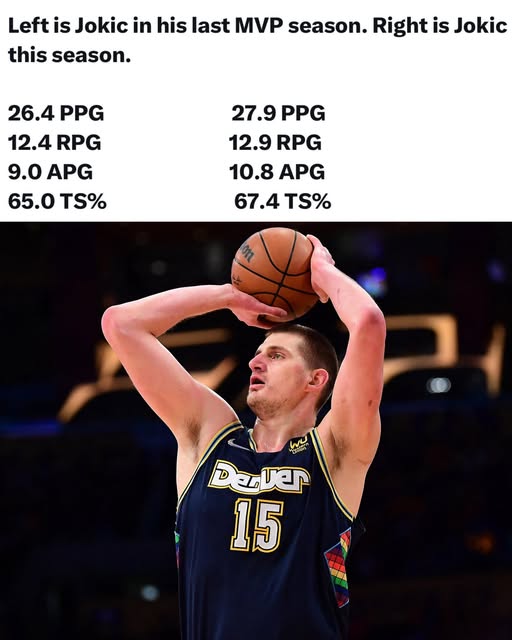
From a statistical perspective, Jokić’s numbers reinforce the idea that he is in a class of his own. Consistently ranking among the league leaders in triple-doubles for a big man, he combines scoring, rebounding, and assisting in a way that has few parallels. Historically, only a handful of centers have approached similar versatility in their prime, and even fewer have done so with the same efficiency and consistency. Wilt Chamberlain, for example, dominated scoring and rebounding but did not exhibit Jokić’s passing creativity. Kareem Abdul-Jabbar combined longevity and scoring prowess, yet he did not run an offense from the post. In this way, Jokić is not merely one of the best of his era; he is reshaping the expectations for what a center can be, demonstrating that size and skill are not mutually exclusive with creativity and basketball intelligence.
The evolution of the center position in the modern NBA highlights just how rare Jokić’s talents are. While the league increasingly values big men who can shoot, handle, and create, few execute all these elements at an elite level as consistently as Jokić. Players like Joel Embiid or Anthony Davis may offer elite scoring and rim protection, but neither has the same combination of passing creativity, floor awareness, and all-around impact that defines Jokić’s game. Even historically, the synthesis of passing, scoring, and positional intelligence at 7 feet tall is nearly unprecedented. He is effectively creating a new prototype for what a center can achieve in contemporary basketball, blending physical dominance with cerebral playmaking in ways that are both elegant and devastatingly effective.
Finally, Jokić’s impact extends beyond statistics and individual accolades. His presence fundamentally alters the dynamics of his team’s offense, creating space, dictating tempo, and forcing opponents into difficult defensive choices. He elevates his teammates, not only through scoring and passing but also through leadership and basketball intuition. The ripple effects of his style are felt across all positions, creating opportunities that would not exist without his unique combination of vision, skill, and IQ. In this sense, he is comparable not just to great individual players, but to transformative forces in basketball history who changed the way the game is played and understood.
In conclusion, comparing Nikola Jokić to other players is inherently challenging because he embodies multiple roles that are rarely combined in one individual. He possesses the passing ability of Magic Johnson and Arvydas Sabonis, the scoring versatility of Larry Bird, the fundamental dominance of Tim Duncan, and the size and presence of traditional centers like Kareem Abdul-Jabbar. Yet no single player fully captures the totality of his skill set. He is a point-center, a floor general, a scorer, a rebounder, and a basketball intellect all in one, redefining the expectations for his position. His combination of court vision, scoring ability, rebounding intelligence, durability, and leadership places him in an extremely rare category, one that few players in history could realistically share. To understand Jokić is to understand that modern basketball is evolving, and he stands at the forefront of that evolution, proving that greatness comes not just from physical attributes or statistical dominance, but from a synthesis of skill, intelligence, and adaptability that challenges the very definition of positional roles in the NBA.