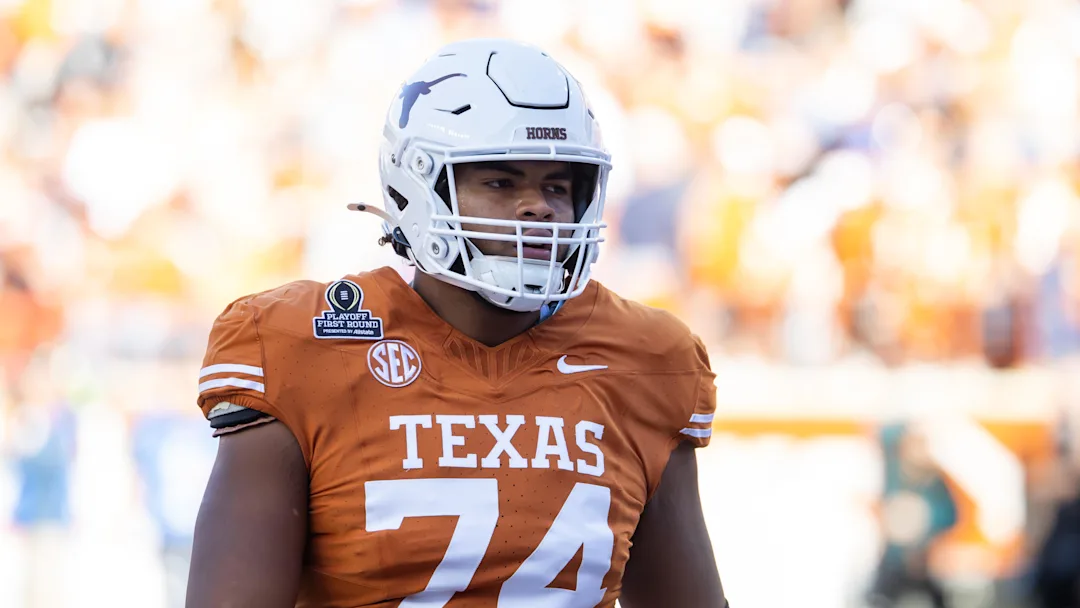
Momentum inside the Texas Longhorns football program has been building steadily, but when a veteran presence in the locker room takes time to single out younger players, it carries a different level of weight. That’s exactly what happened when offensive tackle Trevor Goosby spoke candidly about two emerging talents within the roster, offering insight into both their development and the broader trajectory of the team. In a program loaded with expectations, depth, and national attention, those kinds of endorsements are rarely given lightly.
Goosby’s comments didn’t come across as routine praise or media-friendly optimism. Instead, they reflected a growing confidence within the Texas locker room that the next wave of stars is not only ready but already contributing to the culture that head coach Steve Sarkisian has worked to establish. For a team with playoff aspirations and a reputation to uphold as it navigates elite competition, internal belief can often be the difference between potential and realization.
The first of the two players Goosby highlighted was Arch Manning, a name that carries enormous expectations even before a single snap is taken at full capacity. Manning’s presence in Austin has been under a microscope since his arrival, with fans, analysts, and former players all projecting what his future could look like. But inside the locker room, the narrative is far less about hype and far more about daily habits.
According to Goosby, what separates Manning is not just his natural ability, but his approach to preparation. He described a quarterback who is constantly studying, constantly asking questions, and constantly looking for ways to improve. In a position that demands leadership as much as talent, those traits are often what determine long-term success. Goosby’s perspective as an offensive lineman is particularly valuable here, because linemen tend to judge quarterbacks not by highlight throws, but by command, communication, and consistency.
Manning’s ability to earn the respect of older players early in his career speaks volumes. It suggests that his transition from highly touted recruit to legitimate contributor is already underway. While his last name inevitably brings attention, it is his work ethic that appears to be winning over teammates. Goosby emphasized that Manning doesn’t carry himself like someone entitled to anything; instead, he approaches each day as if he has something to prove.
That mentality has a ripple effect across the offense. When a quarterback shows that level of commitment, it raises the standard for everyone else. Receivers run sharper routes, linemen lock in on assignments, and the entire unit operates with a greater sense of urgency. For Texas, which has been striving to maintain consistency at the quarterback position, that kind of internal stability could be transformative.
The second player Goosby praised was wide receiver Ryan Wingo, another young talent whose impact is beginning to surface in meaningful ways. Unlike Manning, whose position naturally places him in the spotlight, Wingo’s rise has been more about quietly proving himself through performance. But within the program, his progress has not gone unnoticed.
Goosby spoke highly of Wingo’s explosiveness, route-running precision, and ability to stretch the field. For an offense that thrives on balance and versatility, having a receiver who can consistently threaten defenses vertically adds a critical dimension. It forces opposing secondaries to adjust, creates space underneath, and opens opportunities for other playmakers.
What stood out most in Goosby’s comments about Wingo, however, was his emphasis on consistency. Young receivers often flash potential but struggle with the day-to-day demands of college football. Wingo, according to Goosby, has avoided that trap by bringing the same level of intensity to practice that he shows in games. That reliability is what earns trust from quarterbacks and coaches alike.
In many ways, Wingo represents the modern evolution of the Texas offense. He combines speed with physicality, technique with instinct, and confidence with discipline. As the Longhorns continue to refine their identity, players like Wingo become essential pieces of the puzzle. They are not just contributors; they are tone-setters.
Goosby’s praise for both Manning and Wingo also highlights a broader theme within the program: the alignment between recruiting success and player development. Texas has consistently brought in top-tier talent, but the true measure of a program lies in how that talent is cultivated. The fact that younger players are already earning recognition from veterans suggests that the development process is working.
There is also an element of accountability embedded in Goosby’s remarks. By publicly acknowledging these players, he is effectively challenging them to maintain and elevate their performance. In competitive environments, recognition often comes with increased expectations. Manning and Wingo are no longer just promising prospects; they are players the team is counting on.
For Texas, the timing of this internal growth is crucial. As the program continues to compete at the highest level, depth becomes a defining factor. Injuries, fatigue, and the grind of a long season test every roster. Having young players who are ready to step in without a drop-off in performance can be the difference between a good season and a great one.
Goosby’s role as a veteran offensive lineman adds another layer of significance to his comments. The offensive line is often considered the backbone of any football team, and linemen tend to have a clear understanding of who is truly prepared. Their perspective is shaped by physical battles, film study, and constant communication. When someone in that position speaks highly of teammates, it carries credibility.
His endorsement of Manning suggests confidence in the quarterback’s ability to lead the offense effectively. His praise for Wingo indicates trust in the receiver’s ability to execute under pressure. Together, those two elements form the foundation of a dynamic offensive unit.
Beyond individual performances, there is a cultural component to all of this. Texas has been working to build a culture of competition, discipline, and accountability. When younger players embrace those values early, it accelerates the overall progress of the team. Goosby’s comments reflect a locker room where standards are understood and upheld, regardless of experience level.
That kind of environment is essential for sustained success. Programs that rely solely on veteran leadership often struggle when those players move on. But teams that develop leadership across all levels create continuity. Manning and Wingo, in this context, are not just future stars; they are part of the present foundation.
It’s also worth noting how these dynamics impact recruiting. Prospective players pay close attention to how current athletes are treated and developed. When they see young players earning respect and making an impact, it reinforces the appeal of the program. Texas has long been a destination for top talent, and stories like this only strengthen that position.
As the season progresses, the spotlight on Manning and Wingo will undoubtedly intensify. Performances will be scrutinized, expectations will grow, and challenges will emerge. But the early endorsement from a teammate like Goosby provides a strong indication that they are equipped to handle what lies ahead.
For fans, this kind of insight offers a glimpse beyond the surface. It’s easy to focus on statistics and highlights, but the true story of a team often unfolds in practice sessions, film rooms, and locker room conversations. Goosby’s remarks pull back the curtain just enough to reveal the work being done behind the scenes.
Ultimately, what stands out most is the sense of belief within the Texas program. It’s not just about individual talent; it’s about how that talent comes together to form a cohesive unit. Manning’s leadership potential and Wingo’s playmaking ability are pieces of a larger puzzle, one that Texas is steadily assembling.
Goosby’s willingness to speak openly about his teammates reflects confidence not only in them but in the direction of the program as a whole. It suggests that Texas is not just aiming to compete but to establish itself as a consistent force at the highest level of college football.
As the Longhorns continue their journey, the development of young players will remain a central storyline. If Manning and Wingo continue on their current trajectory, they won’t just justify the praise—they’ll amplify it. And if Goosby’s assessment is any indication, Texas may already be seeing the early stages of something special taking shape within its roster.