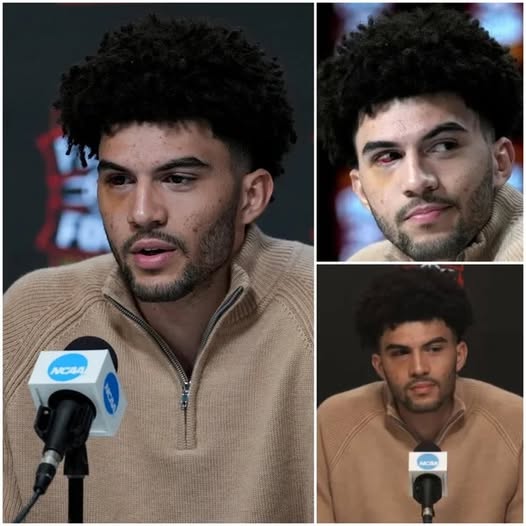
The final moments of the national semifinal loss to UConn Huskies men’s basketball didn’t just leave a mark on the scoreboard for Duke Blue Devils men’s basketball—they left a visible, painful imprint on the face of freshman phenom Cameron Boozer. In the days following the crushing defeat, Boozer broke his silence with a revelation that added a new layer to the narrative surrounding Duke’s abrupt end to what had been a dominant season: he had been playing through a fractured eye.
The injury, described by team sources as a fracture around the orbital bone, occurred during the high-intensity clash against UConn, a game that quickly escalated into a physical battle in the paint. Boozer, who had already become the focal point of Duke’s offense and identity throughout the 2025–26 season, found himself absorbing contact possession after possession. Elbows, forearms, and hard contests at the rim were constant, and while officials let much of the physicality go, the toll on Boozer’s body—and particularly his face—became impossible to ignore.
By the second half, television cameras caught glimpses of swelling around his eye. By the final buzzer, it was clear something was seriously wrong. Now, with confirmation of a fracture, the full scope of what Boozer endured has come into focus.
“I was seeing double at one point,” Boozer admitted in a postgame reflection that has since circulated widely across the college basketball landscape. “But I wasn’t coming out. Not in that moment. Not with everything on the line.”
That statement alone speaks volumes about the mentality that has made Boozer one of the most talked-about young stars in the sport. From the opening tip of the season to the final possession against UConn, he has carried himself like a veteran, not a freshman. But it also underscores the fine line between toughness and risk—a line Boozer walked in real time under the brightest lights of the NCAA Tournament.
The loss itself was devastating. Duke entered the Final Four with legitimate championship expectations, fueled by Boozer’s meteoric rise and a roster that blended elite youth with experienced contributors. Many analysts had pegged the Blue Devils as the most complete team remaining in the tournament. Instead, it was UConn—a program that has quietly built a reputation for peaking in March—that dictated the terms of the game.
From the opening minutes, UConn made it clear that Boozer would not have an easy night. Double teams came quickly. Help defenders rotated aggressively. Every touch in the post was met with resistance. And when Boozer attacked the rim, he was met not just with vertical contests but with the kind of body blows that wear down even the strongest players.
It was in one of those sequences—midway through the first half—that the injury reportedly occurred. Driving baseline, Boozer absorbed contact from multiple defenders, taking an elbow near his eye as he attempted a contested layup. The whistle never came. The play continued. And Boozer, like he had all season, got up and kept going.
What followed was a performance defined less by efficiency and more by sheer will. His stat line, while solid, didn’t fully capture the circumstances. Every rebound required a battle. Every shot attempt came with pressure. Every defensive possession demanded focus despite impaired vision.
For Jon Scheyer, the head coach of Duke, Boozer’s effort was emblematic of the culture he has been trying to build since taking over the program.
“He gave us everything,” Scheyer said in his postgame press conference. “More than people realize. There are things guys play through that never get talked about. Tonight, I think people saw just how tough he is.”
Scheyer’s comments hint at a broader reality within high-level college basketball: injuries, especially those sustained in high-stakes games, are often downplayed in the moment. Players push through. Coaches trust their stars. And only afterward does the full story emerge.
In Boozer’s case, the aftermath has been as much emotional as it has been physical.

“I’ve never felt anything like that,” Boozer said, referring to the combination of pain and disappointment. “Not just losing, but knowing I couldn’t be at my best when my team needed me most. That’s the part that stays with you.”
For a player who had spent the season redefining expectations for freshmen, the loss—and the circumstances surrounding it—represent a pivotal moment. Boozer is no longer just the rising star. He is now a player who has experienced the highest of highs and the lowest of lows in rapid succession.
Teammates have rallied around him in the days since. Several took to social media to praise his toughness and leadership, emphasizing that his willingness to play through injury inspired the entire locker room. Behind closed doors, sources indicate that Boozer has been both reflective and resolute, already channeling the experience into motivation for the future.
The medical outlook, fortunately, appears positive. Orbital fractures, while painful and potentially serious, often heal without surgical intervention if properly managed. Boozer is expected to make a full recovery, though the timeline will depend on swelling reduction and follow-up evaluations.
Still, the incident has reignited conversations about officiating and player safety in college basketball. Throughout the tournament, there were growing concerns about the level of physicality being allowed, particularly in games involving dominant interior players like Boozer. Critics argue that inconsistent whistle standards can create environments where excessive contact goes unchecked, increasing the risk of injury.
Supporters of a more physical style counter that March basketball has always been defined by its intensity and that players must adapt. Boozer himself has taken a measured stance on the issue.
“It’s part of the game,” he said. “You have to be ready for it. But at the same time, you want it to be fair. You want to know what’s a foul and what’s not.”
That balance—between toughness and protection—remains one of the sport’s ongoing challenges.
For Duke, the loss to UConn marks the end of a season that promised more. With Boozer leading the way, the Blue Devils had established themselves as a powerhouse, capable of beating anyone on any given night. Their exit, however, serves as a reminder of the thin margins that define postseason success.
For Boozer, the journey is just beginning.
Even before the injury revelation, there was already significant buzz about his future. NBA scouts have been closely monitoring his development, with many projecting him as a potential top pick whenever he chooses to declare. His combination of size, skill, and basketball IQ has drawn comparisons to some of the game’s greats.
Now, with the added dimension of having played through adversity on one of the biggest stages in the sport, his profile has only grown.
“He’s built for this,” one scout noted. “What he showed in that game—playing through pain, competing at that level—that’s what teams look for. That’s what separates good players from great ones.”
The offseason will provide Boozer with an opportunity to heal, both physically and emotionally. It will also give him time to reflect on what has been a whirlwind year—one that saw him rise from highly touted recruit to national Player of the Year and centerpiece of one of college basketball’s most storied programs.
But if his recent comments are any indication, Boozer isn’t interested in dwelling on what might have been.
“This isn’t the end,” he said. “It’s just part of the story. We’ll be back.”
Those words carry weight, not just because of who is saying them, but because of what they represent. For Duke fans, they offer reassurance that the program’s future remains bright. For opponents, they serve as a warning that Boozer’s best may still be ahead.
And for Boozer himself, they mark the beginning of the next chapter—a chapter shaped by resilience, defined by growth, and driven by the memory of a game that took more from him than anyone initially realized.
In the end, the image of Cameron Boozer leaving the court—eye swollen, expression a mix of pain and determination—may become one of the defining visuals of this year’s tournament. Not because of the loss, but because of what it revealed about the player at the center of it all.
A fractured eye can heal. The disappointment of a missed opportunity can linger. But the experience, the lessons, and the resolve that come from moments like this often lay the foundation for something greater.
For Cameron Boozer and Duke, that “something greater” now becomes the mission.