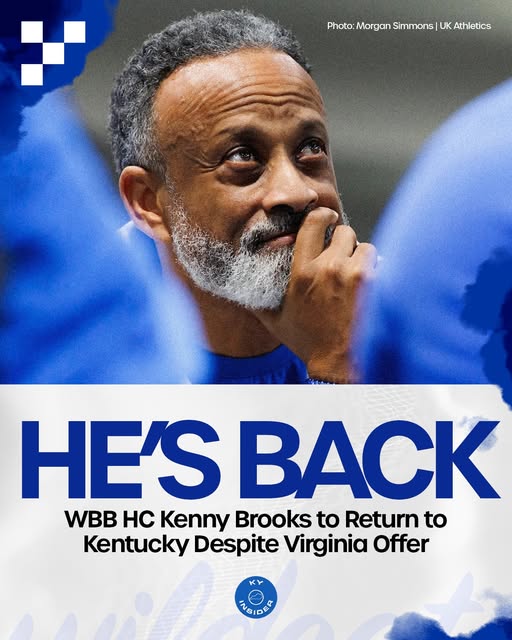
In a move that has quickly reshaped the conversation around the college basketball coaching carousel, Kenny Brooks has decided to remain at Kentucky, turning down a significant opportunity to take over the head coaching position at Virginia. The decision, which comes amid intense speculation and behind-the-scenes negotiations, signals not only Brooks’ commitment to his current program but also speaks volumes about the evolving dynamics of coaching loyalty, institutional fit, and long-term vision in modern college athletics.
For days, momentum had been building around the possibility of Brooks making the jump. Virginia, a program with a strong basketball pedigree and a recent history of success, represented an enticing prospect. The appeal was obvious: a fresh challenge, a new recruiting base, and the chance to leave a personal imprint on a program already accustomed to competing at a high level. Many around the sport assumed that the pull of such an opportunity—combined with the prestige of leading a program like Virginia—would be enough to lure Brooks away. Instead, his decision to stay at Kentucky has flipped that narrative entirely.
At the heart of Brooks’ choice appears to be a deep sense of alignment with what Kentucky is building. Coaching decisions at this level rarely hinge on a single factor; they are the result of a complex equation involving resources, relationships, roster composition, administrative support, and personal comfort. In Kentucky, Brooks has found a situation where those variables appear to be working in harmony. There is continuity, there is belief, and perhaps most importantly, there is unfinished business.
Kentucky, as a basketball institution, carries a unique blend of pressure and opportunity. Expectations are always sky-high, and every season is measured against championship standards. For some coaches, that environment can be overwhelming, even suffocating. For others, it becomes a source of motivation, a stage upon which to prove themselves. Brooks seems to fall firmly into the latter category. By choosing to stay, he is effectively embracing that challenge and signaling confidence in his ability to meet it.
Another important layer to this decision is the roster Brooks currently oversees. In the era of the transfer portal and NIL-driven movement, roster stability is increasingly rare. When a coach finds a group that fits his system and culture, there is a strong incentive to see that vision through. Leaving now would have meant handing that progress over to someone else, starting from scratch in a new environment, and navigating a completely different set of variables. Staying allows Brooks to continue developing players he has already invested in—both athletically and personally.
Recruiting also plays a significant role. Relationships with recruits, their families, and high school or grassroots programs are built over time. A coaching move can disrupt those pipelines, sometimes irreparably. By remaining at Kentucky, Brooks preserves the trust he has cultivated and reinforces the message that his program offers stability. In a landscape where players are constantly evaluating their options, that kind of consistency can be a powerful recruiting tool.
From Kentucky’s perspective, this is a major win. Retaining a coach who was actively pursued by another high-profile program sends a clear message about the strength and appeal of the institution. It suggests that Kentucky is not merely a stepping stone but a destination in its own right. That perception matters—not just to fans, but to players, recruits, and potential staff members. Stability at the top often translates into stability throughout the program, creating an environment where sustained success becomes more achievable.
There is also an emotional component that should not be overlooked. Coaches, despite the businesslike nature of their profession, form deep connections with their players, staff, and communities. Walking away from those relationships is never easy. Brooks’ decision hints at a level of attachment that goes beyond professional calculation. It reflects a belief that what he is building at Kentucky is meaningful and worth continuing.
On the other side of the equation, Virginia now faces the challenge of recalibrating its search. Missing out on a top target can shift timelines and force programs to revisit their priorities. It also underscores how competitive the market has become for proven coaching talent. Programs are no longer just selling tradition or facilities; they are selling vision, alignment, and the promise of long-term partnership. In this case, Kentucky appears to have offered a more compelling package on those fronts.
The broader implications of Brooks’ decision extend beyond the two programs directly involved. In recent years, there has been a noticeable increase in coaching movement, driven by financial incentives, institutional changes, and the evolving structure of college athletics. Against that backdrop, a decision to stay put—especially when presented with a high-profile alternative—stands out. It suggests that, despite the volatility of the current landscape, there are still situations where continuity and commitment outweigh the allure of change.
Fans, of course, will interpret this news through their own lenses. Kentucky supporters are likely to view it as a validation of their program’s direction and a reason for optimism moving forward. The idea that their coach turned down another major opportunity reinforces confidence and builds anticipation for what comes next. Virginia fans, meanwhile, may experience a mix of disappointment and curiosity as they await the next chapter in their program’s leadership story.
Media narratives will inevitably follow. Some will frame Brooks’ decision as a loyalty play, emphasizing his dedication to Kentucky. Others will analyze it through a strategic lens, arguing that the timing or circumstances simply made more sense for him to stay. Both perspectives can be true simultaneously. Coaching decisions are rarely binary; they exist in shades of gray, shaped by a multitude of factors that are not always visible to the public.
Looking ahead, the real impact of this decision will be measured over time. If Kentucky continues to improve, competes at a high level, and perhaps makes deep postseason runs, Brooks’ choice will be seen as a pivotal moment—a turning point that allowed the program to maintain momentum and build something lasting. If results fall short, critics may question whether he missed an opportunity to reset in a different environment. That is the nature of high-stakes decision-making in sports; outcomes ultimately define perception.
For Brooks himself, the focus now shifts back to the day-to-day work of coaching. Decisions like this can create a surge of attention, but they also raise expectations. Staying at Kentucky means doubling down on the vision he has already articulated. It means continuing to develop players, refine strategies, and navigate the challenges that come with leading a high-profile program. The spotlight will be brighter, and the margin for error may feel smaller, but those are the conditions that often produce the most compelling stories in sports.
There is also an element of identity at play. Coaches often talk about finding the right “fit,” a place where their philosophy aligns with the institution’s values and goals. Brooks’ decision suggests that he believes he has found that fit at Kentucky. Rather than chasing a new opportunity, he is choosing to deepen his roots where he is. In an era defined by movement and change, that kind of decision carries its own significance.
Ultimately, this moment serves as a reminder that success in college basketball is not solely determined by wins and losses. It is shaped by decisions—some visible, others not—that influence the trajectory of programs and careers. Brooks’ choice to remain at Kentucky is one of those decisions. It may not come with the immediate drama of a game-winning shot or a tournament upset, but its ripple effects could be just as profound.
As the offseason continues and the next season approaches, the conversation will gradually shift from what might have been to what is. Kentucky will move forward with its coach firmly in place, its plans intact, and its ambitions undiminished. Virginia will continue its search, undoubtedly identifying new candidates and new possibilities. And Brooks, having made his choice, will return to the work that defines his profession, carrying with him the knowledge that he turned down one path in order to fully commit to another.