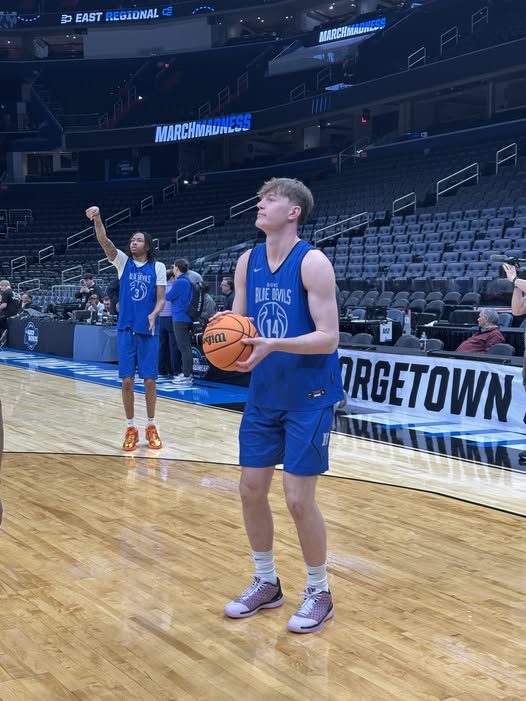
News that Nik Khamenia is likely headed for the transfer portal lands with a mix of disappointment and understanding, a familiar emotional blend in the modern era of college basketball. Situations like this are no longer surprising, even when the player in question is someone fans have grown to appreciate over the course of a season. Khamenia’s trajectory at Duke was, in many ways, emblematic of a young player finding his footing. He did not arrive as a finished product, and early in the season there were clear signs that he needed time to adjust to the pace, physicality, and expectations of high-level college basketball. That adjustment period, however, gradually gave way to meaningful development.
By the end of the season, Khamenia had carved out a role as a reliable contributor. His improvement was not just incremental; it was noticeable in both confidence and execution. He began to look more comfortable within the system, making smarter decisions, showing better awareness, and contributing in ways that went beyond the box score. It was the kind of growth that programs hope for when they invest in developing players over time. From that perspective, there is a sense that, had he remained, he could have entered the next season poised for a significant leap.
At the same time, the realities surrounding his potential departure reflect the shifting dynamics of the sport. The transfer portal has fundamentally altered how players, programs, and outside influences interact. In Khamenia’s case, it appears that his representation took an active role throughout the season, advocating for expanded opportunities and a more clearly defined role. That kind of involvement is increasingly common, as agencies look to position their clients for both immediate exposure and long-term professional prospects. From their standpoint, pushing for guarantees or a more prominent role is part of the job.
Whether those expectations aligned with Duke’s plans is another matter. Coaching staffs must balance development, team chemistry, and performance, often making decisions based on what they believe gives the team the best chance to succeed. Early in the season, when Khamenia was still adjusting, it is understandable that his minutes or responsibilities may not have matched what his camp envisioned. Even as he improved, there may have remained a gap between what he had earned and what was being sought on his behalf. In today’s environment, that gap can quickly lead to a decision to explore other options.
Family influence also cannot be overlooked. A player’s inner circle often plays a significant role in shaping these decisions, offering guidance, perspective, and sometimes pressure. In Khamenia’s situation, it is reasonable to assume that his father had input, as is the case with many young athletes navigating complex choices about their future. These decisions are rarely made in isolation; they are the product of conversations, सलाह, and differing viewpoints about what path offers the best combination of opportunity, development, and security.
For fans, moments like this are difficult because they disrupt the sense of continuity that once defined college basketball. There was a time when player development was a multi-year process, and supporters could watch individuals grow within a program, forming connections that deepened over time. Now, the landscape is far more fluid. Rosters can change dramatically from one season to the next, and even players who seem to be on the cusp of a breakout can depart in search of a better situation.
That fluidity is not inherently negative, but it does come with trade-offs. On one hand, players have more agency than ever before. They are no longer locked into situations that may not serve their interests, and they can seek environments that offer greater opportunity or alignment with their goals. On the other hand, the increased movement can make it harder for teams to build cohesion and for fans to form lasting attachments. It also introduces a more transactional element into the sport, where decisions are often influenced by factors that extend beyond on-court performance.
The role of agencies underscores this shift. Their presence brings a level of professionalism and advocacy that was less visible in previous eras. They negotiate, advise, and push for outcomes that benefit their clients, sometimes in ways that can create tension within a team structure. From their perspective, every decision is part of a larger career strategy. From a program’s perspective, those same decisions can complicate efforts to maintain stability and balance.
In Khamenia’s case, the sense is that both sides may have had valid viewpoints. Duke likely saw a player who was developing well and projected to have a solid, if not significant, role moving forward. His camp, meanwhile, may have viewed his late-season progress as evidence that he was ready for a larger platform or more guaranteed opportunities. When those perspectives diverge, the transfer portal becomes the mechanism through which players seek alignment elsewhere.
There is also a broader conversation to be had about what college basketball has become. The increasing emphasis on name, image, and likeness opportunities, combined with the ease of transferring, has contributed to a system that many view as more business-oriented than ever before. For some, this is a necessary evolution, recognizing the value that players bring to the sport and ensuring they have the ability to benefit from their talents. For others, it represents a departure from the traditional ideals of college athletics, where development, education, and team identity were more central.
The truth likely lies somewhere in between. The current system offers opportunities that were long overdue, but it also introduces challenges that the sport is still learning to navigate. Questions about regulation, fairness, and sustainability remain unresolved. There is a growing sense that some form of governing structure is needed to provide clarity and consistency, though what that structure should look like is still a matter of debate.
Against that backdrop, individual stories like Khamenia’s take on added significance. They are not just about one player’s decision, but about the broader forces shaping the sport. His departure, if it becomes official, will be another data point in an ongoing transformation, one that is redefining what it means to be a college athlete and how programs operate.
From a purely basketball standpoint, it is fair to wonder what might have been. Khamenia’s improvement suggested that he was on an upward trajectory, and continuity within a system often accelerates development. Another year at Duke could have provided the stability and familiarity needed to unlock a higher level of performance. There is also value in staying within a program that has already invested in a player’s growth, where coaches understand his strengths and areas for improvement.
At the same time, the possibility exists that a new environment could offer benefits that outweigh those considerations. A different system, a different role, or simply a fresh start can sometimes catalyze progress in ways that are difficult to predict. Players who transfer often do so with the belief that they can find a better fit elsewhere, and in many cases, that belief proves justified.
Ultimately, there is no simple way to evaluate decisions like this. They are shaped by a complex interplay of personal ambition, external influence, and evolving circumstances. For fans, the best approach may be to appreciate what a player contributed while he was part of the program and to wish him well in whatever comes next.
That sentiment feels particularly appropriate here. Khamenia may not have been a finished product when the season began, but he showed growth, resilience, and the ability to adapt. Those qualities are worth acknowledging, regardless of where he ultimately plays next. His time at Duke, even if it ends sooner than many would have hoped, was not without value.
As the sport continues to evolve, situations like this will remain common. Players will come and go, sometimes quickly, and programs will adapt as best they can. The challenge for everyone involved is to find a balance that preserves the competitive integrity and emotional connection that make college basketball special, while also embracing the changes that are reshaping it.
In the meantime, all that can be said is that it is never easy to see a player you like move on. There is a sense of loss, of unrealized potential within a familiar setting. But there is also an understanding that this is the reality of the modern game. It is, increasingly, a business-centered environment, with all the complexities that entails.
Khamenia’s story fits squarely within that reality. It reflects both the opportunities and the tensions that define this era. And while his departure may be disappointing for those who hoped to see him continue his journey at Duke, it is also a reminder of how much the landscape has changed, and how much it continues to change with each passing season.