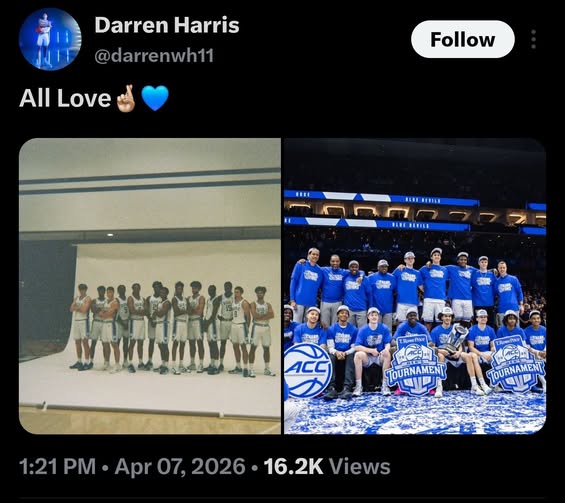
Darren Harris shared a message on X, and for those who had the chance to be around him, it felt like more than just another post from a college athlete moving on to the next chapter. It felt personal. It felt like the closing of a meaningful, if relatively brief, chapter defined not just by basketball, but by character, connection, and quiet impact. For me, covering him over these past two seasons at Duke wasn’t just part of the job—it was something I genuinely looked forward to.
There are players you speak to because you have to, because deadlines demand it, because the story needs a quote. And then there are players like Darren Harris, the kind you find yourself gravitating toward because every interaction offers something more. He wasn’t just available; he was present. He didn’t just answer questions; he engaged. In a space that can often feel transactional, Darren brought something human.
From the first time I spoke with him in the locker room, there was an ease about him that stood out. Not forced, not rehearsed—just natural. He carried himself with a calm confidence, the kind that doesn’t need to announce itself. You could ask him about a tough loss, a shooting slump, or a big moment, and he’d meet the question with thoughtfulness. Not clichés, not deflections, but real answers. That kind of openness is rare, especially at a place like Duke where expectations are relentless and the spotlight never really dims.
What made Darren especially enjoyable to cover was his insight. He saw the game deeply, and more importantly, he could articulate what he saw. Whether breaking down defensive rotations, talking about his role within the team, or reflecting on his own growth, he gave you substance. You walked away from conversations with him feeling like you understood the game a little better, like you’d been let in on something beyond the surface.
But it wasn’t just what he said—it was how he said it. There was a friendliness, a genuine warmth that made every interaction feel less like an interview and more like a conversation. He remembered people. He made eye contact. He listened. Those might sound like small things, but in an environment where players are constantly pulled in different directions, they matter. They leave an impression.
Over the past two seasons, I watched him navigate the highs and lows that come with college basketball. The wins that energize a locker room, the losses that linger longer than anyone wants, the individual moments of success, and the stretches where things don’t quite click. Through it all, Darren remained steady. He didn’t let the highs inflate him or the lows define him. That consistency, that emotional balance, is something that often goes unnoticed from the outside, but it’s invaluable within a team.
There’s also something to be said about the way he fit into the culture. Duke has a standard, not just in performance, but in how players represent the program. Darren embodied that in a way that felt authentic. He wasn’t trying to be something he wasn’t. He was simply himself, and that was more than enough. Teammates respected him. Coaches trusted him. And for those of us covering the team, he became someone we knew we could rely on.
In many ways, players like Darren are the connective tissue of a team. They may not always be the headline, but they’re essential to the story. They bring stability. They bring perspective. They help shape the environment in ways that aren’t always captured in box scores or highlight reels. And when they move on, you realize just how much they contributed to the overall experience.
As I think back on the conversations we had, what stands out most is the sense that Darren understood the bigger picture. Yes, he was committed to getting better on the court, to competing, to helping his team win. But there was also an awareness of the moment, of the opportunity, of the relationships being built along the way. That kind of perspective doesn’t just happen; it’s cultivated. It speaks to who he is beyond basketball.
There’s a certain appreciation that comes with covering players over multiple seasons. You see the growth, not just in skill, but in maturity. You watch them become more comfortable in their own skin, more confident in their voice. With Darren, that progression was clear. He became more assured, more expressive, but never lost the qualities that made him approachable in the first place.
And now, as he moves on to whatever comes next, there’s a mix of emotions. On one hand, there’s excitement. Players like Darren, with his mindset and demeanor, are built to succeed beyond college. He has the tools, not just physically, but mentally and emotionally. On the other hand, there’s a sense of loss, at least from the perspective of those who had the privilege of covering him. The locker room won’t quite feel the same without his presence.
It’s easy to focus on what players accomplish statistically, and that’s part of the story. But it’s not the whole story. The way a player carries himself, the way he treats people, the way he contributes to the culture—those things matter just as much, even if they’re harder to quantify. Darren Harris excelled in those areas. He made covering the team more enjoyable, more meaningful.
There’s a line that often gets used in sports when someone moves on: “Go be great.” It can sound like a cliché, something said out of habit. But in Darren’s case, it feels fitting. Not because greatness is guaranteed, but because he approaches things in a way that gives him a real chance to achieve it. He puts in the work. He thinks the game. He connects with people. Those are the building blocks.
Wherever his path leads—whether it’s continuing in basketball at the next level or pursuing something entirely different—there’s little doubt he’ll leave a positive impression. That’s just who he is. And for those of us who had the chance to interact with him during his time at Duke, that’s what we’ll remember most.
In a profession that often moves quickly from one story to the next, it’s easy to forget the individual moments, the small interactions that make the job worthwhile. But certain players stick with you. Darren Harris is one of those players for me. Not because of any single moment, but because of the consistency of who he was every time we spoke.
So as he turns the page, there’s nothing left to say but thank you. Thank you for the time, for the conversations, for the openness. Thank you for making the job a little easier and a lot more enjoyable. And most of all, thank you for being exactly who you are.
Go be great, Darren.