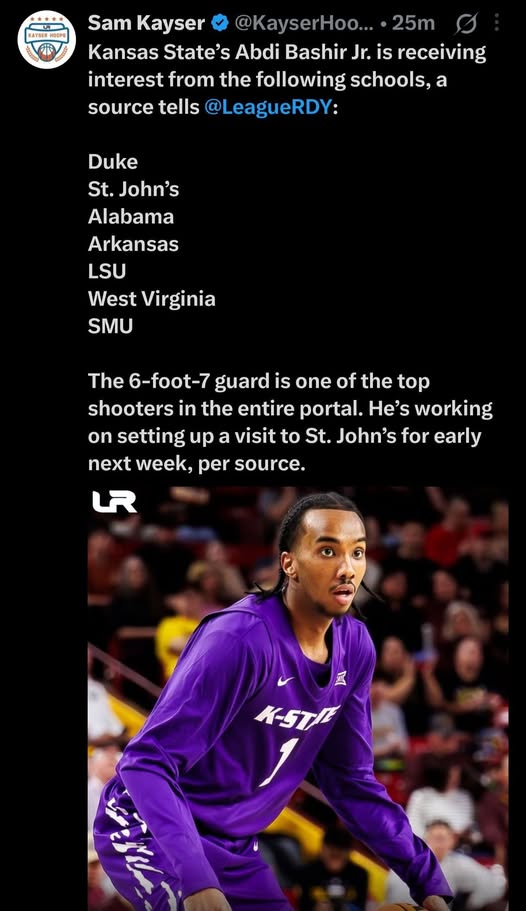
Duke’s reported interest in Abdi Bashir Jr. feels like the kind of move that quietly signals intent without needing a press conference to explain it. On the surface, it’s a simple evaluation of a talented player coming off a strong season at Kansas State. But when you dig a little deeper, it starts to look like something more deliberate—a recognition of a specific skill set that has become increasingly valuable in today’s game, especially for a program that expects to compete at the highest level every single year.
Bashir’s numbers immediately jump off the page. Averaging 13.2 points per game is solid, but it’s the efficiency and the volume behind the arc that really turn heads. Shooting 44.4 percent from three-point range while taking 8.4 attempts per game is not just impressive—it’s rare. That combination of accuracy and confidence suggests a player who isn’t just capable of knocking down open looks, but one who actively bends defenses. Opponents don’t get the luxury of going under screens or losing track of him for even a second. Every possession demands attention, and that kind of gravity changes how a team can function offensively.
At 6-foot-7, Bashir also fits the modern mold of a perimeter player who brings size without sacrificing skill. The days when guards and wings were neatly separated into rigid categories are fading, and players like him blur those lines in useful ways. He has the length to shoot over smaller defenders and the mobility to operate on the perimeter, making him a matchup problem in multiple directions. For a team like Duke, which often thrives on versatility and spacing, that profile is incredibly appealing.
There’s also something to be said about where Bashir comes from and what that journey represents. A Nebraska native who made his mark at Kansas State, he didn’t necessarily arrive with overwhelming hype. Instead, he built his reputation through production and consistency. That kind of path often produces players with a different edge—guys who understand how to carve out roles, who don’t take opportunities for granted, and who are willing to adapt when asked. In a program loaded with talent and expectations, that mindset can be just as important as raw ability.
From Duke’s perspective, the interest makes sense when you consider the broader landscape of college basketball. Spacing has become non-negotiable. Teams that can’t reliably stretch the floor often find themselves stuck in half-court situations that feel cramped and predictable. Adding a shooter of Bashir’s caliber would immediately address that concern. Defenses would have to honor him well beyond the three-point line, opening driving lanes and creating cleaner looks for others. It’s not just about the shots he makes; it’s about the opportunities he creates without even touching the ball.
There’s also the tempo factor. Players who are willing to take threes in transition, especially at a high percentage, can change the rhythm of a game. A quick pull-up from deep forces defenses to scramble and can flip momentum in a matter of seconds. Bashir’s willingness to shoot at volume suggests he’s comfortable in those moments. He’s not waiting for the perfect setup—he’s ready to act when the opportunity presents itself. That kind of decisiveness can be contagious.
Of course, any potential move like this comes with questions. Translating production from one environment to another isn’t always seamless. Duke’s system, expectations, and level of competition can differ in subtle but meaningful ways. The role Bashir would play might not mirror what he had at Kansas State. He could be asked to do more in certain areas or less in others. The key will be how well his skill set integrates with the pieces already in place.
Defense is another area that inevitably enters the conversation. Size gives Bashir a foundation to be effective on that end, but consistency and effort will determine how impactful he can be. At 6-foot-7, he has the potential to guard multiple positions, contest shots, and contribute to a switching scheme. If he can pair his offensive firepower with reliable defense, his overall value increases significantly. For a program with championship aspirations, two-way contributions are often what separate good players from essential ones.
There’s also an intangible element that comes with being a high-level shooter. Confidence is not optional—it’s required. Players who shoot at the volume Bashir does have to believe in their ability, even after a miss or two. That mentality can be a double-edged sword, but when it’s paired with efficiency, it becomes a weapon. Coaches love players who can maintain that balance, who know when to keep firing and when to make the extra pass. If Bashir has demonstrated that awareness, it only strengthens the case for his fit.
For Duke, the appeal may also lie in lineup flexibility. A player like Bashir allows for different combinations, enabling the coaching staff to experiment with spacing-heavy units or larger lineups that still maintain perimeter shooting. He could function as a primary option in certain sets or as a complementary piece who thrives off the attention drawn by others. That adaptability is valuable over the course of a long season, where matchups and game plans can vary widely.
Another layer to consider is how players like Bashir influence development within a team. Younger players, especially those still refining their perimeter skills, can benefit from practicing alongside someone with his shooting ability. The standard gets raised. The margin for error shrinks. It creates an environment where improvement isn’t just encouraged—it’s expected. That ripple effect can be difficult to quantify, but it often shows up in the way a team evolves over time.
The reported interest also speaks to how programs evaluate talent beyond traditional metrics. Yes, points per game and shooting percentages matter, but so do things like shot selection, movement without the ball, and decision-making under pressure. A player who consistently finds ways to get quality looks, even against disciplined defenses, is demonstrating a deeper understanding of the game. If Bashir has shown that level of awareness, it makes him even more intriguing as a potential addition.
There’s an excitement that comes with imagining how a player like him could perform on a bigger stage. The combination of size and shooting tends to translate well, especially when surrounded by other high-level talent. Open looks might come more frequently. Defensive attention might be spread thinner. In that kind of environment, efficiency can sometimes improve rather than decline. It becomes less about carrying an offense and more about maximizing opportunities within a system.
At the same time, expectations would inevitably rise. Playing for a program with Duke’s history means every game is scrutinized, every performance analyzed. There’s a different kind of pressure that comes with that spotlight. How a player responds to it can shape their trajectory. Some thrive, feeding off the energy and attention. Others need time to adjust. Bashir’s experience and composure will play a role in determining how he navigates that transition, if it happens.
Ultimately, the reported interest feels like a logical intersection of need and opportunity. Duke is always looking to stay ahead of the curve, to identify players who can enhance what they already do well while addressing areas of improvement. Bashir’s shooting, size, and proven production make him a compelling candidate in that regard. He represents a skill set that is not only valuable but increasingly essential in modern basketball.
Whether anything materializes from this interest remains to be seen, but the mere connection is enough to spark conversation. It highlights how programs are constantly evaluating, projecting, and searching for the right pieces to complete the puzzle. In Bashir’s case, the puzzle involves a player who has already demonstrated he can perform at a high level, now potentially being considered for a stage where the stakes—and the rewards—are even higher.
If nothing else, it’s a reminder of how quickly narratives can shift in college basketball. A strong season, a standout skill, and suddenly the attention expands. For Bashir, that attention reflects what he’s accomplished and what he might still become. For Duke, it’s about recognizing that potential and deciding whether it fits into their vision. And for anyone watching, it’s another intriguing storyline in a sport that never really runs out of them.