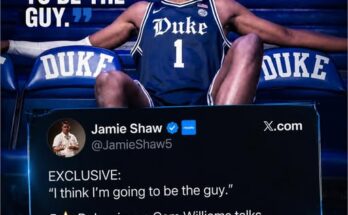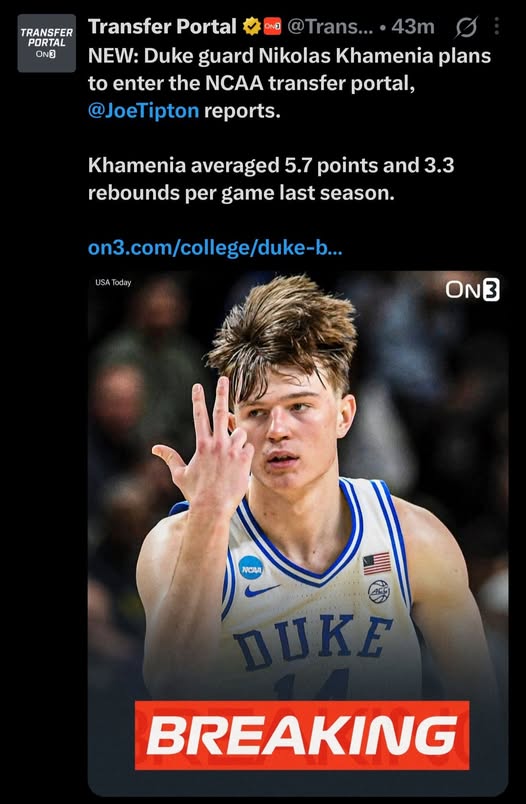
Nik Khamenia jumping into the portal too just adds another layer to what’s already starting to feel like a full-on unraveling. It’s not even shocking anymore, and that might be the worst part. There used to be a moment of pause when a name like that surfaced, a second where you’d double-check if it was real or just rumor. Now it’s almost automatic—refresh, confirm, shake your head, move on. That numbness says a lot about where things are right now. The portal isn’t just active; it’s consuming everything around it, and players who once felt like foundational pieces suddenly look like temporary rentals.
Khamenia isn’t just some random depth guy either. This is someone who people expected to grow into something meaningful, someone who had a trajectory, a storyline that fans could latch onto. Development used to be part of the appeal—watching a player struggle, adjust, improve, and eventually become a key contributor. That arc feels like it’s disappearing. Instead of waiting for that payoff, everything is compressed into shorter windows. If it doesn’t click fast enough, if the situation isn’t perfect, if there’s even a hint of uncertainty, the exit door is right there, wide open.
And it’s not entirely on the players either. The system practically nudges them in that direction. Opportunities shift constantly, coaching situations change, depth charts get reshuffled overnight. Stability is almost an illusion. From a player’s perspective, why sit around and hope things align when you can actively search for a better fit? It makes sense logically, but emotionally it’s exhausting for anyone trying to follow along. You invest in a roster, learn the names, buy into the potential, and then suddenly half of it is gone before it ever fully materializes.
What makes Khamenia’s move hit harder is the timing. It’s not happening in isolation; it’s part of a wave. One departure can be explained away—fit issues, playing time, personal reasons. But when it stacks up like this, it starts to feel systemic. You start questioning what’s going on behind the scenes, whether it’s communication, culture, or just the unavoidable reality of modern roster management. Whatever the reason, the end result is the same: continuity takes a hit, and rebuilding becomes a constant cycle rather than a phase.
There’s also the fan perspective, which doesn’t get talked about enough in these situations. Following a team used to mean forming connections over time. You’d watch players come in as unknowns and leave as established figures, and that journey was part of what made everything feel meaningful. Now, it’s harder to build that connection when the roster feels like a revolving door. You can still care, but it’s different. More cautious, maybe even a little detached. You celebrate the highs, but there’s always that underlying awareness that it might be short-lived.
At the same time, there’s a strange kind of acceptance creeping in. People complain, sure, but there’s also this understanding that this is just how things are now. The portal isn’t going anywhere. If anything, it’s becoming more central to how teams operate. Recruiting doesn’t stop at incoming freshmen; it’s year-round, and it includes your own roster. Retention has become just as important as acquisition, maybe even more so. Coaches aren’t just building teams anymore—they’re constantly re-recruiting the players they already have, trying to convince them to stay in a system that might not offer immediate gratification.
Khamenia entering the portal is a reminder of how fragile those relationships can be. It only takes a small shift—a change in role, a new addition at the same position, a different scheme—and suddenly the equation changes. What once looked like a clear path forward turns into uncertainty, and uncertainty is the one thing the current system doesn’t reward. Players have options, and they’re not afraid to explore them.
There’s also the ripple effect to consider. One player leaving doesn’t just create a vacancy; it alters the entire dynamic. Depth charts shift, roles expand or contract, incoming recruits start reevaluating their decisions. It’s like pulling a thread and watching the whole fabric adjust. In some cases, it opens up opportunities for others, which is the silver lining. Someone who was buried might suddenly get their shot. But that doesn’t erase the sense of loss that comes with seeing potential walk out the door.
It’s easy to default to frustration in moments like this, to see it as something being taken away. And in a way, it is. The traditional model of team-building, of gradual progression and long-term cohesion, is being replaced by something more fluid, more transactional. That shift isn’t inherently bad, but it does change the emotional experience of following a team. It requires a different mindset, one that’s more adaptable and less reliant on continuity.
Still, there’s something about cases like Khamenia’s that hits a nerve. Maybe it’s the feeling that there was unfinished business, that we didn’t get to see how it could have played out. Potential is a powerful thing, and when it’s left unrealized in a particular setting, it leaves behind a kind of lingering “what if.” What if he had stayed? What if things had clicked? Those questions don’t have answers, and that’s part of what makes it frustrating.
At the same time, there’s a recognition that this might be the best move for him individually. The portal isn’t just about leaving; it’s about finding the right situation. Sometimes that means more playing time, sometimes it’s a better scheme fit, sometimes it’s something off the field that outsiders don’t fully understand. Players are making decisions based on their own priorities, and those don’t always align with what fans or programs might want. That tension is built into the system.
As more names enter the portal, the narrative starts to shift from individual decisions to broader trends. It becomes less about why one player left and more about what it says collectively. Are these isolated cases, or is there a deeper issue? Is it a reflection of internal challenges, or just the reality of competing in an environment where movement is constant? Those questions don’t have easy answers, but they’re impossible to ignore when the list keeps growing.
And yet, even with all the departures, there’s still a sense that things can turn around quickly. That’s the other side of the portal—it’s not just an exit, it’s an entry point. For every player leaving, there’s the possibility of someone new coming in, someone who might fit better, contribute immediately, and change the narrative just as quickly. The same system that creates instability also provides opportunities for rapid improvement. It’s chaotic, but it’s not entirely one-sided.
The challenge is balancing those two realities. On one hand, you don’t want to downplay the impact of losing players like Khamenia. On the other, you can’t ignore the fact that the roster is never truly static anymore. It’s a living thing, constantly evolving, and sometimes that evolution involves losing pieces that once seemed important. The key is whether the overall direction remains positive, whether the program can adapt and continue to build despite the churn.
Right now, though, it’s hard not to feel that immediate sting. Another name, another departure, another reminder that nothing is guaranteed. You start to wonder who’s next, which rumors might turn into confirmations, how much of the current roster will actually be there when the next season rolls around. That uncertainty becomes part of the experience, whether you like it or not.
In the end, Khamenia entering the portal is both a specific moment and part of a larger pattern. It’s one decision among many, but it carries weight because of what it represents. The game is changing, the dynamics are shifting, and everyone involved—players, coaches, fans—is trying to adjust in real time. Some will benefit from that change, others will feel like they’re losing something in the process. Most will probably experience a mix of both.
For now, all you can really do is watch it unfold. React, speculate, maybe even vent a little, but ultimately accept that this is the landscape. Players will come and go, sometimes faster than you’d like, and the challenge is finding a way to stay invested without expecting permanence. It’s not the same as it used to be, and it probably never will be again. Whether that’s a good thing or a bad thing depends on your perspective, but moments like this make it hard not to lean toward frustration, at least in the short term.