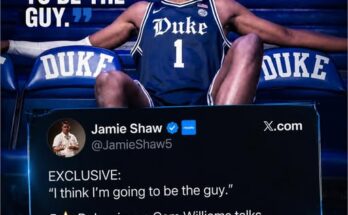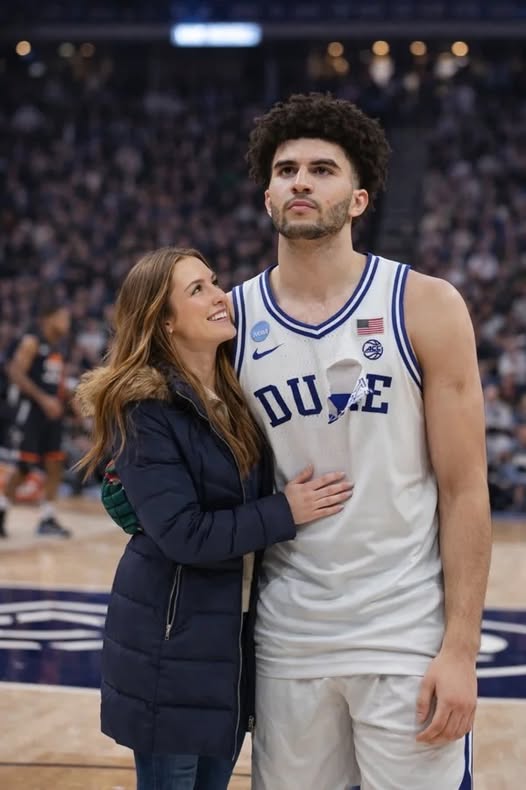
The world of elite high school and college-bound basketball has always carried a certain level of attention, but in the modern era, that spotlight extends far beyond the hardwood. Few young athletes understand that better right now than Cameron Boozer, the Duke-bound phenom whose name has steadily become synonymous with the next generation of basketball excellence. Yet, as is increasingly common in today’s hyper-connected culture, the conversation around rising stars doesn’t stay confined to their performance on the court. It spills into social media, into lifestyle, and into the orbit of the people closest to them.
That reality came into sharp focus recently when Yva Lauren Cao, who has been linked to Boozer, began trending online after sharing a series of beachside photos that quickly captured public attention. Within hours, posts circulated across platforms, drawing thousands of reactions, comments, and reposts. It wasn’t just the images themselves that fueled the moment—it was the way they intersected with the growing visibility of Boozer’s name and brand. In today’s digital landscape, association alone can amplify attention exponentially, and this was a clear example of that phenomenon in action.
For many observers, the moment felt familiar. Social media has a long history of elevating individuals connected to athletes, musicians, and entertainers into the spotlight, often overnight. What might once have been a private or low-profile presence can quickly become a topic of widespread discussion. In Cao’s case, the attention seemed to reflect both curiosity and the internet’s tendency to fixate on the personal lives of emerging public figures. Comments ranged from admiration to surprise, with many users expressing how quickly her name had begun circulating in connection with Boozer.
At the center of it all is Cameron Boozer himself, a player widely regarded as one of the most promising young talents in basketball. As the son of former NBA All-Star Carlos Boozer, expectations have followed him from an early age, but Cameron has consistently shown that his rise is built on his own skill and work ethic. His performances at the high school level have drawn national attention, and his commitment to Duke only heightened the anticipation surrounding his future. With a polished game, strong fundamentals, and a mature approach, he represents the kind of player who attracts both scouts and fans in equal measure.
But with that level of visibility comes a different kind of scrutiny—one that extends beyond statistics and highlight reels. Fans today aren’t just following athletes; they’re following their lives. Social media platforms like Instagram, TikTok, and X have blurred the lines between public and private, creating an environment where even peripheral figures can become central to the conversation. This shift has changed the dynamics of fame, particularly for younger athletes who are still navigating their identities both on and off the court.
The reaction to Cao’s posts illustrates how quickly narratives can form in this environment. Within hours, online discussions began to frame the moment as part of a broader story about Boozer’s rising profile. Some users celebrated the visibility, treating it as a natural extension of his growing fame. Others questioned the intensity of the attention, pointing out how easily the internet can shift focus away from an athlete’s achievements to aspects of their personal life that may have little to do with their professional trajectory.
What’s striking is how these moments often take on a life of their own. A set of photos becomes more than just images—it becomes content, discourse, and, ultimately, a reflection of the audience consuming it. The internet thrives on immediacy, and the speed at which Cao’s name began trending is a testament to how quickly attention can be mobilized when it intersects with an already popular figure like Boozer. In many ways, the moment says as much about the audience as it does about the individuals involved.
For Boozer, this kind of attention is likely just the beginning. As he prepares to transition into the college basketball spotlight at Duke, the level of scrutiny will only increase. Duke has long been one of the most visible programs in the sport, with a fan base and media presence that ensures its players remain in the public eye. From game performances to off-court narratives, everything becomes part of the broader story surrounding the program and its athletes.
This raises important questions about how young athletes manage visibility in an era where every aspect of their lives can be amplified. For previous generations, the focus was largely on performance and team success. Today, it’s a multifaceted experience that includes branding, social media presence, and the ability to navigate public attention with a level of maturity that wasn’t always required before. Boozer, by all accounts, has handled his rise with composure, but moments like this serve as a reminder of the broader ecosystem he’s stepping into.
For Cao, the sudden surge in attention highlights another dimension of modern visibility—the way individuals can find themselves thrust into the spotlight simply by association. It’s a dynamic that can be both empowering and challenging. On one hand, it offers opportunities for recognition and influence. On the other, it can bring a level of scrutiny that’s difficult to anticipate or control. The reactions to her posts demonstrate how quickly public perception can form, often based on limited information and shaped by the tone of online discourse.
There’s also a cultural component to consider. Social media has created a space where visual content plays a central role in how people present themselves and how they’re perceived by others. Beachside photos, travel snapshots, and lifestyle posts are a common part of many users’ feeds, yet when tied to someone connected to a rising athlete, they can take on a different significance. The context changes, and with it, the scale of the reaction.
In many ways, this moment reflects the broader evolution of celebrity culture. Fame is no longer confined to traditional achievements or milestones—it’s fluid, often shaped by the interplay between individuals and the platforms they use. For young athletes like Boozer, this means navigating a landscape where their personal and professional lives are increasingly intertwined in the public eye. It’s a challenge that requires not just talent, but awareness and adaptability.
As the buzz continues to circulate, it’s worth considering what it ultimately means for Boozer’s trajectory. If anything, it underscores the level of interest surrounding him as he prepares for the next stage of his career. Attention, in all its forms, is a byproduct of prominence, and Boozer’s rise ensures that moments like this will continue to emerge. The key will be maintaining focus on what brought him into the spotlight in the first place—his ability on the basketball court.
At the same time, the moment serves as a reminder of how quickly the narrative around public figures can expand. A single post can spark conversations that reach far beyond its original context, drawing in audiences who might not have otherwise been engaged. It’s a testament to the power of digital platforms and the role they play in shaping modern visibility.
Ultimately, the intersection of Boozer’s rising career and Cao’s sudden online attention highlights a reality that defines this era: the spotlight is rarely singular. It spreads, evolves, and often brings unexpected elements into focus. For fans, it offers a glimpse into the broader world surrounding the athletes they follow. For the individuals at the center of it, it’s an experience that requires navigating both opportunity and scrutiny in equal measure.
As Cameron Boozer continues his journey toward college basketball and beyond, moments like this will likely become part of the larger narrative that follows him. They may not define his career, but they do reflect the environment in which it’s unfolding—one where the boundaries between public and private are constantly shifting, and where attention can emerge from the most unexpected places.