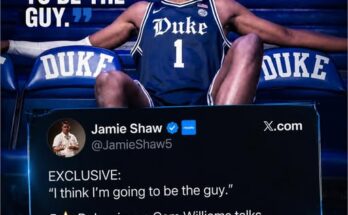
Reports that Duke’s top transfer portal target is seeking as much as $5 million have reignited the ever-intensifying conversation around the economics of modern college basketball. In an era defined by name, image, and likeness (NIL) opportunities and a transfer portal that has effectively reshaped roster construction, such a figure no longer sounds entirely implausible—even if it still raises eyebrows. The number itself is less important than what it represents: a new market reality in which elite players, especially proven ones with immediate impact potential, are commanding compensation that rivals or even exceeds that of some professional rookies overseas.
For Duke, a program that has historically thrived on recruiting elite high school talent and developing it within a structured system, the pursuit of a high-priced transfer signals a subtle but meaningful shift. The Blue Devils are not abandoning their traditional model, but they are clearly adapting. The transfer portal has become too influential to ignore, especially when rival programs are leveraging it to fill gaps quickly with experienced players. When a team with championship aspirations identifies a missing piece—whether it’s a scoring guard, a rim-protecting big, or a versatile wing—it often turns to the portal rather than waiting for a freshman to develop.
The reported $5 million asking price underscores just how valuable top-tier transfers have become. Unlike incoming freshmen, who are largely projecting potential, transfer players often come with a track record of performance at the college level. Coaches and general managers can evaluate their production, efficiency, and fit with far greater certainty. That level of predictability carries a premium, particularly for programs that believe they are one or two players away from contending for a national title.
At the same time, the figure raises questions about sustainability and competitive balance. Not every program has access to the kind of financial backing required to compete in this emerging marketplace. NIL collectives, boosters, and corporate partnerships have created a tiered system where certain schools can consistently outbid others for top talent. Duke, with its national brand and strong alumni network, is better positioned than most, but even it must weigh the cost against broader roster needs. Allocating a significant portion of resources to one player can limit flexibility elsewhere, making the evaluation process even more critical.
There is also the matter of locker room dynamics. When one player is reportedly earning several million dollars, it inevitably affects team chemistry. Coaches must navigate not only on-court roles but also the financial realities that players are increasingly aware of. Transparency, communication, and leadership become essential in maintaining cohesion. Veteran coaches often emphasize that winning cultures are built on shared sacrifice and accountability, values that can be harder to sustain when compensation levels vary so dramatically.
From the player’s perspective, the situation is equally complex. The opportunity to earn $5 million in college is unprecedented and, for many, life-changing. It reflects the growing recognition that college athletes generate significant revenue and deserve a share of it. However, it also places immense pressure on the player to perform at a level commensurate with that investment. Every game, every possession, and every decision will be scrutinized through the lens of that price tag. Expectations will be sky-high, and anything short of elite production may be viewed as a disappointment.
The broader implications extend beyond a single program or player. College basketball is in the midst of a structural transformation that shows no signs of slowing. The transfer portal has introduced a level of mobility that empowers players but challenges traditional notions of team building. NIL has added a financial dimension that was previously absent, creating opportunities but also complexities. Together, these forces are reshaping the sport in ways that are still being understood.
Critics argue that the current system lacks sufficient regulation and risks turning college athletics into a bidding war. They point to figures like $5 million as evidence that the line between amateur and professional sports has effectively disappeared. Supporters, on the other hand, contend that the market is simply correcting a long-standing imbalance. For decades, players generated billions in revenue without direct compensation. Now, they have the ability to capitalize on their value, and the market is determining what that value is.
For Duke, the decision to pursue such a high-profile and potentially expensive transfer will likely hinge on fit as much as cost. Talent alone is not enough; the player must align with the team’s style, culture, and goals. The coaching staff will need to assess how the player complements returning pieces, how he handles pressure, and how he contributes beyond the box score. In many ways, the evaluation process mirrors that of professional teams, which is perhaps the most telling sign of how much the landscape has changed.
The ripple effects of such a deal could be significant. If Duke—or any other program—successfully integrates a player with a $5 million NIL valuation and translates that into on-court success, it could set a precedent that others will follow. Conversely, if the investment does not yield the desired results, it may prompt a reevaluation of how resources are allocated. In either case, the outcome will be closely watched by coaches, administrators, and players across the country.
Recruiting strategies are already evolving in response to these dynamics. High school prospects are paying attention to the numbers being discussed in the portal, and it inevitably shapes their expectations. Some may choose to enter college with an eye toward transferring later, viewing the portal as a pathway to maximize their earning potential. Others may prioritize immediate NIL opportunities over long-term development. Programs must adapt to these shifting priorities while still building cohesive, competitive teams.
Another layer to consider is the role of agents and advisors. As NIL deals grow in size and complexity, players increasingly rely on representation to navigate the landscape. Negotiations that once revolved around playing time and development now include financial terms, brand partnerships, and contract structures. This professionalization of the college athlete experience brings benefits but also introduces new challenges, including the need for education and oversight.
The reported $5 million figure also highlights the growing importance of collective organizations that pool resources to support athletes. These groups often operate independently of the university, creating a parallel infrastructure that influences recruiting and retention. Their effectiveness can be a decisive factor in landing top talent, and their strategies vary widely from one program to another. For a school like Duke, leveraging these networks effectively is essential in competing at the highest level.
Despite the eye-popping numbers, it is worth remembering that not every player commands such a price. The vast majority of college athletes earn far less, and many still receive modest NIL deals relative to the headlines. The market is heavily concentrated at the top, where a small number of elite players drive much of the financial activity. This concentration raises questions about equity within teams and across the sport, but it also reflects broader economic patterns seen in professional leagues.
Ultimately, the situation underscores a fundamental truth: college basketball is no longer operating under its old model. The combination of player mobility and financial opportunity has created a new ecosystem, one that rewards adaptability and strategic thinking. Programs that can navigate this landscape effectively—balancing talent acquisition, financial resources, and team culture—will have a significant advantage.
For fans, the changes bring both excitement and uncertainty. The transfer portal has made the offseason more dynamic, with roster turnover and high-profile moves generating constant interest. At the same time, it can be harder to form long-term attachments to players who may only stay for a year. The introduction of large NIL deals adds another layer of intrigue, as fans track not only performance but also the business side of the sport.
As the story around Duke’s top transfer target continues to unfold, it serves as a snapshot of a broader تحول. Whether the reported $5 million figure proves accurate or not, the mere possibility of such a deal speaks volumes about where college basketball is headed. The sport is evolving rapidly, and with each new development, it moves further away from its traditional roots and closer to a model that resembles professional competition.
In that context, Duke’s pursuit is less about a single player and more about positioning itself in a changing landscape. The program’s willingness to engage at this level suggests a recognition that competing for championships now requires more than just elite recruiting and coaching. It demands a comprehensive approach that includes financial strategy, player management, and an understanding of a market that is still taking shape.
The coming months will provide more clarity, not only on this კონკრეტული recruitment but on the direction of the sport as a whole. For now, the reported asking price stands as a powerful symbol of the new era—one defined by opportunity, complexity, and a reimagining of what it means to be a college athlete.