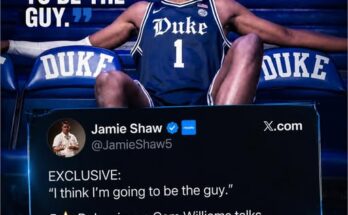
Cameron Boozer has officially arrived, and not quietly either. In a season filled with rising stars, breakout performances, and shifting expectations, Boozer didn’t just meet the hype—he overwhelmed it. Winning the 2026 Wooden Award as a freshman places him in an elite category, one reserved for players who don’t just adapt to college basketball but redefine it the moment they step onto the court. It’s not just about talent, because plenty of freshmen arrive with that. It’s about presence, composure, and the rare ability to dominate games while still learning the system. Boozer made it look like he’d been doing this for years.
From the very first game of the season, there was something different about him. You could see it in the way defenses reacted before he even touched the ball. Opponents adjusted their schemes, collapsed into the paint, and threw double teams early, all in an effort to disrupt his rhythm. It didn’t work. Boozer showed a level of patience and basketball IQ that felt far beyond his age. He wasn’t rushing shots, forcing plays, or chasing numbers. Instead, he let the game come to him, and when it did, he made the right decision almost every time. That’s what separated him—not just what he could do, but how and when he chose to do it.
There’s a physicality to Boozer’s game that immediately stands out. He plays with strength and balance, able to absorb contact and still finish with control. In the paint, he’s relentless, carving out space and using footwork that feels polished beyond his years. But what truly makes him dangerous is how he pairs that physical presence with finesse. He’s just as comfortable stepping out and hitting mid-range shots or facilitating from the high post as he is backing down defenders. That versatility forces opponents into impossible decisions—guard him tight and risk being driven past, or give him space and watch him knock down shots with ease.
Beyond the raw skills, there’s an emotional steadiness to Boozer that coaches dream about. Freshmen often ride waves—high highs and low lows—but Boozer maintained a consistent level of intensity and focus throughout the season. Even in hostile environments, with crowds trying to rattle him and defenders playing aggressively, he rarely looked fazed. It wasn’t arrogance; it was confidence rooted in preparation. He trusted his work, and it showed every time he stepped onto the floor.
What makes his Wooden Award win even more impressive is the level of competition he faced. College basketball this season was loaded with experienced upperclassmen, players who had spent years refining their craft and understanding the nuances of the game. For a freshman to rise above all of that, to not only compete but clearly stand out, says everything about Boozer’s impact. He wasn’t just good for a freshman—he was the best player in the country, period.
There were moments throughout the season that felt like turning points, games where Boozer seemed to elevate even further. Tight matchups where every possession mattered, where the pressure was at its highest—those were the games where he thrived. He didn’t shrink from the spotlight; he expanded into it. Big rebounds in traffic, clutch baskets late in games, smart defensive rotations—he consistently made winning plays. That’s the kind of impact that doesn’t always show up in highlight reels but wins respect from teammates and coaches alike.
Speaking of teammates, Boozer’s influence extended far beyond his individual performance. He made everyone around him better. Whether it was drawing defenders and creating open looks for shooters or communicating on defense to keep everyone aligned, he played with a team-first mentality that elevated the entire program. For someone with his level of talent, it would have been easy to focus on personal accolades, but that never seemed to be his priority. The Wooden Award is a reflection of his excellence, but it’s also a byproduct of how he approached the game—with unselfishness and purpose.
There’s also something to be said about the expectations he carried into the season. Boozer wasn’t an under-the-radar prospect; he came in with a spotlight already fixed on him. Every performance was scrutinized, every mistake magnified. That kind of pressure can weigh heavily on young players, but Boozer handled it with maturity. He didn’t try to silence critics with flashy plays or bold statements. Instead, he let his consistency do the talking. Game after game, he delivered, building a body of work that became impossible to ignore.
As the season progressed, the conversation around the Wooden Award began to shift. Early on, it was filled with a mix of veteran stars and emerging talents, but Boozer’s name kept climbing higher on the list. By the midpoint of the season, he wasn’t just in the conversation—he was leading it. Analysts began to point out his efficiency, his leadership, and his ability to impact both ends of the floor. It wasn’t hype anymore; it was recognition of something real.
Defense is often overlooked when discussing standout freshmen, but Boozer made it a central part of his identity. He wasn’t just scoring points; he was altering shots, grabbing rebounds, and switching onto different positions with ease. His awareness allowed him to anticipate plays before they developed, putting him in the right position time and time again. That defensive commitment added another layer to his game, making him one of the most complete players in college basketball.
There’s a certain energy that great players bring, something that can’t be measured by stats alone. Boozer had that. You could feel it in the arena when he was on the court. There was an anticipation, a sense that something important was about to happen. Fans leaned forward, teammates fed off his presence, and even opponents seemed to recognize that they were dealing with someone special. That kind of aura isn’t common, especially for someone so early in their career.
Winning the Wooden Award as a freshman places Boozer in rare company, and it inevitably leads to conversations about what comes next. The trajectory he’s on suggests a future filled with opportunities at the highest level of the game. But what makes his story compelling isn’t just where he’s going—it’s how he’s getting there. There’s a discipline and humility in his approach that suggests he’s not satisfied with what he’s already accomplished. If anything, this achievement feels like a starting point rather than a peak.
It’s also worth acknowledging the broader significance of his win. College basketball thrives on stories like this—players who come in and immediately make an impact, who bring excitement and elevate the level of competition. Boozer’s season has been one of those stories, the kind that draws attention and inspires younger players watching from afar. Seeing someone step into that spotlight and succeed at such a high level reinforces the idea that greatness isn’t just about experience; it’s about preparation, mindset, and execution.
As the celebrations begin and the award is officially his, there’s a sense that this moment will be remembered for a long time. Not just because a freshman won the Wooden Award, but because of how he did it. Boozer didn’t rely on one-dimensional excellence or short bursts of brilliance. He built his case over an entire season, game by game, play by play, showing a level of consistency that’s rare at any stage of a career.
The image of him holding that trophy feels fitting, almost inevitable in hindsight. It represents not just his individual journey but the countless hours of work that led to this point. Every practice, every adjustment, every challenge faced along the way—it all contributed to this moment. And while awards are never the sole measure of a player’s impact, this one feels particularly meaningful because it captures the essence of what Boozer brought to the game this season.
There’s no telling exactly what the future holds, but if this season is any indication, Cameron Boozer is just getting started. The Wooden Award is a milestone, a recognition of excellence that places him among the best, but it doesn’t define his limits. If anything, it expands them. The standard he’s set for himself is now incredibly high, and based on everything he’s shown so far, he’s more than capable of meeting it.
For now, though, it’s enough to appreciate what he’s done. A freshman stepping into college basketball and emerging as the best player in the country is something special. It doesn’t happen often, and when it does, it leaves a lasting impression. Boozer’s season will be remembered not just for the award at the end, but for the journey that led there—the performances, the growth, and the undeniable impact he made every time he took the court.