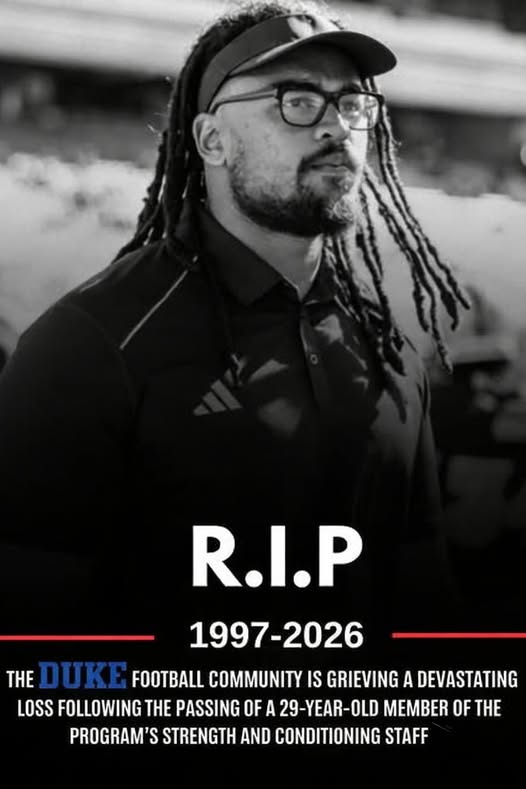
The Duke football community is grappling with an overwhelming sense of grief following the sudden and heartbreaking loss of a beloved member of its strength and conditioning staff, who has passed away at just 29 years old. The news has sent shockwaves through the program, leaving players, coaches, and colleagues struggling to come to terms with a tragedy that feels both sudden and deeply personal. For many within the team, this is not just the loss of a staff member, but the loss of a mentor, a motivator, and a friend whose presence had become an integral part of their daily lives.
According to those close to the situation, the young staff member had recently experienced a medical emergency that initially raised concerns but also sparked hope when he appeared to be recovering. In fact, he had even managed to return briefly to the sidelines, a moment that brought relief and optimism to those who had been worried about his condition. Seeing him back, even for a short time, reassured many that he was on the path to recovery. That is what makes the news of his passing all the more devastating. The sense that he was getting better, that he would soon be fully back doing what he loved, has only deepened the sorrow now felt across the Duke football family.
In response to the tragic news, Duke made the immediate decision to cancel all team activities. Practices were halted, meetings postponed, and the usual rhythm of the program was brought to a standstill. This pause was not just a logistical decision, but a necessary space for players and staff to process their emotions, reflect, and support one another during an incredibly difficult time. In moments like this, the game itself becomes secondary, as the human impact of loss takes precedence over competition and preparation.
Those who worked alongside him have spoken about the passion and energy he brought to his role every single day. Strength and conditioning coaches often operate behind the scenes, but their influence is profound. They are the ones who push athletes beyond their perceived limits, who instill discipline and resilience, and who help build not only physical strength but mental toughness. For many players, this staff member was a constant presence—someone who believed in them, challenged them, and celebrated their growth both on and off the field.
His colleagues describe him as someone who approached his work with genuine enthusiasm and care. He was known for his ability to connect with players, to understand their individual needs, and to motivate them in ways that felt personal and meaningful. Whether it was an early morning workout or a grueling training session, he brought an energy that lifted those around him. He wasn’t just instructing drills or tracking progress; he was building relationships, fostering trust, and helping shape the culture of the program.
For the players, the loss is particularly difficult. Many of them spent countless hours under his guidance, forming bonds that extended far beyond the weight room. He was someone they could talk to, lean on, and look up to. In the demanding world of college athletics, where pressures can be intense and expectations high, having someone who genuinely cares can make all the difference. His presence provided not only structure and accountability but also encouragement and support.
The emotional impact of his passing is being felt across all levels of the program. Coaches, who worked closely with him in developing training strategies and supporting athlete performance, are mourning the loss of a valued colleague. Support staff, who saw firsthand the dedication he brought to his role, are remembering the positive influence he had on the team environment. Even those who may not have interacted with him daily are feeling the weight of the loss, as his contributions were woven into the fabric of the program.
In a statement released by Duke, the university expressed its deep sorrow, saying, “The Duke Football family mourns this loss. Our thoughts are with everyone who knew and loved him.” While brief, the message reflects the collective grief being experienced by the entire community. It is a reminder that, beyond the structure of a football program, there is a family—one that shares not only victories and achievements but also moments of profound loss.
Tragedies like this often bring into sharp focus the fragility of life and the importance of cherishing every moment. For a young individual with so much potential and passion, the loss feels especially unfair. At 29, he was still in the early stages of what promised to be a meaningful and impactful career. Those who knew him believed he had a bright future ahead, not only in the world of athletics but in the lives he would continue to influence.
As the Duke football program begins to navigate this difficult period, there will undoubtedly be a process of healing that unfolds over time. Grief does not follow a straight path, and for many, the coming days and weeks will bring a mix of emotions—sadness, disbelief, reflection, and eventually, remembrance. The support systems within the team will play a crucial role, as players and staff lean on one another to cope with the loss.
In the midst of this sorrow, there is also a desire to honor his memory in meaningful ways. Whether through tributes, moments of silence, or carrying forward the values he embodied, the program will look for ways to ensure that his impact is not forgotten. Often, the legacy of someone like him lives on in the habits they instilled, the standards they set, and the lives they touched.
For the players, one of the most powerful ways to honor him may be through their continued dedication to the game and to each other. The lessons he taught—about perseverance, discipline, and teamwork—will remain with them long after this moment has passed. In this way, his influence endures, shaping not only their performance on the field but their character as individuals.
The broader college football community has also begun to take notice, with messages of support and condolences coming in from other programs, coaches, and fans. These expressions of sympathy serve as a reminder that, despite the competitive nature of sports, there is a shared humanity that connects everyone involved. Loss is something that transcends rivalries and records, bringing people together in empathy and understanding.
As more details emerge about the circumstances surrounding his medical emergency, there may be questions and discussions that follow. However, for now, the focus remains on mourning, remembering, and supporting those most affected. The immediate priority is ensuring that players and staff have the resources they need to cope with the emotional impact, including access to counseling and support services.
In times like these, it becomes clear that the true strength of a team is not measured solely by its performance on the field, but by how it comes together in moments of adversity. The Duke football program is now faced with one of its most difficult challenges, and how it responds will be a testament to the bonds that have been built within it.
The loss of a young life is always deeply painful, and when that life has touched so many others, the ripple effects are profound. For those who knew him, the memories will remain—moments of laughter, words of encouragement, shared मेहनत and অর্জন, and the countless small interactions that, together, formed a lasting connection. These memories will become a source of comfort, even as the pain of loss lingers.
As the days go on, there will be a gradual return to routine. Practices will resume, games will be played, and the season will continue. But things will not be exactly the same. There will be an empty space where he once stood, a reminder of what has been lost. At the same time, there will also be a renewed sense of purpose—to carry forward his spirit, to support one another, and to honor his memory through unity and resilience.
Ultimately, while his time was far too short, the impact he made in those 29 years is undeniable. He leaves behind not just a role that needs to be filled, but a legacy that cannot be replaced. The Duke football family will move forward, but it will do so with a piece of its heart forever changed, holding onto the memory of someone who gave so much to the people around him.