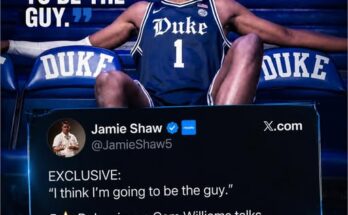
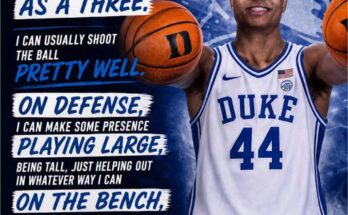
The spotlight around Duke basketball rarely dims, but in the current moment it feels particularly intense as questions swirl about the program’s next wave of talent and how it will shape the near future. Much of that attention has turned toward Isaiah Evans, a highly regarded prospect whose looming NBA decision is becoming one of the most closely watched storylines tied to the Blue Devils. The intrigue has only deepened following Cayden Boozer’s recent choice, which subtly but meaningfully shifted the conversation about roster construction, opportunity, and timing in Durham.
Evans arrives at this crossroads with considerable expectations already attached to his name. Known for his scoring instincts, length on the wing, and ability to create offense in multiple ways, he represents the modern archetype NBA teams covet. His shooting touch stretches defenses, while his fluidity and confidence allow him to operate both on and off the ball. For a Duke program that thrives on blending elite freshmen with returning contributors, Evans fits the mold of a player who could make an immediate impact while also projecting as a professional prospect.
Yet the question isn’t just about ability—it’s about timing. The modern college basketball landscape, shaped by NIL opportunities and evolving NBA draft evaluations, has made the decision-making process far more complex than it once was. For Evans, the calculus involves weighing immediate draft potential against the benefits of development, exposure, and refinement at the collegiate level. Duke has long been a proving ground for one-and-done stars, but it has also become a place where players can elevate their stock by embracing a larger role over time.
Cayden Boozer’s decision plays an important role in this equation. As another elite talent with strong ties to high expectations, Boozer’s path offered a reference point for how top prospects are approaching their futures. His choice signaled a willingness to prioritize fit, growth, and long-term trajectory over simply accelerating to the next level as quickly as possible. For Evans, that example doesn’t dictate his path, but it does add context. It highlights the idea that development is not linear and that strategic patience can sometimes yield better outcomes than an early leap.
Within Duke’s system, Evans would have the opportunity to showcase his versatility in a structured yet dynamic environment. The Blue Devils’ offense often emphasizes spacing, ball movement, and the ability to exploit mismatches—conditions that align well with Evans’ skill set. At the same time, the program’s defensive expectations would challenge him to expand his impact beyond scoring. NBA scouts consistently look for players who can contribute on both ends of the floor, and a season (or more) at Duke could provide Evans with the platform to demonstrate growth in areas such as perimeter defense, physicality, and decision-making.
There is also the matter of role clarity. One of the risks for any young prospect considering an early jump to the NBA is landing in a situation where opportunities are limited. For Evans, staying at Duke could mean stepping into a prominent role where he is not only featured but also entrusted with significant responsibility. That kind of experience can be invaluable, allowing a player to develop leadership qualities and a deeper understanding of the game. Conversely, declaring early might place him in a more uncertain position, where minutes and development opportunities are harder to predict.
The financial component cannot be ignored either. NIL has changed the landscape by providing college athletes with legitimate earning potential while they develop their game. For a player like Evans, whose profile already carries national recognition, the opportunity to build his brand at Duke could be significant. This adds another layer to the decision-making process, as the immediate financial incentive to turn professional is no longer as straightforward as it once was.
At the same time, the allure of the NBA remains powerful. The chance to compete at the highest level, to test one’s abilities against elite talent, and to begin a professional career is something many players dream about from a young age. For Evans, the question becomes whether his current trajectory positions him strongly enough in the eyes of NBA evaluators to make that leap worthwhile now, or whether additional time in college could elevate him into a more secure draft position.
Cayden Boozer’s situation underscores how individual these decisions are. While comparisons are inevitable, each player must assess their own readiness, circumstances, and goals. Boozer’s choice may have emphasized patience and development, but Evans’ path could just as easily lean in a different direction depending on how he and his advisors view his prospects. The key is finding the balance between ambition and preparedness—a balance that can ultimately shape the trajectory of a player’s career.
For Duke, the outcome of Evans’ decision carries broader implications. The program’s ability to attract and retain top talent is central to its continued success, and each high-profile decision contributes to its reputation among future recruits. If Evans chooses to stay and thrive, it reinforces the idea that Duke is not just a stepping stone but a destination where players can grow and maximize their potential. If he opts for the NBA, it highlights the program’s role as a launching pad for elite talent ready to take the next step.
Fans, of course, have their own perspectives. Some are eager to see Evans don a Duke jersey and make an immediate impact, envisioning highlight-reel performances and deep tournament runs. Others understand the pull of the NBA and the personal considerations that come with such a decision. In many ways, this tension reflects the broader dynamics of modern college basketball, where the line between amateur and professional aspirations is increasingly blurred.
As the decision looms, the conversation around Evans will continue to evolve. Evaluators will dissect his strengths and areas for improvement, projecting how his game might translate to the next level. Analysts will debate the merits of staying versus leaving, often with differing conclusions. Through it all, Evans remains at the center of the narrative, navigating a pivotal moment that will shape not only his immediate future but also his long-term career.
What stands out most is the sense of possibility. Whether at Duke or in the NBA, Evans has the tools to carve out a meaningful path. His scoring ability, physical profile, and competitive mindset provide a strong foundation, but the next step will be about refining those attributes and applying them consistently against high-level competition. The environment he chooses—college or professional—will play a significant role in how that development unfolds.
In the end, there is no universally correct answer, only the one that aligns best with Evans’ goals and circumstances. The influence of Cayden Boozer’s decision adds an interesting layer to the discussion, but it does not define it. Instead, it serves as a reminder of the diverse paths available to today’s top prospects and the importance of making a choice that reflects both ambition and readiness.
As the basketball world waits for clarity, the focus remains on what Evans could become. His decision will mark the next chapter in his journey, but it will also contribute to the ongoing narrative of Duke basketball and its place in the evolving landscape of the sport. Whether he stays to develop further in Durham or takes the leap to the NBA, the attention surrounding him is unlikely to fade. If anything, it will only intensify, following him as he continues to chase the potential that has already made him one of the most compelling young players to watch.