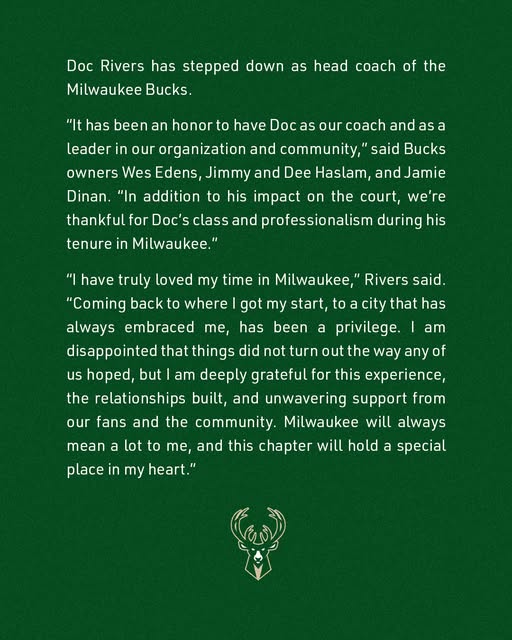
The world of professional basketball is a landscape of constant change, evolution, and surprises. Coaches come and go, each leaving their mark in unique ways, shaping teams, careers, and the sport itself. Recently, the announcement that Doc Rivers has resigned as head coach of the Milwaukee Bucks has sent ripples throughout the basketball community. This decision marks the end of a chapter for one of the most respected coaches in the NBA, and it prompts reflection on his journey, accomplishments, challenges, and what lies ahead.
This essay aims to explore in depth the significance of Rivers’s resignation, providing a comprehensive overview of his coaching career, his impact on the teams he led—including the Milwaukee Bucks—and the broader implications for the franchise and the league.
1. The Early Life and Playing Career of Doc Rivers
1.1. Childhood and Playing Career
Born on October 13, 1961, in Chicago, Illinois, Doc Rivers, whose full name is Glenn Anton Rivers, grew up in a basketball-loving family. His father, a police officer, instilled discipline and a love for the game early on. Rivers attended Proviso East High School in Maywood, Illinois, where he showcased his talent and leadership qualities.
He played college basketball at Marquette University, where he distinguished himself both as a player and a leader. As a point guard, Rivers was known for his basketball IQ, court vision, and leadership—traits that would later define his coaching style.
1.2. NBA Playing Career
Drafted in the 1983 NBA Draft by the Atlanta Hawks, Rivers’s playing career spanned over a decade, with stints at several teams including the Atlanta Hawks, Los Angeles Clippers, New York Knicks, and San Antonio Spurs. Though never a superstar, Rivers was a reliable role player, known for his passing, defense, and leadership on the court.
His playing career laid a strong foundation of understanding team dynamics, the importance of leadership, and the nuances of game strategy—all qualities he would carry into his coaching career.
2. Transition to Coaching: From Player to Leader
2.1. Early Coaching Roles
After retiring from playing, Rivers transitioned into coaching, initially serving as a youth coach and then moving into assistant coaching roles. His first head coaching opportunity came with the Orlando Magic in 2000, marking his entry into the NBA head coaching ranks.
2.2. Rise to Prominence
Rivers quickly gained recognition for his strategic acumen, leadership, and ability to develop players. His coaching style emphasized defense, teamwork, and mental toughness—principles he had cultivated during his playing days.
3. Coaching Career Highlights
3.1. Orlando Magic (2000–2003)
Rivers’s first NBA head coaching job was with the Orlando Magic. Though his tenure was marked by efforts to rebuild the team, it laid the groundwork for his coaching philosophy. His ability to manage young players and instill discipline earned him respect within the league.
3.2. Boston Celtics (2004–2013)
Rivers’s most notable coaching stint was with the Boston Celtics. Hired in 2004, he inherited a team in turmoil but quickly transformed it into a championship contender. Under his leadership, the Celtics secured an NBA championship in 2008, ending an 22-year title drought.
His tenure with Boston was characterized by:
Building a resilient, defense-minded team.
Developing young talent like Paul Pierce and Ray Allen.
Navigating injuries and roster changes.
Cultivating a strong team culture.
Rivers’s ability to motivate and strategize earned him NBA Coach of the Year honors in 2000 and widespread respect.
3.3. Los Angeles Clippers (2013–2020)
In 2013, Rivers took over the Los Angeles Clippers, turning around a franchise that had struggled for consistency. His leadership transformed the Clippers into perennial playoff contenders, often leading the team deep into the postseason.
During his Clippers tenure, he:
Managed high-profile stars like Chris Paul, Blake Griffin, and DeAndre Jordan.
Fostered a competitive and disciplined team culture.
Led the Clippers to multiple playoff runs, including a trip to the Western Conference Finals in 2014.
While a championship eluded him, Rivers’s impact on the Clippers was profound, establishing them as a consistent playoff team.
3.4. The Milwaukee Bucks (2020–2023)
In 2020, Rivers became the head coach of the Milwaukee Bucks, inheriting a team led by Giannis Antetokounmpo. His arrival was seen as a move to bring experience, discipline, and strategic insight to a franchise hungry for success.
During his tenure, Rivers faced the challenge of maximizing Giannis’s talents, integrating veteran players, and navigating the pressures of championship contention.
4. Rivers’s Coaching Philosophy and Style
4.1. Defensive Focus
One of Rivers’s hallmark traits is his emphasis on defense. His teams are known for their disciplined, tenacious approach to stopping opponents, which often becomes the foundation of their success.
4.2. Leadership and Player Development
Rivers’s leadership style combines accountability with support. He is known for his ability to motivate players, adapt strategies to their strengths, and foster a unified team culture.
4.3. Strategic Flexibility
Throughout his career, Rivers has demonstrated tactical flexibility—adjusting game plans based on opponent strengths, game situations, and personnel.
5. The Impact of Rivers’s Resignation on Milwaukee
5.1. The Context of the Resignation
Rivers’s decision to step down as head coach of the Bucks marks a significant turning point for the franchise. It comes amid high expectations, a competitive roster, and a desire to contend for an NBA championship.
While the specifics of the resignation are not publicly detailed, it is often a culmination of factors such as team performance, personal considerations, and future ambitions.
5.2. Immediate Reactions
The basketball community has reacted with respect and curiosity. Many acknowledge Rivers’s contributions in elevating the Bucks, his leadership qualities, and the void his departure leaves.
5.3. Future Directions for the Bucks
The Bucks now face the challenge of finding a new head coach capable of maintaining the team’s competitive edge, developing young talent, and possibly elevating their championship aspirations.
6. Reflecting on Rivers’s Legacy
6.1. Achievements and Contributions
Four-time NBA Coach of the Year finalist.
NBA Championship with the Boston Celtics in 2008.
Multiple deep playoff runs with the Clippers.
Known for his resilience, leadership, and tactical acumen.
6.2. Impact on Players
Rivers has mentored numerous players, helping to unlock their potential and foster leadership qualities. His influence extends beyond X’s and O’s to shaping the mental toughness of his teams.
6.3. Broader Influence on the League
Rivers’s coaching philosophy and success have made him a respected figure league-wide, influencing coaching styles and team cultures.
7. The Future of Doc Rivers
7.1. Potential Opportunities
Rivers’s coaching acumen and experience make him a highly sought-after candidate for future coaching positions. Whether he takes a hiatus or joins another franchise, his next move will be closely watched.
7.2. Beyond Coaching
Rivers may also explore roles in broadcasting, mentorship, or basketball administration, leveraging his extensive knowledge of the game.
7.3. Personal and Professional Goals
Having achieved significant milestones, Rivers might focus on personal growth, family, and contributing to the sport’s development in other capacities.
8. Broader Implications for the NBA
8.1. Coaching Turnover and League Dynamics
Rivers’s departure highlights the volatility and high stakes of NBA coaching careers. It underscores the importance of strategic leadership in building successful teams.
8.2. The Role of Leadership and Culture
His resignation prompts teams to evaluate how leadership, culture, and coaching philosophies influence sustained success.
8.3. The Significance of Experience
Rivers’s career exemplifies how experience, resilience, and adaptability are crucial in navigating the complexities of professional basketball.
9. A Legacy of Leadership and Resilience
The resignation of Doc Rivers as head coach of the Milwaukee Bucks marks the end of an impactful chapter not only for him but also for the franchise and the league. His journey from a player to one of the most respected coaches in NBA history reflects a life dedicated to the sport and to fostering excellence.
Throughout his career, Rivers has been celebrated for his leadership, tactical intelligence, and ability to inspire teams to perform at their best. His contributions have left an indelible mark on every team he’s coached, and his influence will be felt for years to come.
While his departure from the Bucks closes a chapter, it opens new opportunities—either for Rivers to take on new challenges or for the franchise to seek fresh leadership. Whatever the future holds, Doc Rivers’s legacy as a resilient, strategic, and inspiring figure in basketball is secure.
In the grand narrative of NBA history, his story exemplifies perseverance, leadership, and unwavering dedication—traits that continue to inspire players, coaches, and fans alike.