Under the fading glow of stadium lights and the lingering tension of a hard-fought rivalry game, what should have been a routine postgame cool-down instead spiraled into chaos. The latest clash between Duke and Boston College on the baseball diamond ended not with handshakes and quiet exits, but with a violent, emotional brawl that stunned players, coaches, and the few remaining spectators who hadn’t yet filed out.
Moments earlier, the final out had been recorded—an exclamation point on a game already thick with intensity. Throughout the matchup, both sides had played with an edge that hinted at something deeper than just conference standings. Inside pitches had been exchanged, batters had stared down pitchers a second too long, and dugouts had chirped back and forth in a steady stream of barely contained hostility. It was the kind of game where every small moment felt personal.
As the teams began the customary postgame process, the tension didn’t dissipate—it sharpened. A glance turned into words, words turned into shouting, and within seconds, the thin line separating competitive fire from outright confrontation snapped.
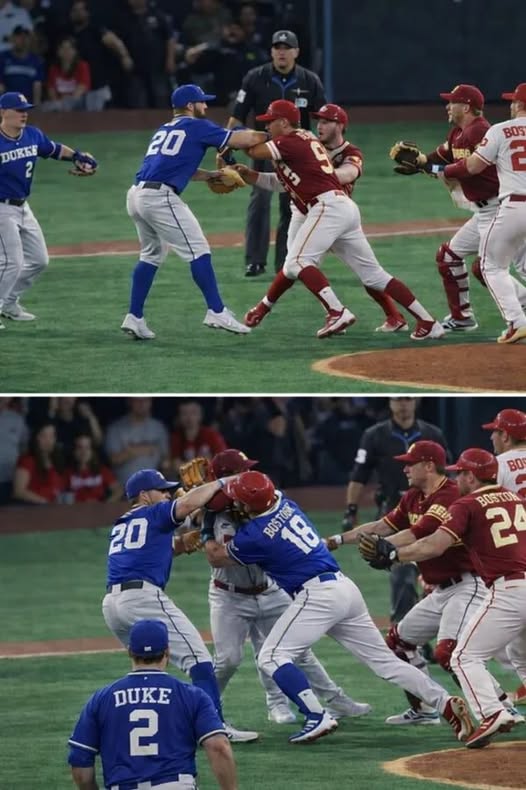
It started near the first-base line. A Duke player, still amped from the final inning, reportedly exchanged heated words with a Boston College opponent. Teammates from both sides quickly converged—not to diffuse the situation, but to defend their own. What followed was a sudden surge of bodies, voices, and adrenaline.
Players shoved, helmets flew, and gloves hit the dirt as the confrontation escalated. The scene turned into a chaotic swirl of uniforms as punches were thrown and players grappled with one another. Some tried to pull teammates away, but others charged in, unwilling to back down. The dugouts emptied almost instantly, with both benches sprinting onto the field.
Coaches rushed in behind them, some shouting for restraint, others physically inserting themselves between players to break things up. Their efforts were frantic but determined, as they tried to restore order amid the confusion. Umpires, who moments earlier had been focused on balls and strikes, now found themselves attempting to manage a full-scale melee.
From the stands, the reaction was a mix of shock and disbelief. A few fans pulled out phones, capturing footage of the incident, while others simply stood frozen, watching as the situation unfolded. The energy in the ballpark had shifted dramatically—from competitive excitement to something far more volatile.
The brawl itself lasted only a few minutes, but it felt much longer. Gradually, through the combined efforts of coaches, staff, and players who managed to regain composure, the mass began to break apart. Individuals were separated, tempers slowly cooled, and the shouting gave way to heavy breathing and lingering glares.
Even as order was restored, the damage had been done. Players from both teams were escorted back toward their respective dugouts, some still visibly shaken, others clearly still simmering with frustration. Equipment lay scattered across the field—a visual reminder of how quickly things had unraveled.
In the aftermath, questions immediately began to surface. What exactly triggered the initial confrontation? Had tensions been building throughout the game, or even prior to it? Rivalries in college sports are nothing new, but this incident seemed to cross a line that few expect—or want—to see.
Observers pointed to several moments during the game that may have contributed to the explosion. There were close pitches that nearly hit batters, aggressive slides into bases, and verbal exchanges that hinted at unresolved animosity. In isolation, each incident might have been dismissed as part of the game’s competitive nature. Taken together, they formed a combustible mix.
For the players involved, the emotions were likely complex. Baseball, often seen as a measured and strategic sport, can still ignite intense passion. When pride, rivalry, and adrenaline collide, the result can be unpredictable. In this case, that unpredictability turned into a very public and very physical confrontation.
Coaches from both programs faced the immediate challenge of regaining control—not just in the moment, but in the hours and days that would follow. Discipline, accountability, and reflection would become the focus as they worked to address what had happened. Incidents like this don’t just affect those directly involved; they ripple outward, impacting team culture, program reputation, and the broader perception of the sport.
Officials were expected to review the situation thoroughly. Video footage from multiple angles, along with reports from umpires and staff, would help determine any disciplinary actions. Suspensions, fines, or other penalties often follow such incidents, particularly when they involve physical altercations.
For fans and analysts, the brawl sparked debate about the nature of rivalry and the boundaries of competitive behavior. Some argued that passion is an essential part of sports—that the intensity seen on the field is what makes these matchups compelling. Others countered that there’s a clear line between passion and loss of control, and that this incident crossed it decisively.
Social media quickly amplified the story. Clips of the altercation circulated widely, drawing reactions from across the sports world. Some viewers expressed disappointment, calling the scene unnecessary and damaging. Others focused on the underlying tension that led to the moment, suggesting that the signs had been there all along.
Lost in the spectacle, however, was the game itself—a contest that, by most accounts, had been competitive and hard-fought. The players’ performances, the strategic decisions, and the athletic moments that defined the matchup were overshadowed by the closing chaos. It was a reminder of how quickly narratives can shift.
For the athletes, the incident will likely linger. College players are still developing not just their skills, but also their ability to manage high-pressure situations. Moments like this become part of that learning process, however difficult or public they may be.
In the days ahead, both teams would need to regroup. Practices would take on a different tone, with an emphasis on discipline and composure. Conversations within locker rooms would likely be candid, addressing not only what happened but how to prevent it from happening again.
Rivalries, by their nature, are built on emotion. They bring out the best—and sometimes the worst—in competitors. When managed well, that intensity fuels memorable performances and dramatic moments. When it spills over, as it did here, it can overshadow everything else.
The hope, moving forward, is that this incident serves as a turning point rather than a defining feature. That players and coaches alike can channel their competitive fire into the game itself, rather than allowing it to erupt beyond it.
As the stadium lights eventually dimmed and the field was cleared, the echoes of the confrontation lingered. What had started as a baseball game ended as something far more chaotic—a stark reminder of how quickly control can be lost when emotions run high.
And while the final score will be recorded in the standings, it’s the images of that postgame brawl that will remain etched in memory, prompting reflection on the fine line between rivalry and restraint.