The air outside the stadium still carried the energy of the game, that electric mix of adrenaline, disappointment, and celebration that lingers long after the final out. Fans streamed out in clusters, some buzzing with excitement, others muttering about missed opportunities and what could have been. The scoreboard result was still fresh in everyone’s mind: Duke had just delivered a commanding 12–2 victory over No. 12 USC, ending the contest early with a 7-inning run-rule decision. For Duke supporters, it was the kind of win that fuels confidence and pride. For others, especially those with loyalties tied elsewhere, it stung.
It was in that emotionally charged atmosphere that things began to unravel.
At first, nothing seemed out of the ordinary. Groups of fans lingered around the stadium exits, some snapping photos, others debating key plays from the game. A few vendors were still trying to sell the last of their merchandise, calling out half-heartedly as the crowd thinned. But near one corner of the parking area, voices began to rise above the general noise. It started as a disagreement—sharp words exchanged between two individuals who, moments earlier, had likely been strangers brought together only by their shared presence at the game.
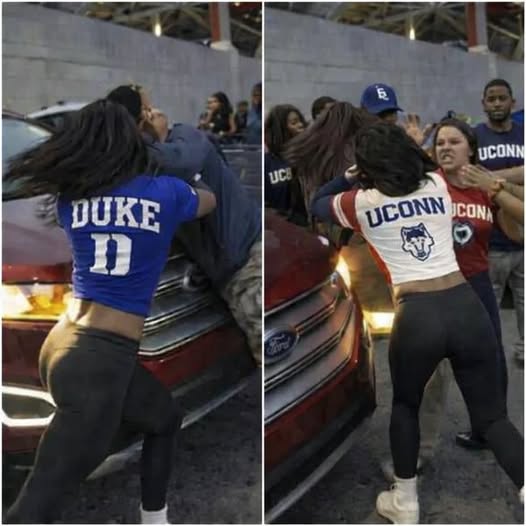
One was identified as a Duke supporter, still wearing team colors, clearly energized by the dominant performance he had just witnessed. The other, a fan connected to the UConn program, seemed equally passionate, though his frustration was more evident. What began as a verbal back-and-forth quickly drew attention. Nearby fans slowed their pace, sensing the tension. Some tried to ignore it, while others instinctively drifted closer, curiosity taking over.
The argument itself was difficult to follow in its early moments. It appeared to revolve around more than just the game that had just ended. There were references to past matchups, to rankings, to perceived disrespect between programs. Voices grew louder, sharper, more personal. Each man seemed determined not to back down, their words escalating from playful jabs into pointed insults.
A small circle began to form, as onlookers gathered at a cautious distance. Some pulled out their phones, anticipating that something unusual might happen. Others attempted to defuse the situation, offering half-hearted suggestions to “just let it go” or “walk away.” But those efforts barely registered. The two men were locked in, their focus narrowed entirely on each other.
Then came the moment when everything shifted.
A shove—sudden, forceful—broke whatever thin line had remained between argument and action. It was enough to ignite the situation instantly. The second fan responded almost immediately, pushing back with equal intensity. What followed was a rapid escalation that left the surrounding crowd stunned. The confrontation turned physical, and within seconds, the two were grappling, their movements fueled by a mix of anger and adrenaline.
Gasps rippled through the crowd. Some people stepped back quickly, creating more space, while others edged closer despite the obvious risk. A few voices rose above the chaos, urging them to stop, but the pleas were drowned out by the noise of the scuffle. The altercation was chaotic, unpredictable—more intense than anyone nearby had expected when the argument first began.
It wasn’t just the physicality of the fight that caught people off guard; it was the sheer intensity. Both individuals seemed fully committed, neither willing to yield. Their movements were erratic, driven more by emotion than control. At one point, they stumbled, nearly falling to the ground before regaining their footing and continuing. The unpredictability of it all added to the sense of disbelief among those watching.
Some bystanders began to intervene, cautiously at first. A few stepped forward, arms outstretched, trying to separate the two. Others shouted more forcefully now, their voices carrying urgency. It took multiple attempts before anyone could make a meaningful impact. Even then, separating them proved difficult, as each tried to break free and continue the confrontation.
Eventually, with enough people involved, the two were pulled apart. They were held at a distance, still shouting, still visibly agitated. The energy hadn’t dissipated; it had merely been contained. Those closest to them worked to keep them separated, acting as a barrier while others called for security.
The aftermath was just as striking as the altercation itself. The crowd, once animated by curiosity, now buzzed with a different kind of energy—one of disbelief and reflection. Conversations erupted in every direction, with people recounting what they had just seen, each version slightly different depending on where they had been standing.
For some, the incident was a shocking reminder of how quickly emotions can spiral out of control. What began as a disagreement between fans had escalated into something far more serious in a matter of moments. For others, it was a cautionary tale about the intensity of sports culture, where passion can sometimes cross a line.
Security personnel arrived shortly after, taking control of the situation. The two individuals were kept apart and escorted away, though their frustration was still evident. Questions lingered about what might happen next—whether there would be consequences, whether the incident would have any lasting impact beyond the immediate moment.
As the crowd slowly dispersed, the energy around the stadium shifted again. The earlier excitement of Duke’s decisive victory had been overshadowed, at least temporarily, by the altercation. Conversations that might have centered on standout performances or key plays now revolved around what had happened outside the gates.
Yet, in many ways, the incident reflected something deeper about the nature of sports fandom. The same passion that fuels celebration can, under the right—or wrong—circumstances, lead to conflict. Rivalries, pride, and emotional investment all play a role, creating an environment where reactions can become amplified.
Most fans, of course, never cross that line. They celebrate, they debate, they engage in spirited discussions, but they ultimately maintain a sense of perspective. Moments like this stand out precisely because they are exceptions, not the norm. They serve as reminders of how important it is to keep that perspective intact, even in the heat of the moment.
In the hours that followed, clips of the altercation began to circulate, captured by those who had pulled out their phones at the first sign of trouble. Each angle told a slightly different story, but the core of it remained the same: a heated exchange that escalated into something far more intense than anyone had anticipated.
Reactions varied widely. Some viewers expressed shock, others frustration, and a few even attempted to downplay it as an isolated incident. But for those who had been there in person, the memory was more vivid. They had felt the tension build, had seen the moment it tipped over, had experienced firsthand the sudden shift from argument to chaos.
As the day gave way to evening, the stadium area returned to normal. The crowds thinned, the vendors packed up, and the echoes of both the game and the altercation began to fade. What remained were the stories—shared, retold, and gradually shaped by perspective.
Duke’s dominant performance on the field deserved attention, and for many, it still held that place. A 12–2 run-rule victory over a ranked opponent is no small feat, and it spoke to the team’s strength and execution. But the events outside the stadium added an unexpected layer to the day, one that would likely be remembered alongside the game itself.
In the end, the altercation served as a stark reminder of how quickly things can change. A celebration can turn into a confrontation, a disagreement into a fight. It highlighted the importance of self-control, of recognizing when to step back rather than push forward.
For those who witnessed it, the scene would not be easily forgotten. The raised voices, the sudden escalation, the efforts to intervene—it all combined into a moment that stood out sharply against the backdrop of an otherwise routine game day.
And as the story continued to spread, it carried with it a simple but powerful message: passion is a defining part of sports, but without balance, it can lead to moments that overshadow everything else.