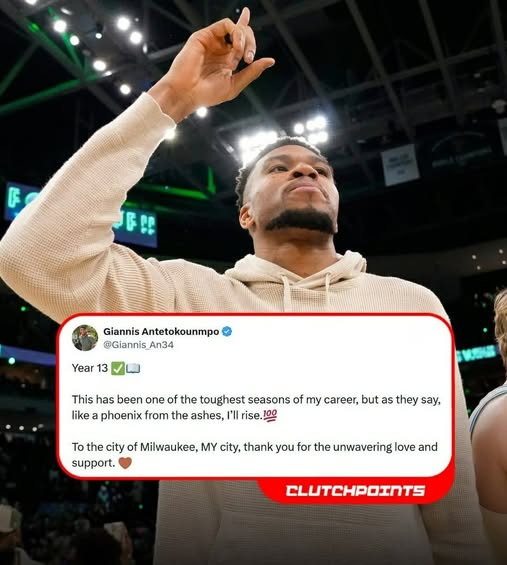
Giannis Antetokounmpo calling Milwaukee “my city” isn’t just a soundbite, and it isn’t something you can fake for headlines or contracts. It carries the weight of years that didn’t always look like they would lead to banners or MVP trophies, years that tested loyalty in ways most superstar narratives never really have to confront. When he says it, it feels less like ownership and more like belonging, like a relationship that grew slowly, stubbornly, and sometimes painfully, until it became something unshakable.
It’s easy now, in hindsight, to wrap everything in a neat story about destiny. A young player arrives, works relentlessly, becomes one of the best in the world, delivers a championship, and declares his love for the city that believed in him. But real life rarely moves that cleanly. Milwaukee wasn’t supposed to be the center of the basketball universe. It wasn’t the market that attracts instant glamour or guarantees patience. And Giannis wasn’t supposed to become this version of himself so quickly, or maybe even at all, depending on who you asked back then.
What makes his words resonate is everything that came before them. The early years when he was still figuring out the league, still learning what his body could do, still adjusting to a life that had changed almost overnight. The losses that stacked up, the playoff exits that raised uncomfortable questions, the whispers that grew louder each season he didn’t win it all. In a different story, those whispers turn into movement. A star leaves. A city understands but never really gets over it. The cycle repeats somewhere else.
But that didn’t happen here.
Instead, something slower and more deliberate took shape. There was a kind of mutual investment that doesn’t always exist in modern sports. Milwaukee didn’t just cheer for Giannis when things were good; it grew with him, defended him, and sometimes demanded more from him. And Giannis, for his part, didn’t treat the city as a temporary stop on a larger journey. He leaned into it. He stayed. He built something that felt rooted rather than rented.
That’s why “my city” lands differently. It doesn’t sound like branding. It sounds like someone who has lived the full arc of a place’s expectations, frustrations, and hopes. Someone who understands what it means for a smaller market to dream big and to fear, quietly, that those dreams might eventually be taken elsewhere.
There’s also something deeply human about the way that connection has evolved. It wasn’t instant love. It couldn’t have been. There were cultural differences, personal adjustments, and the simple reality of being young and far from everything familiar. Over time, though, familiarity turned into comfort, and comfort turned into pride. Not just pride in what he accomplished there, but pride in being associated with the place itself.
You can see it in the way he talks about Milwaukee, like it’s part of his identity rather than just the location of his job. That kind of language usually comes after long histories, after shared experiences that go beyond wins and losses. It comes after moments where leaving might have been easier, or at least more conventional, and choosing to stay required a different kind of mindset.
And that’s where the story starts to feel unfinished in the most compelling way. Because even after the championship, even after the individual accolades, there’s still a sense that the relationship hasn’t reached its final chapter. Not in a forced, narrative-driven sense, but in the way that real bonds rarely have clear endpoints. They evolve. They deepen. They get tested again.
The league around him keeps shifting. New contenders rise, old ones reshape themselves, and the pressure to win never really fades. Each season brings new questions, new challenges, new reasons for outsiders to speculate about what might come next. That’s just part of being at his level. But inside that noise, the core of his connection to Milwaukee seems to hold steady.
There’s something almost defiant about that steadiness. In an era where movement is often framed as ambition and staying can be misread as complacency, Giannis has carved out a different interpretation. Staying, in his case, isn’t about settling. It’s about building. It’s about proving that greatness doesn’t have to follow a predetermined path through the biggest markets or the most convenient superteam formations.
That doesn’t mean it’s always been smooth. No meaningful relationship ever is. There have been disappointments that lingered longer than expected, moments where the future felt uncertain, stretches where the weight of expectations pressed down harder than anyone would openly admit. Through all of that, though, the foundation didn’t crack. If anything, it seemed to absorb those pressures and come out stronger.
You can sense that resilience in the way he frames things now. “My city” isn’t a claim of perfection. It’s a recognition of everything that has been weathered together. It’s an acknowledgment that the ups and downs are part of what makes the connection real in the first place. Without them, the victories wouldn’t carry the same meaning.
And maybe that’s why it still feels like there’s more to come. Not necessarily in the sense of needing another championship to validate anything, but in the sense that stories like this tend to keep unfolding in unexpected ways. There are always new layers to add, new challenges to navigate, new moments that redefine what the relationship looks like.
Fans can feel that, too. There’s a different kind of energy when the bond between a player and a city feels authentic. It changes the way games are experienced, the way setbacks are processed, the way hope is sustained. It creates a shared narrative that extends beyond any single season.
For Giannis, that narrative is already rich with meaning, but it isn’t closed. Every time he steps on the court in Milwaukee, there’s a continuation of something that started long before the spotlight found him. Every interaction, every statement, every reminder that this is still “his city” adds another layer to a story that refuses to be reduced to a single defining moment.
In a league that often moves at a relentless pace, where the next storyline quickly replaces the last, there’s something grounding about that kind of continuity. It reminds people that not everything has to be transient, that some connections are worth investing in over the long term, even when the path isn’t straightforward.
So when he says those words, it doesn’t feel like the end of anything. If anything, it feels like a checkpoint, a pause in a journey that still has distance left. There’s an understanding that whatever comes next, it will be shaped by the same commitment that got them here in the first place.
And that’s what keeps the intrigue alive. Not just the possibility of more success, but the certainty that whatever happens will be part of a story built on something real. A story where “my city” isn’t just a phrase, but a reflection of years spent growing into something that neither side wants to let go of anytime soon.