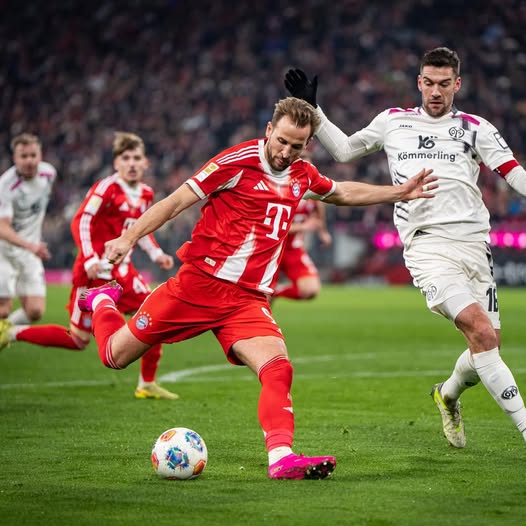
Harry Kane’s latest strike against Mainz 05 did more than add another goal to Bayern Munich’s relentless march through the season; it carved his name into a new chapter of his own career history. With that finish, Kane reached 50 goals for FC Bayern in the 2025 calendar year, a landmark he had never previously touched at club level. For a player whose career has been defined by consistency, reliability, and an almost mechanical relationship with the back of the net, the fact that this is his first time reaching such a figure in a single calendar year only underlines the extraordinary nature of what he is producing in Munich. When club and country are combined, his tally rises to 59 goals in 2025, a number that places him firmly among the most prolific footballers on the planet this year, and with one final match against Heidenheim still to come, the sense is that the story may not yet be finished.
What makes this achievement resonate so deeply is the context of Kane’s journey. For years at Tottenham Hotspur, he was the embodiment of loyalty, excellence, and individual brilliance often fighting against the limitations of circumstance. He won Golden Boots, broke club records, and became England’s all-time leading scorer, yet the defining team honours remained elusive. His move to Bayern Munich was therefore about more than just a change of scenery; it was about aligning his prime years with a club built to dominate domestically and compete relentlessly for European glory. The goals have flowed almost immediately, but 2025 has taken that output to a level even his most ardent supporters might not have confidently predicted.
Scoring 50 goals in a calendar year for a single club is not simply about talent; it is about adaptation, durability, and a ruthless mentality that refuses to plateau. Kane has had to integrate into a new league, a new culture, and a new tactical environment, all while carrying the weight of expectation that comes with being Bayern Munich’s marquee striker. The Bundesliga is often described as striker-friendly, but that label can oversimplify the challenge. Defenders are aggressive, transitions are fast, and the physical demands are unrelenting. Kane has not just survived in this environment; he has mastered it, bringing his trademark intelligence, finishing variety, and playmaking instincts into a system that amplifies his strengths.
The goal against Mainz 05 was emblematic of Kane’s Bayern era. It was not merely about the final touch, but about his positioning, his anticipation, and his calm under pressure. Time and again this year, he has shown that his goals are not accidents or moments of chaos, but the product of a striker who reads the game several steps ahead. Whether it is a penalty struck with icy composure, a first-time finish inside the box, a header that seems to defy gravity, or a long-range effort that catches a goalkeeper off guard, Kane’s 50 goals have come in almost every conceivable form. That variety is part of what makes this milestone so impressive; opponents know what he wants to do, yet stopping him remains another matter entirely.
Reaching 50 club goals in 2025 also speaks to Kane’s physical and mental conditioning. Modern football is unforgiving, with congested calendars, constant travel, and minimal recovery time. Injuries have derailed many prolific careers, but Kane has managed to maintain a level of availability and sharpness that allows him to keep scoring week after week. His professionalism, attention to detail, and understanding of his own body have been crucial. At 31, an age where some strikers begin to show signs of decline, Kane appears to be refining his game, becoming more efficient rather than less dangerous.
When the international dimension is added, the scale of his year becomes even clearer. Fifty-nine goals in all competitions for club and country in 2025 is an elite-level return by any standard. For England, Kane remains the focal point, the leader, and the reference point around which the attack revolves. His goals for the national team this year have carried the same hallmarks as his club form: authority, composure, and a sense of inevitability. Balancing the demands of Bayern Munich and England has never dulled his edge; if anything, the confidence gained in one arena seems to fuel his performances in the other.
There is also a historical dimension to consider. Bayern Munich is a club defined by legendary forwards, from Gerd Müller to Robert Lewandowski, players whose names are synonymous with goal-scoring excellence. To reach 50 goals in a calendar year places Kane in a conversation that is both flattering and daunting. Comparisons are inevitable, but Kane’s achievement stands on its own merits. He is not trying to replicate anyone else’s legacy; he is building his own, shaped by his unique blend of English grit and continental polish. His ability to drop deep, link play, and still arrive in the box at precisely the right moment adds layers to Bayern’s attack that go beyond raw numbers.
The psychological impact of this milestone cannot be overlooked either. Strikers live on confidence, and each goal reinforces the belief that the next one will come. Reaching 50 removes a barrier, a psychological threshold that, once crossed, often opens the door to even greater freedom. Kane now plays without the weight of chasing that number; instead, he plays to extend it, to see how far he can push the limits of his own output. With one match left in the calendar year against Heidenheim, there is a tangible sense of anticipation. Another goal would not just pad the statistics; it would symbolize momentum carried into the next phase of the season and beyond.
The broader implications for Bayern Munich are equally significant. A striker in this kind of form elevates the entire team. Defenders are drawn to Kane, creating space for wingers and midfield runners. Opponents alter their game plans, often focusing so heavily on containing him that other threats are allowed to flourish. Kane’s presence has a gravitational pull, and his goals are both a cause and a consequence of Bayern’s attacking fluidity. The 50-goal mark is therefore not just a personal accolade; it is a reflection of a symbiotic relationship between player and club.
There is also an emotional resonance to this achievement for Kane himself. For years, critics questioned whether he could translate his Premier League dominance to a different environment, whether he could thrive outside England, and whether he could be the leading man at a club with Bayern’s expectations. The answer, delivered emphatically through 50 goals in a single year, is unequivocal. Kane has not just adapted; he has thrived. He has embraced the pressure, the scrutiny, and the demand for constant excellence, turning them into fuel rather than obstacles.
As the calendar year draws to a close, the match against Heidenheim takes on symbolic importance. It is the final opportunity of 2025 for Kane to add to an already staggering tally, to put a final exclamation point on a year that has redefined his career benchmarks. Whether he scores or not, the achievement of reaching 50 goals for Bayern in a calendar year is already secured, but footballers of Kane’s calibre are rarely satisfied with what they have already done. There is always another target, another record, another moment to seize.
Ultimately, Harry Kane’s 50th goal of 2025 for Bayern Munich is more than a statistic; it is a statement. It speaks to longevity, adaptability, and an unrelenting hunger for improvement. It reinforces his status as one of the defining strikers of his generation and underscores the wisdom of his move to Munich. In a year filled with goals, pressure, and expectation, Kane has not merely met the standard set before him; he has raised it. As Bayern prepare for their final game of the year and Kane looks ahead to whatever comes next, one thing is clear: history has already been made, and the sense remains that this chapter is far from the last.