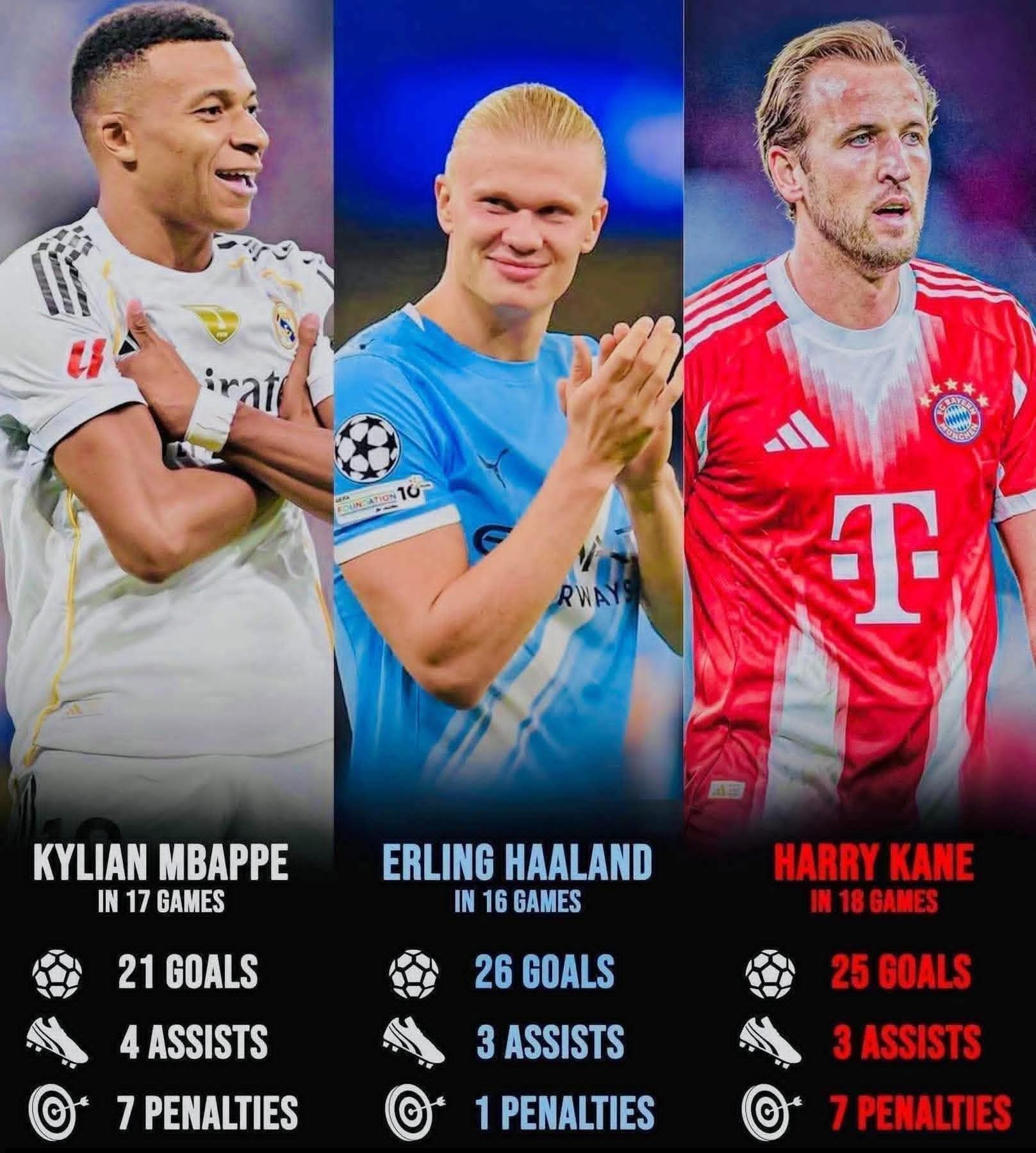
The question of who is the best player between Kylian Mbappé, Erling Haaland, and Harry Kane is one of the defining football debates of this era because it forces us to confront what we truly value in a footballer. Is it raw speed and superstar aura, is it ruthless goal scoring efficiency, or is it all-around mastery and intelligence? These three players represent different interpretations of modern greatness, and comparing them is less about statistics alone and more about impact, style, longevity, and influence on the game.
Kylian Mbappé is football’s most electrifying force. Watching him feels like witnessing a controlled explosion. His pace is not just fast, it is devastating, the kind that changes how entire teams set up defensively. Fullbacks drop deeper, center backs hesitate to step out, and midfielders rush passes simply because Mbappé is waiting in space. What separates him from most fast players in history is that his speed is matched by elite technical quality. He does not just outrun defenders, he beats them with feints, timing, and composure. His finishing is calm, precise, and adaptable, whether it is a delicate chip, a near-post blast, or a composed penalty.
Mbappé’s biggest argument lies in the moments that matter most. He has consistently delivered on the biggest stages, especially at international level. Winning the World Cup as a teenager and then scoring a hat-trick in a World Cup final years later places him in a category that very few players in history can touch. Those performances are not just impressive; they are defining. They show a player who does not shrink under pressure but grows larger. Mbappé carries an inevitability about him, the sense that no matter how tightly a match is controlled, he will create something decisive.
He is also a versatile attacker. While many see him primarily as a left winger, Mbappé can play centrally, drift wide, or operate as a second striker. He contributes not only goals but also assists, drawing defenders away to create space for teammates. His dribbling ability forces double teams, which opens the pitch. Tactically, he gives managers flexibility because he can be the focal point or the devastating weapon operating off another striker.
However, Mbappé is not without weaknesses. His off-ball defensive work is inconsistent, and there are matches where he appears disconnected if the ball does not come to him early. He thrives in systems built to maximize his strengths, and when those systems falter, his influence can dip. Yet even in those moments, one sprint, one touch, one finish can decide a match, and that is a rare quality.
Erling Haaland represents a different kind of dominance, one rooted in inevitability rather than flair. He is football reduced to its most brutal truth: put the ball in the box, and he will score. Haaland’s physical profile is extraordinary. He combines the size and strength of a traditional number nine with speed that defenders cannot match. He does not need many touches to impact a game, and that efficiency is terrifying for opponents. Where some strikers require rhythm and buildup, Haaland requires opportunity, and he converts those opportunities at historic rates.
What makes Haaland exceptional is not just the volume of goals but the variety of situations in which he scores. He finishes with both feet, with his head, from rebounds, through balls, cutbacks, and crosses. He times his runs with machine-like precision, constantly staying on the shoulder of defenders. His movement inside the penalty area is among the best the game has ever seen, and it is often underappreciated because it lacks aesthetic flair. But football matches are decided in boxes, and Haaland owns both physically and mentally.
At club level, his impact has been immediate and overwhelming. He elevates already strong teams into historically dominant ones by guaranteeing goals. Defenders know what he will try to do, yet they still fail to stop him. That inevitability is the mark of greatness. Unlike many star forwards, Haaland does not need to dominate possession or take constant shots. He is content to wait, to lurk, and then to strike decisively.
The main criticism of Haaland is his relative lack of involvement outside goal scoring. He does not drop deep to dictate play, and he is not a creative hub. When teams manage to cut off supply, his influence on the match can appear limited. In games where space is tight and service is restricted, he can look isolated. This has raised questions about his adaptability in different tactical systems and his impact at international level, where the quality of service may not match elite club standards. Still, judging a striker primarily on his build-up play risks missing the point of his greatness. His job is to score, and he does that better than almost anyone.
Harry Kane stands as the most complete footballer of the three, even if he lacks the raw explosiveness of Mbappé or the physical intimidation of Haaland. Kane’s intelligence is his defining trait. He reads the game like a playmaker while finishing like an elite striker. His ability to drop into midfield, receive the ball under pressure, and pick out precise passes makes him the tactical heartbeat of his teams. He does not just score goals; he orchestrates attacks.
Kane’s shooting technique is among the best in modern football. He can score from distance, inside the box, from free kicks, and from penalties with equal confidence. His composure in one-on-one situations is exceptional, and his understanding of goalkeeper positioning allows him to finish without relying on power alone. Unlike many strikers, Kane can dominate matches even when he does not score, simply through his link-up play and leadership.
One of Kane’s strongest arguments is consistency. Season after season, regardless of teammates or tactical setups, he delivers goals and assists at elite levels. He has carried teams through difficult periods, often being the difference between mediocrity and contention. His leadership, professionalism, and football IQ elevate those around him. In many ways, he represents the evolution of the traditional striker into a modern, multifunctional attacker.
Yet Kane’s career also highlights the importance of context. For much of his prime, he played in teams that did not consistently compete for the biggest trophies. While this should not diminish his individual brilliance, it does affect perception. Football history often remembers winners more vividly than performers, and Kane has fewer defining team moments on the grandest stages compared to Mbappé. Internationally, despite strong individual performances, he has not yet delivered a moment that reshapes his legacy in the way Mbappé has.
When deciding who the best player is, the answer ultimately depends on criteria. If the measure is pure match-winning potential on the biggest stages, Mbappé stands slightly ahead. His ability to change a game with one run, one touch, or one decision makes him the most feared player of the three. If the measure is goal scoring efficiency and physical dominance, Haaland is unmatched. No defender wants to face him, and no team feels safe with him on the pitch. If the measure is all-around football intelligence and completeness, Kane may be the superior footballer, capable of influencing every phase of play.
In a broader sense, Mbappé feels like the defining superstar of this generation, the player whose highlights will be replayed decades from now. Haaland feels like a record-breaker, a statistical phenomenon who could redefine what we believe is possible for a striker. Kane feels like a craftsman, a master of the game whose brilliance is sometimes quieter but deeply respected by those who truly understand football.
If one name must be chosen as the best overall right now, Mbappé likely edges the debate because of his combination of individual brilliance, versatility, and proven performances on football’s biggest stages. However, the margin is razor thin, and football history may ultimately remember all three not as rivals to be ranked, but as different answers to the same question of greatness in a modern game that allows many forms of excellence to coexist.