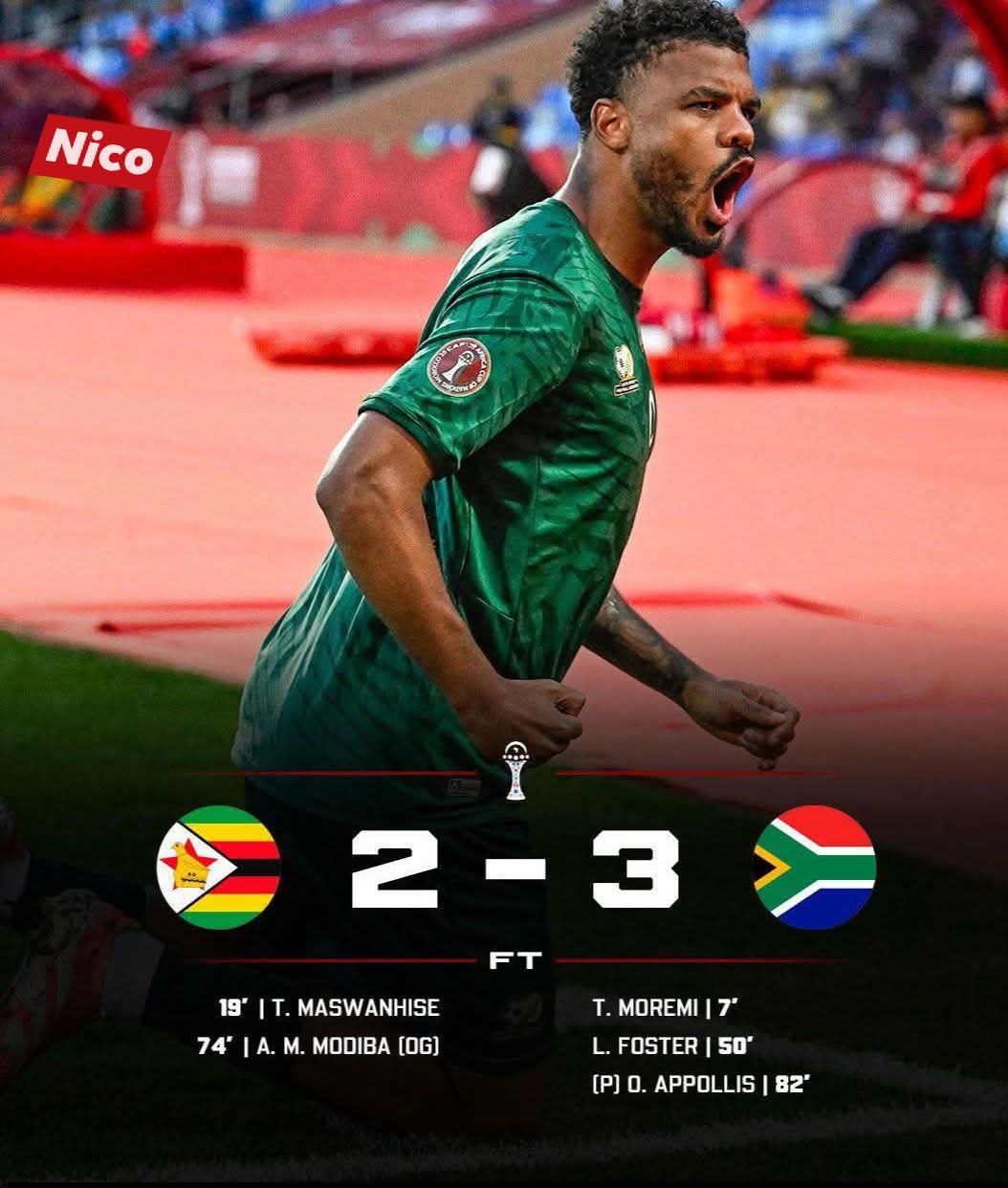
South Africa won a crazy match against Zimbabwe in the final group game, a night that felt less like a football fixture and more like a full emotional storm that refused to settle until the very last whistle. From the opening moments, it was clear that this would not be a cautious or predictable contest. Both teams arrived knowing exactly what was at stake, and that urgency poured onto the pitch in waves, turning every challenge into a statement and every touch into a potential turning point. The atmosphere crackled with tension, the kind that makes even the simplest pass feel heavy, and from the stands to the technical areas, everyone sensed that something dramatic was unfolding.
Zimbabwe started the game with fearless intent, pressing high and refusing to let South Africa settle into any kind of rhythm. Their energy was immediate and infectious, and it caught South Africa slightly off guard. Within the opening minutes, Zimbabwe created chances that forced the South African defense to scramble, with last-ditch blocks and hurried clearances becoming the order of the day. The ball moved quickly, tackles flew in, and the tempo never dipped, as if both teams had silently agreed that there would be no slow burn, only chaos from the first whistle.
South Africa responded by trying to impose their physical presence and experience, but Zimbabwe’s midfield refused to be overrun. Every loose ball was contested, every second ball fought for like it was the last of the match. When Zimbabwe finally broke through with the opening goal, the stadium erupted. It was the kind of goal that seemed to lift the entire team, a sharp move finished with conviction, sending a message that Zimbabwe were not there to make up the numbers. For a moment, South Africa looked rattled, their defensive shape stretched and their usual composure replaced by visible frustration.
That frustration nearly cost them again when Zimbabwe continued to push forward, smelling blood and sensing vulnerability. South Africa’s goalkeeper became a central figure early on, producing crucial saves to keep the deficit from growing. Each stop was greeted with relief from the South African bench and growing belief from the players on the pitch. Slowly, that belief translated into calmer possession, and South Africa began to find spaces between Zimbabwe’s aggressive lines.
The equalizer came through sheer persistence rather than polish. A scrappy sequence in the box, deflections, bodies everywhere, and then the ball finally crossed the line. It was not a pretty goal, but in a game like this, beauty was irrelevant. What mattered was momentum, and that goal swung it sharply. South Africa’s players celebrated with raw emotion, not just joy but release, as if a heavy weight had been lifted from their shoulders.
Instead of settling the game, the equalizer seemed to pour fuel on the fire. Zimbabwe refused to retreat, responding with renewed intensity, and the match opened up even more. End-to-end action followed, with both teams exchanging chances at a dizzying pace. South Africa hit the post with a powerful strike from distance, while Zimbabwe wasted a golden opportunity at the other end, sending a close-range effort wide when it seemed easier to score.
As the match wore on, fatigue began to creep in, but it did nothing to dull the drama. Mistakes became more frequent, yet those errors only added to the unpredictability. A misplaced pass here, a mistimed tackle there, and suddenly the entire flow of the game could change. When Zimbabwe retook the lead with a stunning goal from outside the box, it felt like another twist in a story that refused to settle. The shot flew past the goalkeeper and into the top corner, leaving everyone frozen for a split second before the roar of celebration exploded.
South Africa were staring at elimination, and the pressure was immense. You could see it in the way players shouted instructions, in the frantic gestures from the sideline, in the urgency of every forward run. The response was immediate and desperate, waves of attacks crashing into Zimbabwe’s defensive line. Crosses rained into the box, shots were taken from improbable angles, and Zimbabwe’s defenders threw themselves into challenges with admirable bravery.
The second equalizer came through a moment of individual brilliance. A South African attacker picked up the ball on the edge of the area, skipped past one defender, then another, and unleashed a low drive that found the corner. It was the kind of goal that shifts belief entirely, and suddenly South Africa looked like a team reborn. The bench erupted, substitutes sprinted down the touchline, and the noise from the supporters surged to another level.
With the score level once more, the final stages of the match turned into pure madness. Both teams pushed for the winner, fully aware that a draw might not be enough. Tackles grew heavier, cramps appeared, and tempers flared as the stakes continued to rise. The referee had his hands full, calming confrontations and trying to keep the game flowing amid the chaos.
Zimbabwe came agonizingly close to regaining the lead when a header from a corner crashed against the crossbar, the ball bouncing down and somehow staying out. South Africa responded with a lightning-fast counterattack that ended with a shot narrowly missing the target. It was relentless, exhausting football, the kind that leaves players bent over, gasping for breath, yet somehow still finding the energy to sprint again.
As stoppage time approached, the sense of inevitability began to build. It felt like this match demanded a decisive moment, something dramatic enough to match the madness that had come before. That moment arrived in the dying minutes when South Africa won a free kick just outside the box. The tension was unbearable. Players argued over who would take it, Zimbabwe set their wall, and the stadium seemed to hold its breath.
The strike was perfect. The ball curled over the wall, dipping just enough to evade the goalkeeper’s outstretched hands before nestling into the net. For a split second, there was silence, disbelief hanging in the air, and then absolute pandemonium. South Africa had completed the turnaround in the most dramatic fashion imaginable. Players sprinted toward the corner flag, piling on top of the goal scorer, while others collapsed to the ground in sheer exhaustion and relief.
Zimbabwe were stunned but not defeated in spirit. They threw everything forward in the final moments, launching long balls into the box, hoping for one last miracle. South Africa defended with their lives, clearing lines, blocking shots, and refusing to let the lead slip away. When the final whistle finally blew, it felt almost unreal, as if the match had existed in its own chaotic bubble outside of time.
South Africa’s players celebrated wildly, knowing they had survived one of the most intense group games imaginable. It was a victory built on resilience, belief, and an unyielding refusal to accept defeat, even when the odds seemed stacked against them. Zimbabwe, despite the heartbreak, earned immense respect for their fearless performance, pushing South Africa to the absolute limit and playing their part in a game that will be remembered for a long time.
This was not just a football match; it was a reminder of why the sport captivates so deeply. The unpredictability, the emotional swings, the moments of brilliance and heartbreak all collided into one unforgettable night. South Africa emerged victorious, but the story of this crazy encounter belongs to both teams, a testament to the passion and drama that define the beautiful game.