Dan Hurley is one of one, a coach like no other in college basketball, and that phrase — one of one — captures something deeper than a simple compliment or a meme. It speaks to a unique journey, a personality that doesn’t quite fit any template, a coaching career that has threads weaving through family legacy, basketball philosophy, emotional intensity, and one of the sport’s most compelling modern narratives. Hurley’s rise to national prominence is not the tale of a coach who follows an easy blueprint; it is the story of a man shaped by competition, driven by perfectionism, and defined by an intensity that can border on transcendent, frustrating, hilarious, and unforgettable all at once.
Dan Hurley didn’t arrive on the college basketball scene fully formed as a national figure overnight. Basketball was in his blood. He grew up in a household where the game was more than a sport — it was a language, a way of life. His father, Bob Hurley Sr., is one of the greatest high school basketball coaches in American history, a Hall of Famer whose St. Anthony teams were legendary for toughness, defense, discipline, and an ethos that turned under‑the‑radar players into college prospects year after year. Dan Hurley absorbed that environment not as an observer but as a participant; he was steeped in training, drills, and the relentless pursuit of excellence almost from birth. He learned the language of basketball early, and that fluency would follow him through his playing days and into his coaching career.
As a player, Hurley was known for his grit and cerebral approach. He wasn’t the tallest or most athletically gifted, but he was smart, competitive, and fundamentally sound — the kind of player who understood that the game’s margins are often won or lost in toughness rather than talent. Those traits carried him through college basketball and later into professional play overseas. But the arena that would define him was not the court as a player but the sideline as a coach. His coaching career began at the high school level, where he took what he learned from his father and applied it with his own voice. Soon, he was coaching at Wagner College, then followed with a stint at the University of Albany, where his teams showed a discipline and structure that hinted at something more than wins and losses: they showed identity.
When Hurley moved to the University of Rhode Island, his reputation began to broaden. Rhode Island was not a blue‑blood basketball school, but Hurley turned it into a gritty, hard‑nosed program that shocked many observers with its defensive tenacity and competitive spirit. Media outlets, pundits, and fans began to take notice. There was something about Hurley’s teams — they beat with intensity, they played with fire, they seemed to embody his personality on every possession. Those qualities are not easily quantified in statistics, but they resonate in the emotional experience of watching a team compete.
The leap to the University of Connecticut — UConn — was a defining moment. UConn is a storied program with championships in its history, but it had also known periods of inconsistency. Hurley arrived with expectations that were high but tempered by skepticism from those who wondered whether his style could translate to the highest levels of college basketball. What happened next was not just success but a kind of emphatic vindication of his method and mindset. UConn became more than a good team — it became an identity: tough, resilient, disciplined, and unafraid of big moments.
In the 2023 season, Hurley’s UConn team captured national attention by winning the NCAA Tournament, and they did it the hard way — through defense, physicality, and mental toughness that defined every possession. UConn’s march to the title was not pretty in the conventional sense; they weren’t always the flashiest, highest‑scoring team. But they were relentless. They were unshakeable in close games. They were the kind of side that made opponents respect every inch of the floor. And at the center of it all was Hurley — arms pumping on the sidelines, voice raised with intensity that sometimes seemed like it might burst right out of the arena. That season was a statement: Dan Hurley could coach on the biggest stage, and his approach worked in the moments that mattered most.
But the story didn’t stop there. UConn’s 2024 season brought a repeat championship, a repeat validation that Hurley is not a one‑hit wonder but a sustained force in college basketball. Back‑to‑back titles are rare, a fact that speaks to the difficulty of maintaining excellence in a sport as unpredictable as March Madness. Opponents have time to prepare, talent rosters shift from year to year, and injuries or slumps can undo even the most talented teams. Yet Hurley’s UConn teams found ways to win when it counted most, reinforcing that the coach’s methods were not a fluke but a foundation for enduring success. That alone would be enough to suggest that Hurley is one of a kind — but the narrative stretches deeper.
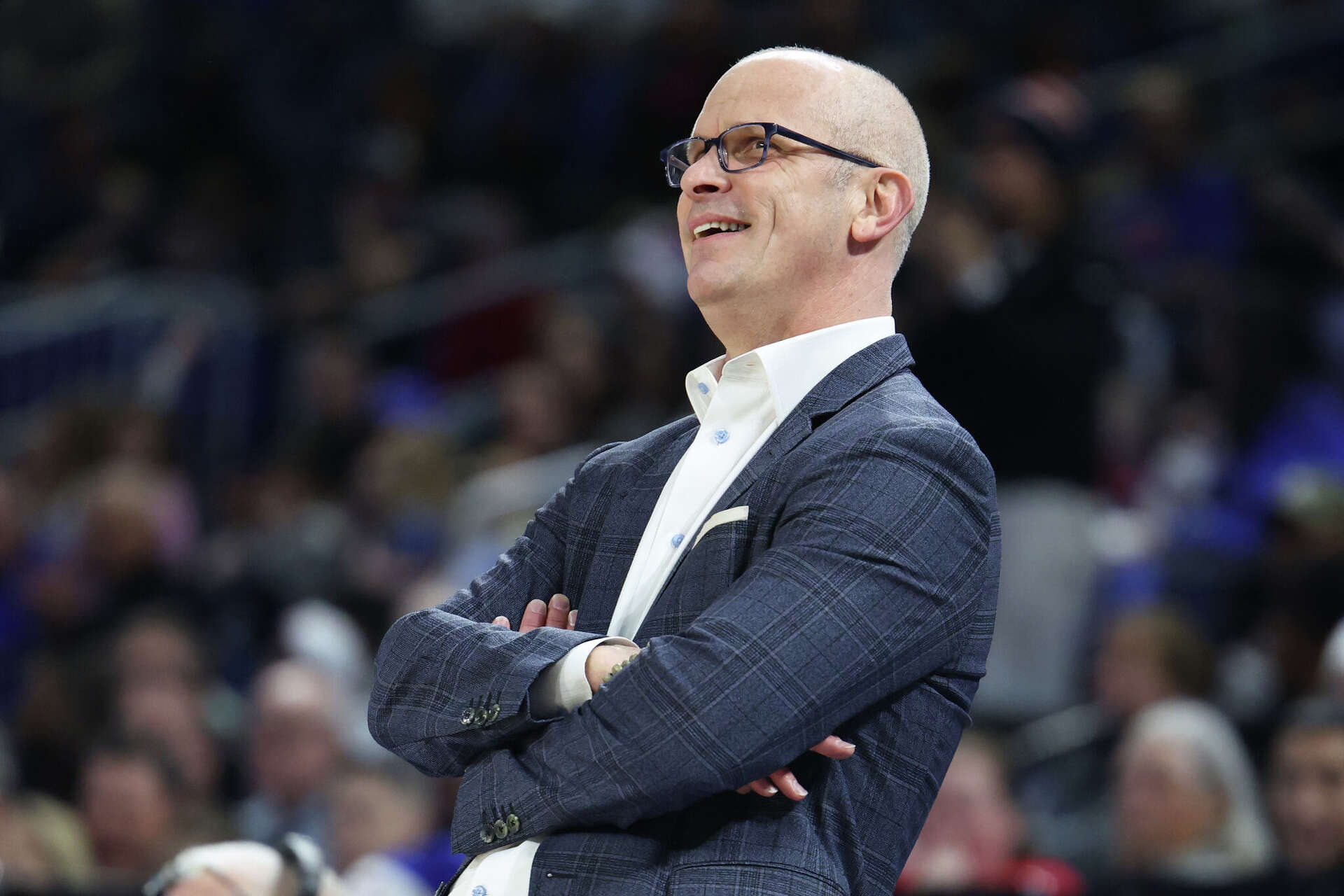
Hurley’s personality is part of what makes him so compelling. On the sidelines, he is animated, expressive, and emotionally invested in every whistle, every possession, every scoreboard change. Some coaches are placid, calm, and calculating; Hurley is kinetic, combustible, and emotionally transparent. Fans often see a coach as a stoic figure, shielding emotion to set an example. Hurley defies that norm. He wears his heart on his sleeve, and in doing so, he invites fans and players into the emotional heartbeat of the game. His reactions — whether exuberant celebration, frustration at a call, or encouragement to a player — are part of the theater of basketball. They make the game feel alive. They make each moment feel consequential.
And what makes him truly “one of one” is not just the energy but how that energy translates into performance. Players under Hurley’s guidance often speak not just about strategy but about belief. They talk about toughness not as a cliché but as a practiced discipline — something that the coach demands and that they internalize. That connection between coach and player is the kind of intangible that transforms a group of individuals into a cohesive unit. It’s why UConn teams have been able to defend with intensity, share the ball, and execute under pressure. They play not for themselves but for the collective identity Hurley has cultivated.
Of course, Hurley’s journey has not been without controversy or criticism. In any high‑profile coaching career, there will be critics, second‑guesses, and disagreements over style or strategy. Some pundits have questioned his intensity, suggested it crosses lines, or criticized certain tactical decisions. But part of the Hurley mystique is that he doesn’t back down from criticism; he adapts, reflects, and uses setbacks as fuel for improvement. That mindset echoes the lessons he learned under his father, where discipline was never optional and accountability was always paramount. He has taken those lessons and made them his own rather than a carbon copy of someone else’s approach. That’s what separates great coaches from good ones — the ability to internalize influences and then create a philosophy that is distinctly their own.
The influence of Hurley’s success extends beyond his own program. Coaches across college basketball take notice when a philosophy translates into championships. His emphasis on defense, physical conditioning, and emotional buy‑in has sparked conversations about competitiveness and team culture across the sport. Recruiting has been impacted too; talented players now look at UConn not just because of its history but because of the identity and development pathway that Hurley’s tenure has created. That ripple effect is the sign of a coach whose influence extends beyond the wins column into the broader ecosystem of college basketball.
And yet, this narrative is not purely about championships or statistics. It’s about how basketball is lived and felt. Hurley’s teams are often described as blue‑collar, hard‑nosed, and never out of a game — even when they fall behind. There’s a relentlessness there, a belief that the next possession is always an opportunity rather than a threat. That mentality is contagious; it inspires fans, energizes arenas, and creates moments that linger in memory because they were earned rather than gifted. When UConn cut down the nets in consecutive seasons, it wasn’t just a trophy celebration — it was the culmination of a process that had defined those teams all year long.
In the broader tapestry of college basketball, Hurley stands out because of this synthesis of identity and outcome. Other coaches might be excellent X’s‑and‑O’s strategists, masters of analytics, or charismatic leaders. Hurley blends those elements with an intensity and authenticity that defy easy categorization. He is cerebral yet emotional, disciplined yet unpredictable. He demands structure but also sparks creativity. And he does it with a presence that feels larger than the typical coaching mold.
Part of what makes the phrase “one of one” so apt is that no other coach in college basketball has walked the path Hurley has walked and arrived where he has with the same voice, the same energy, and the same results. His story is not a copy of someone else’s; it is its own narrative arc with distinct peaks, challenges, and moments that could only belong to him. Fans, whether they love or loathe his energy, can recognize that there is an authenticity to how he coaches, talks, and leads. That authenticity is magnetic. It draws attention, it inspires debate, and it fuels the kind of passionate following that turns a basketball program into a cultural phenomenon.
And at the end of the day, that’s what makes Dan Hurley “one of one.” Sure, the titles matter. Sure, the wins are measurable. But it’s the combination of his journey, his personality, his connection with players, and his impact on the sport that sets him apart. He is not easily boxed into a single descriptor because he defies easy categorization — and that is often the definition of a truly singular figure in any field.
Basketball will remember Dan Hurley not just for what he has accomplished but for how he has accomplished it. His teams play with a DNA that feels unmistakably theirs. His energy seeps into the fabric of the game. And the narrative he continues to write — one season at a time, one game at a time, one championship moment at a time — is a story that has no real parallel. To call him “one of one” isn’t just a humorous phrase or an internet tagline; it’s an acknowledgment of the unique footprint he has made on college basketball, the indelible mark he continues to leave, and the fact that in a sport full of talented coaches, he stands apart not just in achievement, but in identity. Dan Hurley is a coach who could only be himself — and that, truly, makes him one of one.