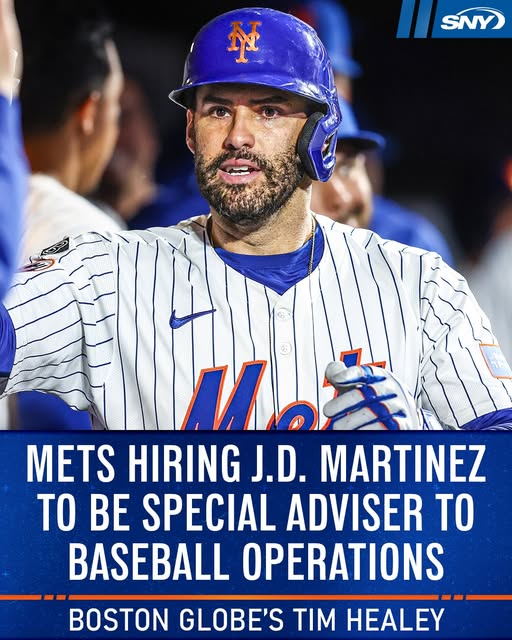
According to Tim Healey of the The Boston Globe, J.D. Martinez is set to join the New York Mets as a special assistant to baseball operations, marking a natural next step for a veteran hitter who recently played a key role in the organization’s success. The move signals a transition from on-field contributor to mentor and advisor, while still keeping Martinez closely connected to the clubhouse and daily rhythms of a major league season.
In this new role, Martinez is expected to spend time working directly with players throughout the year, offering guidance, insight, and hands-on instruction—particularly when it comes to hitting. The structure of the position is said to mirror the kind of involvement that Carlos Beltrán has had in similar capacities, where a former star remains embedded within the organization as a resource for both young talent and established veterans. That kind of presence can be invaluable, especially for a team looking to build on recent success and sustain a competitive edge.
Martinez’s transition into this advisory role feels like a seamless fit when considering his reputation around the league. Throughout his career, he has been known not just for his production at the plate, but for his meticulous approach to hitting—studying mechanics, analyzing swings, and constantly refining technique. Those habits naturally translate into coaching and mentorship, where the ability to break down complex aspects of hitting into digestible insights can make a meaningful difference for players trying to improve or adjust at the highest level.
His presence in the clubhouse also carries credibility. Players tend to respond differently to someone who has recently been in their position, someone who understands the grind of a long season, the pressure of big moments, and the constant need to adapt. Martinez brings that lived experience, along with a track record of success that commands respect. That combination can help foster trust and open communication, which are critical when offering guidance or suggesting adjustments.
The timing of this move is also significant given Martinez’s impact during the Mets’ 2024 season, particularly their run to the National League Championship Series. His contributions during that stretch went beyond just statistics; he provided leadership, stability, and a veteran presence in a lineup that benefited from his experience. Being part of a deep postseason run often strengthens a player’s connection to an organization, and in Martinez’s case, it appears to have laid the groundwork for this next chapter.
For the Mets, bringing Martinez into a special assistant role reflects a broader strategy of integrating experienced voices into their baseball operations. Rather than relying solely on traditional coaching staff or front office personnel, the organization is leveraging the insight of players who have recently competed at a high level. This hybrid approach can create a more dynamic environment, where analytical perspectives and on-field experience intersect to inform decision-making and player development.
Martinez’s role will likely involve a mix of formal and informal interactions. Some of his work may take place during structured sessions—batting practice, film review, or one-on-one meetings—while other contributions may come in more organic settings, such as conversations in the clubhouse or dugout. Often, it’s these informal exchanges that have the most impact, as players feel more comfortable discussing challenges, asking questions, and experimenting with adjustments.
There’s also an element of continuity in bringing Martinez back into the fold. For players who were part of the 2024 roster, his presence provides a familiar voice and reinforces the culture that helped carry the team deep into October. For newer players, it offers a chance to learn from someone who has already been part of that environment and understands what it takes to succeed within it. Maintaining that sense of continuity can be especially important for teams aiming to build sustained success rather than one-off achievements.
Comparisons to Carlos Beltrán’s involvement highlight the value of having a former star embedded within the organization in a mentorship capacity. Beltrán has long been recognized for his ability to connect with players, share insights, and contribute to both individual development and team cohesion. If Martinez can bring a similar presence—particularly with his deep understanding of hitting mechanics—the Mets stand to benefit significantly.
From a broader perspective, this move also reflects a growing trend in baseball, where former players transition into advisory or developmental roles that blur the line between coaching and front office work. These positions allow organizations to tap into the experiential knowledge of players while also integrating them into the strategic side of the game. For someone like Martinez, who has always been deeply engaged with the technical aspects of hitting, this kind of role offers an opportunity to stay involved in a meaningful way without the physical demands of playing.
It will be interesting to see how Martinez’s influence manifests over the course of the season. Improvements in individual player performance, adjustments in approach at the plate, and even subtle shifts in team culture can all be indicators of his impact. While these contributions may not always be immediately visible in box scores, they can play a significant role in a team’s overall success.
Ultimately, Martinez’s move into a special assistant role with the Mets feels like a natural evolution. It allows him to remain connected to the game, contribute his expertise, and help shape the next generation of players. For the Mets, it adds another layer of experience and insight to an organization that is clearly looking to build on its recent achievements and continue competing at a high level.