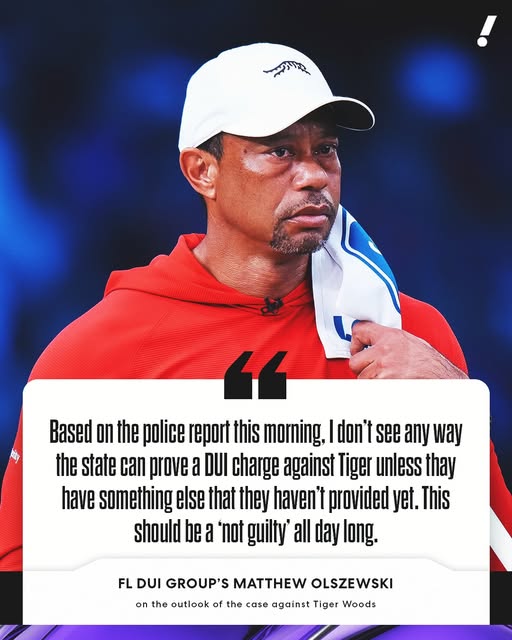
Following the release of the police report, skepticism has already started to emerge from the legal community, including from at least one criminal defense lawyer in Florida who isn’t convinced the case against Tiger Woods holds up under closer scrutiny. That kind of reaction isn’t unusual in high-profile cases, especially when early reports leave room for interpretation or when key details appear inconsistent, incomplete, or open to challenge.
From a defense perspective, police reports are often just the starting point—not the final word. They reflect the observations and conclusions of responding officers at a specific moment in time, but they don’t necessarily capture the full context or account for alternative explanations. A seasoned defense attorney will immediately begin looking for gaps, ambiguities, or procedural issues that could weaken the case if it were to move forward. That includes examining how evidence was gathered, whether proper protocol was followed, and whether the facts as presented actually meet the legal standard required for charges to stick.
In situations involving a public figure like Woods, that scrutiny tends to be even more intense. Not only is there heightened media attention, but there’s also a recognition that high-profile cases can sometimes be influenced—at least in perception—by external pressures. Defense lawyers are quick to point out when a case appears to rely heavily on assumptions rather than concrete, verifiable evidence. If the police report leaves unanswered questions or contains elements that could be interpreted in multiple ways, that becomes fertile ground for building doubt.
One of the key issues a defense lawyer would likely focus on is whether the evidence clearly establishes intent or wrongdoing, depending on the nature of the allegations. In many criminal cases, it’s not enough to show that something happened; prosecutors must demonstrate that it happened in a way that violates specific laws and that the accused had the requisite intent or awareness. If the report doesn’t convincingly establish those elements, it can significantly weaken the prosecution’s position.
Another area of focus is consistency. Are the statements in the report aligned with any available physical evidence or witness accounts? Are there contradictions, or does the timeline raise questions? Even small discrepancies can become significant in a courtroom setting, where the burden of proof lies with the prosecution. A defense attorney’s job is to amplify those uncertainties, turning them into reasonable doubt.
It’s also worth noting that early reactions like this don’t necessarily predict the outcome of a case. Legal proceedings can evolve as more information comes to light, additional evidence is collected, and both sides refine their arguments. However, when an experienced defense lawyer publicly expresses skepticism, it does suggest that the case, at least as currently presented, may not be as straightforward as it initially appears.
For Woods, the situation highlights the complicated intersection of celebrity and the legal system. Public perception can shift quickly based on initial reports, but legal realities often unfold more slowly and with greater nuance. The court of public opinion may react immediately, but actual legal outcomes depend on a much more rigorous process of examination, argument, and evidence.
In the meantime, commentary from legal experts—especially those willing to challenge the prevailing narrative—serves as a reminder that every case has multiple sides. What may seem clear at first glance can become far more complex when viewed through the lens of legal standards and courtroom strategy. And in this instance, at least one Florida defense lawyer is signaling that the case against Tiger Woods may not be as solid as it first appeared.