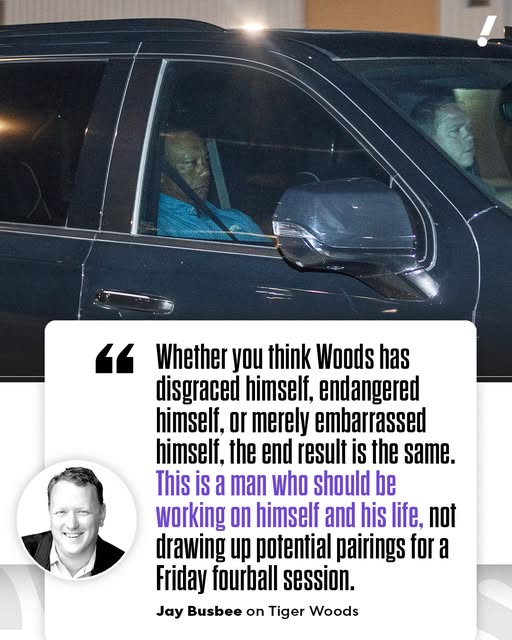
The suggestion from Jay Busbee that Tiger Woods should step back from golf following his recent arrest and automobile accident has sparked a wave of discussion that goes far beyond a single incident. It touches on legacy, physical and mental well-being, public accountability, and the difficult question of when an all-time great should consider stepping away from the sport that defined him. For Woods, this is not the first time his career has intersected with personal adversity, but the timing and nature of this latest situation add another layer to an already complex narrative.
Woods’ career has always existed in extremes—unmatched dominance on the course paired with intense scrutiny off it. From his early rise as a prodigy to becoming one of the most dominant athletes in sports history, he has set standards that few, if any, have matched. Major championships, record-breaking performances, and a global impact on the game of golf have solidified his place among the greatest athletes of all time. Yet, alongside those achievements, his career has also been marked by injuries, personal struggles, and moments that have tested both his resilience and public image.
Busbee’s argument appears to center on the idea that there comes a point where continuing to compete may no longer be in the best interest of the athlete, especially when external factors begin to outweigh the benefits of staying active. In Woods’ case, the recent arrest and car accident raise concerns not just about his ability to compete, but about his overall well-being. Golf, while less physically punishing than some sports, still demands a high level of physical conditioning, mental focus, and emotional stability—areas that can be significantly affected by personal turmoil.
The physical aspect of Woods’ career is already a major consideration. Over the past decade, he has undergone multiple surgeries, particularly on his back and legs, and has repeatedly spoken about the challenges of maintaining his body at a level that allows him to compete. His remarkable comeback to win the Masters in 2019 was a testament to his resilience, but it also highlighted just how difficult the journey has been. Each return to the course has required immense effort, and the margin for error has grown smaller with each passing year.
When incidents like a car accident enter the picture, they add uncertainty to an already fragile physical situation. Even if the injuries are not severe, the cumulative effect of repeated physical setbacks can take a toll. Recovery becomes more complicated, timelines become less predictable, and the risk of further injury increases. For a player who has already pushed his body to its limits, the question becomes whether continuing to compete is sustainable or even advisable.
Beyond the physical, there is the mental and emotional dimension. High-profile incidents such as an arrest can have significant psychological impacts, particularly for someone who has spent much of his life in the public eye. The pressure, scrutiny, and media attention that follow can be overwhelming, even for someone as experienced as Woods. Taking a step back, as Busbee suggests, could provide an opportunity to regroup, reassess priorities, and focus on aspects of life that extend beyond competitive golf.
There is also the matter of legacy. Woods’ legacy in golf is already secure. His achievements, influence, and contributions to the sport are undeniable. Continuing to play, especially if it involves struggles on and off the course, does little to enhance that legacy and could, in some ways, complicate it. For many great athletes, the decision to step away is not about what they have left to prove, but about how they want to be remembered. Stepping back at the right time can preserve the image of greatness, allowing fans to remember the peak rather than the decline.
At the same time, the idea of stepping away is never simple for someone like Woods. Competitive athletes are driven by a desire to perform, to challenge themselves, and to remain part of the game they love. Golf, in particular, allows for longer careers than many other sports, and there is always the possibility of another strong performance, another moment of brilliance. For Woods, the question is not just whether he can play, but whether he still finds fulfillment and purpose in competing at this stage of his life.
Busbee’s perspective also reflects a broader societal conversation about accountability and self-awareness. When public figures face legal or personal issues, there is often an expectation that they take time to address those matters before returning to their professional roles. In this context, stepping back from golf could be seen as a responsible decision, allowing Woods to focus on resolving any outstanding issues and ensuring that he is in the right place physically and mentally before considering a return.
It’s important to note, however, that such decisions ultimately rest with Woods himself. External opinions, whether from journalists, fans, or analysts, can provide perspective, but they cannot fully account for the personal factors that influence such a choice. Woods knows his body, his motivations, and his circumstances better than anyone else. Any decision about stepping back or continuing to compete will be shaped by those internal considerations.
There is also the possibility of redefining what stepping back means. It does not necessarily have to be a permanent retirement. It could involve reducing the number of tournaments he plays, focusing on specific events, or transitioning into a different role within the sport, such as mentoring younger players or contributing to the development of golf in other ways. Woods has already shown an interest in shaping the future of the game, and stepping back from full-time competition could allow him to focus more on those efforts.
The reaction to Busbee’s comments is likely to be mixed. Some will agree that stepping back is the prudent choice, given the circumstances and the cumulative challenges Woods has faced. Others will argue that as long as he is capable and motivated, he should have the freedom to continue competing. This divide reflects the broader tension between respecting an athlete’s autonomy and recognizing the realities of aging, injury, and personal challenges.
Ultimately, the conversation is less about a single incident and more about a turning point. For Woods, the recent arrest and automobile accident may represent a moment of reflection, an opportunity to evaluate where he stands and what he wants moving forward. Whether that leads to stepping back from golf or continuing to compete, it is a decision that will carry significant weight, both for his personal life and for how his career is remembered.
What remains undeniable is Woods’ impact on the sport. Regardless of what he decides, his legacy is already etched into the history of golf. The question now is how the next chapter unfolds—whether it involves continued competition, a gradual transition away from the game, or a complete shift in focus. Busbee’s suggestion adds to that conversation, emphasizing the importance of considering not just what is possible, but what is best.
In the end, the idea that Tiger Woods should step back from golf is not a critique of his greatness, but a reflection of the realities he faces at this stage of his life and career. It acknowledges both his extraordinary achievements and the challenges that come with sustaining excellence over time. Whether or not he chooses to take that step, the discussion itself highlights the complexity of balancing ambition, health, and legacy in the world of professional sports.