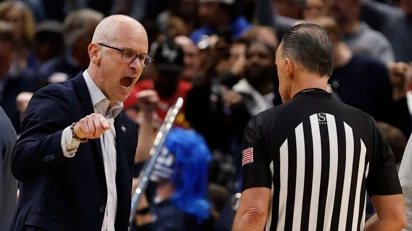
In the world of competitive sports, the line between intense competition and regulation is often razor-thin. Every play, every decision, and every interaction on the court carries weight, not only for the outcome of the game but also for the perception of fairness, sportsmanship, and the integrity of the sport itself. Recently, a moment arose that sparked discussion across the basketball community, raising questions about what constitutes a technical foul and how officials and coaches navigate the high-pressure environment of a game. The incident involved Coach Hurley and referee Roger Ayers, who shared a brief head-to-head contact during a particularly heated stretch of play. While the moment itself lasted only a second or two, its implications, interpretation, and the reactions it generated have sparked debate among fans, analysts, and sports commentators alike.
At the heart of the discussion is the question of intent versus outcome. In basketball, technical fouls are typically called to penalize unsportsmanlike behavior, deliberate infractions, or actions that disrupt the flow of the game. A technical foul can have immediate and significant consequences, including awarding free throws to the opposing team and potentially altering the momentum of a contest. When evaluating an incident like Hurley’s brief contact with Ayers, one must consider both the nature of the contact and the context in which it occurred. Was the contact accidental, the product of intense motion in a confined space, or a deliberate act of aggression or frustration directed at the official? This question is central to the debate, as technical fouls are rarely given for incidental contact, and referees are trained to distinguish between intentional and unintentional interactions.
Coach Hurley is known for his intensity and passion on the sidelines. Throughout his career, he has demonstrated a commitment to advocating for his team, challenging calls when appropriate, and expressing emotions in the heat of competition. This dedication has endeared him to fans and players alike, while also placing him under scrutiny during contentious moments in games. In the incident with Ayers, observers noted that Hurley’s movements were consistent with the emotional energy and engagement he brings to coaching, but some questioned whether the head-to-head contact crossed a threshold that should have triggered a technical foul. The discussion highlights the delicate balance officials must maintain, ensuring that rules are enforced fairly while acknowledging the realities of a high-intensity sport where emotions and physical proximity often intersect.
Referee Roger Ayers, on the other hand, has extensive experience managing the fast-paced dynamics of a basketball game. Officials must make split-second judgments, balancing player behavior, coach interactions, and the overall flow of the game. In the instance of the brief head-to-head contact with Hurley, Ayers had to assess the situation instantaneously, considering the nature of the contact, its intent, and its impact on the game. While some fans and commentators argued that a technical foul was warranted, others defended the decision not to call one, citing the fleeting and likely inadvertent nature of the contact. This tension between perception and instantaneous judgment underscores the challenges faced by referees, whose decisions are made under intense pressure and are often subject to post-game scrutiny.
The reactions to the incident have been varied and insightful, reflecting the diverse perspectives of the basketball community. Fans on social media debated the merits of a technical call, with some highlighting the importance of upholding strict standards for coach conduct, while others emphasized the fast-moving, emotionally charged environment of a live game, suggesting that not every minor contact merits penalization. Analysts provided context, referencing similar incidents in past seasons, exploring how officials have historically interpreted brief, incidental interactions between coaches and referees. Commentators noted that while consistency in officiating is critical, context and intent must also be considered, and they praised officials who can make nuanced decisions under pressure without allowing the game to become bogged down by technical calls for minor infractions.
Another layer of discussion focused on the potential impact of the incident on the game itself. Technical fouls can shift momentum, create opportunities for the opposing team, and alter the psychological dynamics on the court. Some argued that calling a technical in this situation could have unfairly influenced the game, penalizing a coach for what was likely an accidental contact while simultaneously granting an advantage to the other team. Others countered that maintaining the integrity of the rules is paramount and that even brief contact with an official sets a precedent that must be addressed to discourage any escalation in the future. This tension illustrates the broader challenge in sports officiating: striking a balance between fairness, accountability, and the practical realities of human behavior during competitive play.
The incident also serves as a case study in how coaches, officials, and leagues handle moments of potential controversy. Following games with such contentious moments, review processes, discussions among officiating crews, and league evaluations are often employed to ensure that decisions align with established rules and standards. These processes allow for reflection, accountability, and, when necessary, clarification of policies or reinforcement of best practices. In the Hurley-Ayers incident, league officials may review video, assess statements from both the coach and the referee, and determine whether any formal action is necessary, even if a technical foul was not called during live play. This post-game analysis highlights the layers of oversight designed to maintain the integrity and fairness of the sport while protecting officials, coaches, and players.
Another important consideration is the broader message sent to players, coaches, and fans. Technical fouls serve not only to penalize infractions but also to reinforce the standards of sportsmanship and respect expected in the game. By choosing not to issue a technical foul for brief contact, officials implicitly signal that context, intent, and the dynamics of high-intensity play are taken into account, recognizing the human element in competitive sports. Conversely, strict enforcement of rules in every minor instance can create a hyper-technical environment that may detract from the fluidity and enjoyment of the game. Balancing these considerations is central to maintaining the credibility of officiating while preserving the excitement and spontaneity that make basketball compelling.
The discussion surrounding Hurley and Ayers also illuminates the role of perception in sports. Different viewers interpret incidents through diverse lenses shaped by their allegiances, understanding of the rules, and personal expectations of conduct. Fans of Hurley’s team may perceive the contact as innocent or accidental, reflecting the coach’s emotional investment in his players, while fans of the opposing team may view it as an overstep deserving of a technical. Analysts and commentators often provide a mediating perspective, considering rulebooks, precedent, and situational context to assess the appropriateness of a call. The interplay between perception, judgment, and rules enforcement creates an ongoing dialogue that is central to the culture of competitive sports, particularly in high-stakes environments such as the NCAA Tournament, professional leagues, and other competitive arenas.
The moment itself, though brief, encapsulates the intensity of modern basketball. Coaches operate on the sidelines with a combination of strategic focus and emotional investment, responding to the flow of the game and advocating for their players. Referees navigate split-second decisions that impact outcomes, balancing enforcement of rules with the practical realities of dynamic, high-speed play. Fans witness these interactions, analyze them, and form opinions that contribute to the broader narrative of the sport. In this way, what may seem like a fleeting contact between Hurley and Ayers becomes emblematic of the tensions, challenges, and human elements inherent in competitive basketball.
It is also worth noting that sports discussions often extend beyond the court into social media, news outlets, and professional commentary. The Hurley-Ayers incident has sparked conversation on multiple platforms, highlighting how moments in a game can resonate widely and become part of the ongoing discourse around officiating, coach behavior, and the application of rules. Debates about whether a technical foul should have been called serve as opportunities for fans and analysts to educate themselves on the nuances of the game, understand the responsibilities of referees, and appreciate the balance between regulation and the emotional intensity of competitive sports.
Ultimately, the incident invites reflection on the nature of sportsmanship and professionalism. Coaches like Hurley are expected to advocate for their teams passionately, yet they must also navigate boundaries that preserve respect for officials and the integrity of the game. Referees like Ayers operate under intense scrutiny, making rapid judgments that require both firmness and discernment. Moments like these test the judgment, poise, and adaptability of everyone involved, creating teachable moments, sparking debate, and highlighting the complexity of managing high-stakes competition.
The dialogue surrounding Hurley and Ayers also underscores the importance of communication, perspective, and restraint in sports. Coaches learn to manage emotional intensity, understanding when to challenge calls and when to accept rulings to preserve focus and flow. Referees continually refine their ability to interpret actions, assess intent, and maintain authority while keeping the game moving. Fans, commentators, and analysts contribute to the ecosystem by observing, questioning, and providing insights that further the understanding of the game. This cycle of action, response, and discussion exemplifies the dynamic nature of sports, where moments of tension can lead to greater awareness, knowledge, and appreciation of the complexities inherent in competition.
In conclusion, the brief head-to-head contact between Coach Hurley and referee Roger Ayers has generated meaningful discussion because it sits at the intersection of rules enforcement, intent, perception, and competitive intensity. While some argued that a technical foul should have been issued, others emphasized the fleeting and likely inadvertent nature of the contact, highlighting the need for nuanced judgment in high-pressure scenarios. The incident serves as a case study in sportsmanship, officiating, and the human elements of basketball, demonstrating how a single moment can spark analysis, debate, and reflection. Beyond the specifics of the contact itself, the dialogue illustrates the ongoing balance between regulation and emotion, authority and advocacy, and the responsibilities of coaches, referees, and players in maintaining the integrity and excitement of the game. Hurley and Ayers’ interaction is a reminder that sports are as much about judgment, adaptability, and professionalism as they are about athletic skill, and that even brief moments can leave a lasting impact on perception, discussion, and the ongoing story of competitive basketball.