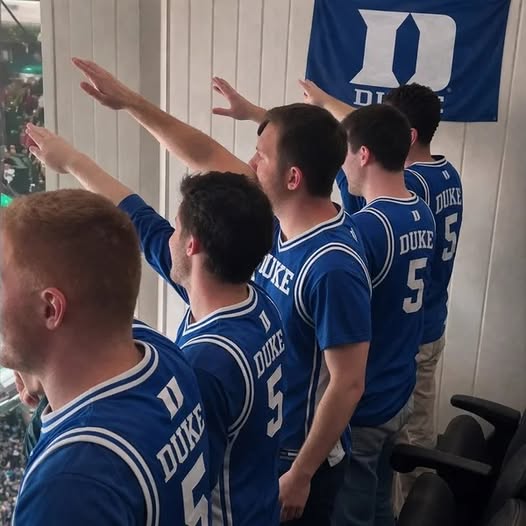
The atmosphere inside the arena had been electric, the kind of charged intensity that defines high-stakes college basketball. Fans clad in school colors filled the stands, chanting, cheering, and living every second of the game as if it were the most important moment of the season. But what began as a typical night of competition quickly spiraled into something far more troubling after a video surfaced online showing a small group of spectators making gestures that many viewers identified as a Nazi salute. Within hours, the footage spread across social media platforms, igniting outrage, confusion, and a wave of questions about what exactly had happened and how such behavior could emerge in such a public setting.
The video itself is brief but unmistakably provocative. Shot from a nearby section of the crowd, it captures a cluster of fans laughing and raising their arms in a synchronized motion that resembles one of the most infamous symbols associated with hate and extremism. While some defenders have attempted to dismiss the gestures as a joke taken out of context or a misguided attempt at humor, the broader public reaction has been far less forgiving. For many, the imagery is too historically loaded to be brushed aside as harmless or accidental.
University officials moved quickly once the clip gained traction. In a statement released shortly after the video began circulating, the school condemned the behavior in strong terms, emphasizing that such actions do not reflect the institution’s values or the spirit of its community. Administrators confirmed that an investigation is underway to identify those involved and determine appropriate disciplinary measures. The message was clear: regardless of intent, gestures associated with hate groups or oppressive regimes have no place in a university environment.
The incident has also drawn attention from conference officials and athletic authorities, who are reportedly reviewing the situation to assess whether additional consequences might be warranted. While fan behavior is often difficult to police in real time, especially in large, high-energy venues, this episode underscores the growing expectation that schools must take proactive steps to ensure their events remain inclusive and respectful spaces.
Social media, as expected, has played a central role in amplifying the story. Within hours of the video’s release, hashtags related to the incident began trending, with thousands of users weighing in. Some expressed anger and disappointment, calling for swift punishment and stronger accountability measures. Others urged caution, suggesting that the clip might not tell the full story or that the individuals involved may not have fully understood the implications of their actions. Still, even among those advocating for context, there is a general consensus that the imagery itself is deeply problematic.
One of the more striking aspects of the reaction has been the way it has sparked broader conversations about fan culture and the boundaries of acceptable behavior at sporting events. College athletics, in particular, occupy a unique space where youthful exuberance and school pride can sometimes blur into recklessness. Chants, gestures, and traditions that might seem harmless to participants can carry very different meanings when viewed through a wider historical or cultural lens. This incident serves as a stark reminder that actions in a crowded arena are never truly private, and that even fleeting moments can have lasting consequences when captured on camera.
Experts in social behavior and group dynamics have pointed out that environments like packed stadiums can sometimes encourage individuals to act in ways they might not otherwise consider. The anonymity of being part of a large crowd, combined with the emotional highs of competition, can lower inhibitions and lead to impulsive decisions. That doesn’t excuse the behavior, but it does help explain how something so widely recognized as offensive could occur in such a public setting.
At the same time, critics argue that explanations rooted in crowd psychology risk minimizing the seriousness of the gesture itself. The Nazi salute is not an ambiguous symbol; it is historically tied to a regime responsible for immense suffering and atrocities. For many people, seeing it replicated—even in a seemingly casual or joking manner—can be deeply hurtful and alarming. This is why institutions often adopt zero-tolerance approaches to symbols and actions associated with hate, regardless of the context in which they appear.
Students and alumni have also begun to weigh in, with some expressing embarrassment over the negative attention the incident has brought to their community. Others have used the moment as an opportunity to call for increased education around the historical significance of such symbols, arguing that ignorance should not be an excuse but can be addressed through better awareness and dialogue. There have even been discussions about implementing new guidelines or campaigns aimed at promoting respectful fan behavior.
Meanwhile, the individuals seen in the video remain unidentified publicly, though reports suggest that efforts to determine their identities are ongoing. This has raised additional questions about privacy, accountability, and the role of online communities in tracking down those involved in controversial incidents. While some believe that public exposure is a necessary part of ensuring consequences, others caution against the potential for harassment or misidentification in the rush to assign blame.
The situation also highlights the evolving relationship between live events and digital media. In an era where nearly every spectator carries a smartphone capable of recording high-quality video, moments that once might have gone unnoticed can now be documented and shared instantly with a global audience. This has fundamentally changed the stakes for behavior in public spaces, particularly at high-profile events. Universities and organizations are increasingly aware that their reputations can be shaped not just by what happens on the court, but by what unfolds in the stands.
For now, the focus remains on the investigation and what it might reveal. University officials have indicated that they are reviewing all available footage and working with event staff to piece together a clearer picture of the incident. Depending on the findings, those involved could face a range of consequences, from warnings to more severe disciplinary actions. The outcome will likely be closely watched, not only by those directly connected to the school but by observers across the broader landscape of college sports.
Beyond the immediate fallout, the incident has sparked a deeper reflection on the responsibilities that come with being part of a public community. Sporting events are meant to be spaces of unity and shared excitement, where people from diverse backgrounds come together to support a common cause. When actions occur that undermine that sense of inclusivity, they can have ripple effects that extend far beyond a single game.
There is also an opportunity here for constructive dialogue. Moments like this, while uncomfortable, can serve as catalysts for important conversations about history, symbolism, and the impact of seemingly small actions. By addressing the issue openly and thoughtfully, institutions can not only respond to the immediate situation but also work to prevent similar incidents in the future.
At the same time, it’s worth recognizing that the vast majority of fans attend games with no intention of causing harm or controversy. They come to cheer, to connect with others, and to be part of something larger than themselves. Incidents like this, while highly visible, represent a tiny fraction of the overall fan experience. Still, their impact can be outsized, particularly when they involve imagery that carries such heavy historical weight.
As the investigation continues, the story remains a reminder of how quickly a single moment can escalate into a major controversy in today’s interconnected world. It also underscores the importance of awareness and responsibility in public settings, especially those as visible and emotionally charged as college sporting events. Whether the individuals involved intended to provoke, to joke, or simply acted without thinking, the reaction to their actions makes one thing clear: some symbols are too significant, and too painful, to be treated lightly.
In the end, how the situation is handled may prove just as important as the incident itself. A measured response that balances accountability with education could help turn a negative moment into a learning experience, both for those directly involved and for the broader community. Conversely, a response perceived as too lenient or dismissive could risk further backlash and prolong the controversy.
For now, the arena lights have dimmed, the game itself fading into the background as attention shifts to what happened in the stands. What should have been remembered for athletic performance and school spirit has instead become a flashpoint for a much larger conversation—one that extends far beyond a single night of basketball and into the ongoing challenge of navigating history, symbolism, and responsibility in a highly connected age.