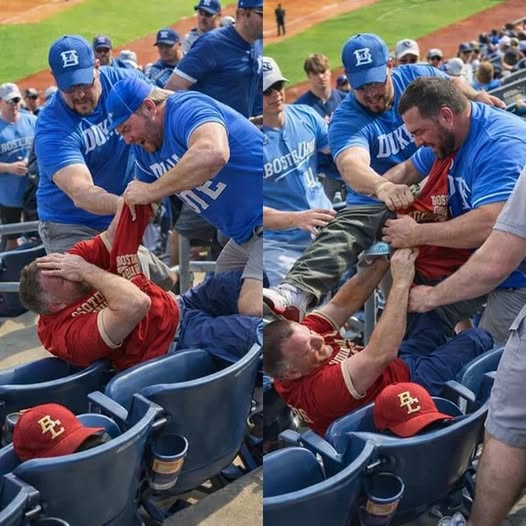
The tension had been building all evening, simmering beneath the surface of what was supposed to be just another competitive college baseball matchup. Fans from both sides packed the stands, their voices rising and falling in waves as Duke and Boston College battled through a hard-fought game that carried more emotional weight than anyone had anticipated. By the final inning, the atmosphere had turned brittle, each pitch and swing charged with a kind of nervous electricity that made even seasoned spectators uneasy. When the last out was recorded, instead of relief or celebration settling over the field, something far more volatile took hold.
What began as scattered shouting quickly escalated into confrontation. Small groups of fans lingered near the exits and along the walkways, arguing over calls, plays, and perceived slights that had occurred during the game. Witnesses would later describe how the tone shifted from typical post-game banter to something sharper, more personal. Insults were exchanged, and the line between rivalry and hostility blurred in a matter of minutes.
At the center of the incident was a Boston College supporter and a Duke fan who, until that moment, had been just two faces in a crowd. According to multiple accounts, the Boston College supporter allegedly made remarks that crossed a deeply sensitive line, directing insults toward the families of Duke players. Those nearby said the comments were loud and pointed, cutting through the surrounding noise and immediately drawing attention. For many, it was the kind of provocation that changes the mood instantly, transforming frustration into anger.
The Duke fan’s reaction was swift and intense. What might have been contained as a heated argument instead spiraled into physical aggression. Witnesses described a sudden surge forward, bodies shifting as people tried to intervene or back away. In the chaos, the Duke fan knocked the Boston College supporter to the ground. What followed was a moment that several onlookers would later call shocking and difficult to process.
The Duke fan stomped on the fallen supporter’s face with brutal force, an act that stunned those close enough to see it clearly. Some spectators screamed, while others rushed in an attempt to pull the attacker away. The violence was brief but severe, unfolding in seconds yet leaving a lasting impression on everyone present. The crowd, which had moments earlier been filled with the usual mix of cheers and groans, now reacted with panic and alarm.
Security personnel moved quickly once the situation became clear. Officers and event staff pushed through the crowd, separating individuals and securing the area around the injured supporter. The Duke fan was restrained as bystanders continued to shout, some calling for calm while others demanded accountability. The scene was chaotic, marked by confusion and heightened emotions as people tried to understand exactly what had happened.
Emergency medical responders were called almost immediately. The injured Boston College supporter lay on the ground as trained personnel assessed the situation. Blood was visible, and the seriousness of the injuries prompted urgent action. Within minutes, the supporter was stabilized and prepared for transport to a nearby hospital. Witnesses described the moment as sobering, the reality of the violence setting in as the adrenaline of the confrontation faded.
For many in attendance, the incident cast a long shadow over the game itself. Conversations that might have focused on standout performances or pivotal plays instead turned to the altercation. People replayed what they had seen, each account adding another layer to an already troubling narrative. Some expressed disbelief that a sporting event could escalate to such a degree, while others pointed to the role of heightened emotions and unchecked provocation.
In the aftermath, questions emerged about how the situation had been allowed to escalate so quickly. Event organizers and security officials faced scrutiny over crowd management and response protocols. While interventions did occur, the speed of the incident highlighted how rapidly tensions can boil over in a charged environment. Discussions began almost immediately about what measures could be implemented to prevent similar occurrences in the future.
The role of verbal provocation also became a central point of debate. While the alleged insults directed at players’ families were widely condemned, many emphasized that words, no matter how offensive, do not justify physical violence. The distinction between cause and response became a focal point in conversations among fans, commentators, and officials alike. It underscored the complexity of assigning responsibility in situations where multiple factors contribute to an explosive outcome.
For the teams themselves, the incident was an unwelcome distraction. Players who had just completed a demanding game now found their efforts overshadowed by an event that had nothing to do with the sport they had trained for. Coaches and staff were left to address not only the physical aftermath but also the emotional impact on players who might have witnessed or heard about the altercation. Statements emphasizing sportsmanship and respect were expected, as both programs sought to distance themselves from the actions of individual fans.
Social media quickly amplified the story, with clips, eyewitness accounts, and commentary spreading far beyond the confines of the stadium. Reactions ranged from outrage to reflection, with many calling for stricter enforcement of codes of conduct at sporting events. Others highlighted the broader cultural issues that can fuel such incidents, including the normalization of aggressive behavior and the tendency for rivalries to be framed in increasingly adversarial terms.
Legal implications also came into focus. The Duke fan involved in the assault faced potential charges, as authorities began to investigate the incident in detail. Statements from witnesses, video evidence, and medical reports would all play a role in determining the outcome. For the injured supporter, recovery became the immediate priority, but the legal process promised to extend the impact of the incident well beyond the night it occurred.
In quieter moments after the chaos had subsided, those who had been present were left to process what they had seen. For some, it was a stark reminder of how quickly situations can escalate when emotions run high and boundaries are crossed. For others, it raised concerns about the safety of attending large sporting events, particularly when rivalries are involved. The sense of community that sports often foster can be fragile, easily disrupted by acts of violence that shift the focus away from the game itself.
There were also voices calling for a more measured perspective, urging people to recognize that while the incident was serious, it was not representative of the vast majority of fans who attend games peacefully. They argued that isolated acts, however severe, should not define the broader culture of college sports. At the same time, they acknowledged the importance of addressing the underlying factors that can lead to such incidents, from inadequate security measures to the ways in which competition is framed and experienced.
As investigations continued and more details emerged, the narrative around the incident evolved. What remained constant was the recognition that something had gone deeply wrong in a setting meant for enjoyment and camaraderie. The image of a fan lying injured on the ground, and another being led away in restraints, stood in stark contrast to the ideals that sports are supposed to embody.
In the end, the game between Duke and Boston College would be remembered not for its score or standout moments, but for the violence that followed. It served as a cautionary tale about the thin line between passion and aggression, and the consequences that can arise when that line is crossed. For those who were there, the memory would likely linger, shaping how they think about and engage with future events.
The hope among many was that the incident would prompt meaningful reflection and change. Whether through improved security protocols, clearer expectations for fan behavior, or broader cultural shifts, there was a shared sense that something needed to be done to prevent a repeat of such a ঘটনা. The challenge lay in translating that awareness into action, ensuring that the lessons of that night were not quickly forgotten.
As the story continued to unfold in the days that followed, it became part of a larger conversation about safety, accountability, and the responsibilities that come with being part of a crowd. It was a reminder that while sports can bring people together, they can also expose fault lines that, if left unaddressed, have the potential to cause real harm.