: —
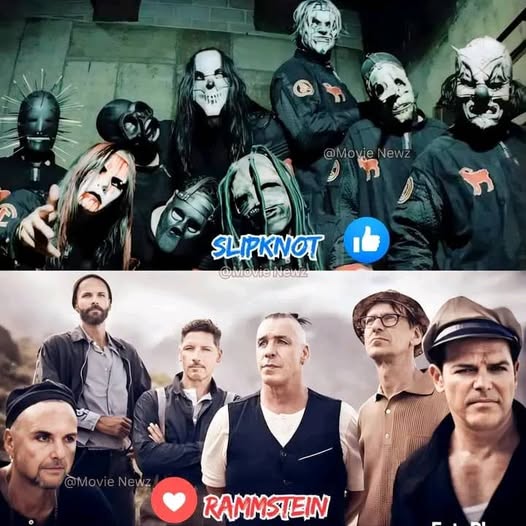
When the conversation turns to modern metal dominance, two names inevitably rise from the noise like industrial colossi: Slipknot and Rammstein. They are not simply bands; they are institutions, movements, and cultural shockwaves that reshaped what heavy music could look like, sound like, and mean. To pit them against each other is less about declaring a definitive winner and more about exploring two radically different philosophies of heaviness colliding at full force. One emerges from the chaos of the American Midwest, fueled by rage, trauma, and unfiltered emotion. The other rises from post–Cold War Germany, cold, precise, and theatrical, hammering discipline and provocation into steel-hard anthems. Both command armies of fans. Both sell out stadiums. Both have redefined metal on a global scale.
Slipknot’s power lies in its rawness. From the moment they burst into the mainstream at the turn of the millennium, they felt dangerous. Nine masked figures, anonymous yet terrifyingly human, delivered a sound that fused death metal brutality, hardcore aggression, and hip-hop rhythmic influence into something feral and unpredictable. Their early work sounded like a mental breakdown set to blast beats, and that chaos resonated with a generation suffocating under social pressure, alienation, and anger. Slipknot didn’t just perform songs; they exorcised demons in real time, turning personal pain into collective catharsis. Their music feels like it might collapse under its own weight at any moment, and that sense of imminent explosion is central to their appeal.
Rammstein, by contrast, is controlled annihilation. Where Slipknot is visceral and frantic, Rammstein is deliberate and monumental. Their sound is rooted in industrial metal, driven by mechanical riffs, martial rhythms, and Till Lindemann’s unmistakable baritone, delivered in sharp, commanding German. There is no chaos here—only crushing inevitability. Every beat lands like a factory press. Every riff is engineered for maximum impact. Rammstein’s music doesn’t lash out blindly; it marches forward with iron certainty, dragging the listener along whether they resist or not.
Lyrically, the divide becomes even clearer. Slipknot’s words often feel ripped from open wounds. Themes of depression, rage, betrayal, identity, and self-loathing dominate their catalog, especially in their formative years. Corey Taylor’s lyrics speak directly to listeners who feel unheard, unwanted, or on the brink of emotional collapse. There is a confessional quality to Slipknot’s music, even at its most violent. It invites the listener to scream along, to purge their own pain through shared fury. That emotional accessibility is one reason Slipknot has maintained such fierce loyalty among fans; the band feels like it understands suffering from the inside.
Rammstein’s lyrics, on the other hand, operate like dark poetry and social commentary wrapped in provocation. They explore taboo subjects—sex, power, violence, politics, and human perversity—often with irony and ambiguity. Lindemann sings not to confess, but to confront. The listener is challenged, unsettled, sometimes even repelled. Meaning is rarely spoon-fed; it lurks beneath layers of metaphor and theatrical exaggeration. Rammstein doesn’t ask for empathy so much as attention, forcing audiences to reckon with uncomfortable truths about desire, authority, and morality. It’s metal as art installation, designed to provoke thought as much as adrenaline.
Then there is the visual battlefield, where Rammstein arguably stands unmatched. Their live shows are legendary to the point of myth, featuring pyrotechnics so intense they border on the absurd. Firestorms erupt on cue, flames shoot from instruments and bodies, and the stage becomes a war zone of heat and light. These spectacles are not mere gimmicks; they are integral to Rammstein’s identity. The band presents itself as a total experience, a meticulously choreographed fusion of sound, fire, and symbolism. Watching Rammstein live feels like witnessing a ritual performed by industrial gods.
Slipknot’s stage presence is no less intense, but it is fueled by physicality rather than precision. Their performances are chaotic, sweat-soaked, and punishing. Band members hurl themselves across the stage, headbanging with such violence it feels unsustainable. The masks, constantly evolving, add a layer of psychological horror, stripping away individuality while amplifying emotion. Slipknot shows feel dangerous not because of fire, but because of the sheer human energy involved. There is always the sense that something could go wrong, that the band might tear itself apart mid-set, and that tension electrifies the crowd.
Culturally, both bands have left indelible marks. Slipknot helped usher extreme metal into the mainstream at a time when it was still considered fringe. They proved that something aggressive, ugly, and uncompromising could achieve massive commercial success without softening its edges. In doing so, they opened doors for countless heavy acts that followed. Their influence can be heard across modern metalcore, deathcore, and alternative metal, in both sound and attitude. Slipknot made it acceptable—powerful, even—to be emotionally broken and brutally loud about it.
Rammstein’s cultural impact is equally profound but operates on a global scale. Singing primarily in German, they shattered the long-held belief that metal needed English lyrics to succeed internationally. They brought industrial metal into arenas and stadiums worldwide, influencing not just musicians but stage designers, visual artists, and performance concepts across genres. Rammstein normalized controversy as part of art, proving that provocation, when executed with intelligence and commitment, could coexist with mainstream popularity. They didn’t just export German metal; they exported a distinctly German artistic identity.
Longevity is another arena where both bands assert dominance. Decades into their careers, neither feels like a legacy act going through the motions. Slipknot has evolved musically, refining their songwriting while retaining their aggression. Albums released deep into their career still spark debate, chart high, and draw new fans. Rammstein, similarly, continues to release music that feels relevant and massive, refusing to dilute their sound or aesthetic. Their late-career tours have been some of the biggest of their entire run, an almost unheard-of feat in heavy music.
So who rules the heavyweight throne? The answer depends entirely on how one defines power. If dominance is measured by emotional impact, by the ability to tap directly into personal anguish and transform it into communal release, Slipknot stands supreme. They are the voice of the fractured, the furious, the unheard, and their music hits like a fist to the chest. If dominance is measured by spectacle, by conceptual unity, and by the sheer force of artistic vision executed without compromise, Rammstein reigns. They are architects of awe, masters of controlled devastation.
Ultimately, Slipknot and Rammstein occupy different ends of the same colossal spectrum. One is chaos incarnate, the other disciplined destruction. One screams from the soul, the other commands from the throne. Rather than canceling each other out, they define the boundaries of what modern metal can achieve. The heavyweight throne may not belong to just one ruler. Instead, it stands suspended between fire and fury, held aloft by two titans who prove that heaviness is not a single sound, but an empire vast enough to contain them both.