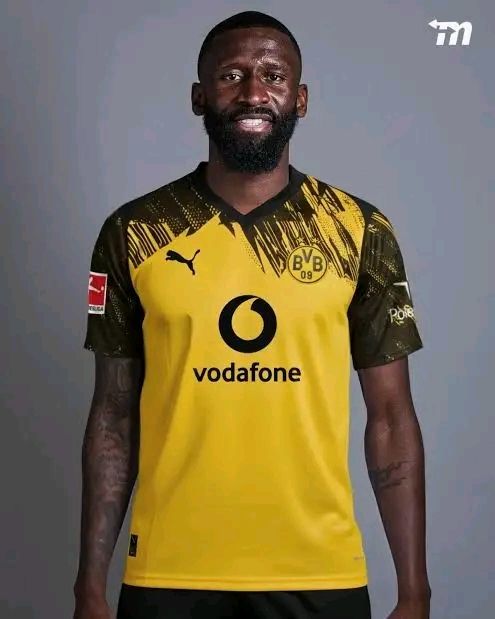
A transfer hammer is brewing in European football, and its epicenter appears to be Dortmund. Behind the scenes, Borussia Dortmund are said to be preparing what insiders describe as a final, carefully structured offer for Antonio Rüdiger, a move that has already ignited intense discussions across the continent. The mere possibility of such a transfer unfolding in January has sent shockwaves through the Bundesliga and beyond, because this is not the kind of deal that usually happens quietly or cautiously in the middle of a season. It is bold, provocative, and potentially transformative. For a club long associated with youth development and attacking brilliance, this would represent a decisive pivot toward experience, authority, and immediate success.
Dortmund’s motivation is clear. Despite their undeniable quality and depth in attacking areas, defensive stability has often been the missing piece in their pursuit of sustained dominance. Matches that should have been controlled slipped away, leads evaporated under pressure, and decisive moments exposed a lack of leadership at the back. The club’s hierarchy has reportedly reached the conclusion that talent alone is no longer enough. To truly challenge for the Bundesliga title and compete deep into European competitions, Dortmund need a defender who brings not only physical strength and tactical intelligence, but also personality, charisma, and the kind of winning mentality forged in football’s most unforgiving arenas.
Antonio Rüdiger embodies exactly that profile. He is a player shaped by elite competition, by title races, Champions League nights, and the relentless expectations that come with playing for Europe’s biggest clubs. His career trajectory tells the story of a defender who thrives under pressure, who relishes responsibility, and who is unafraid to take command of a defensive line. Aggressive yet calculated, emotional yet disciplined, Rüdiger represents the archetype of the modern defensive leader. For Dortmund, his arrival would be more than a reinforcement; it would be a statement that the club is ready to compete on equal footing with the continent’s elite.
What makes this potential transfer so explosive is the timing. January windows are traditionally conservative, shaped by emergency solutions rather than grand visions. Clubs hesitate to disrupt dressing rooms, players hesitate to uproot their lives, and negotiations tend to drag on endlessly. Yet Dortmund appear willing to defy convention. Reports suggest they are exploring every possible mechanism to make the deal work, from creative payment structures to performance-based incentives and long-term planning that aligns sporting ambition with financial responsibility. This willingness to “go deep into the trick box” underlines just how serious the club is about reshaping its trajectory.
Financially, such a move would be a significant undertaking. Rüdiger commands a salary befitting his status, and any deal would require Dortmund to stretch beyond their traditional wage structure. However, the leadership at the club seems to view this not as reckless spending, but as a strategic investment. The logic is straightforward: a stabilized defense could translate into more consistent results, deeper runs in competitions, increased prize money, and enhanced global visibility. In that sense, Rüdiger would not simply be a cost, but a catalyst for growth, both on and off the pitch.
The symbolic impact of the transfer would be just as significant as the tactical one. For years, Bayern Munich have dominated German football not only through their performances, but through their ability to attract and retain the league’s most influential players. A January move of this magnitude by Dortmund would challenge that hierarchy directly. It would signal that the Bundesliga title race is not a foregone conclusion, that power within German football is no longer centralized, and that Dortmund are prepared to seize the initiative rather than wait for opportunity to come knocking.
Within the dressing room, Rüdiger’s presence could be transformative. Younger defenders would suddenly find themselves training alongside a player who has experienced the highest highs and the most intense scrutiny. His communication, positioning, and sheer competitive edge could raise standards across the squad. Defensively, Dortmund would gain the freedom to play higher, press more aggressively, and manage matches with greater confidence. Mentally, the team would benefit from a figure capable of steadying nerves when momentum swings and pressure mounts.
It is precisely this mental dimension that has fueled so much excitement around the potential deal. Dortmund’s struggles in decisive moments have often been framed as psychological rather than technical. Rüdiger is known for his resilience, his confrontational style, and his refusal to back down in hostile environments. These qualities resonate deeply with Dortmund’s fan culture, which values passion, courage, and commitment as much as technical excellence. One can easily imagine Signal Iduna Park embracing him as a new defensive anchor, a player who embodies the fighting spirit that defines the club’s identity.
Across Europe, the reaction has been one of fascination and disbelief. Analysts, agents, and rival clubs are watching closely, aware that a transfer of this scale could ripple through the market. It could influence defensive valuations, reshape transfer strategies, and even trigger counter-moves from competitors unwilling to cede ground. January windows are often quiet, but this potential deal threatens to turn the winter market into a stage for drama and ambition.
Of course, the risks are undeniable. Negotiations of this magnitude are fragile, subject to sudden twists and unexpected obstacles. A failure to close the deal could expose Dortmund to criticism for overreaching or miscalculating. Integrating a high-profile player mid-season always carries uncertainty, and expectations would rise instantly, leaving little room for error. Yet Dortmund’s leadership appears willing to embrace these risks, convinced that progress at the highest level requires courage as much as caution.
If the transfer were to succeed, it could represent a turning point not only for the current season, but for Dortmund’s broader philosophy. It would suggest a club evolving from a model built primarily on development and resale into one capable of blending youth with elite experience. It would demonstrate an understanding that timing matters in football, that windows of opportunity must be seized decisively rather than postponed indefinitely.
Whether Antonio Rüdiger ultimately wears black and yellow remains uncertain. Transfer rumors live in the space between ambition and reality, where confidence clashes with complexity. Yet the fact that such a move is even being discussed speaks volumes about Borussia Dortmund’s mindset. They are no longer content with admirable performances and near-misses. They want silverware, authority, and recognition as genuine contenders.
If this shocking January deal were to materialize, it would go down as one of the most spectacular winter transfers in Bundesliga history. It would redraw expectations, intensify the title race, and remind Europe that Dortmund are prepared to think big when the moment demands it. In a sport defined by moments of daring, this could be the one that reshapes a season, a club, and perhaps even the balance of power in German football.